Architecture vs. Infrastructure
Two words that get mixed up constantly, even by people who spend all day working with computers. One is the plan. The other is what the plan gets built on. A clear, friendly walk-through of both — and why keeping them straight actually matters.
The Big Idea, in One Breath
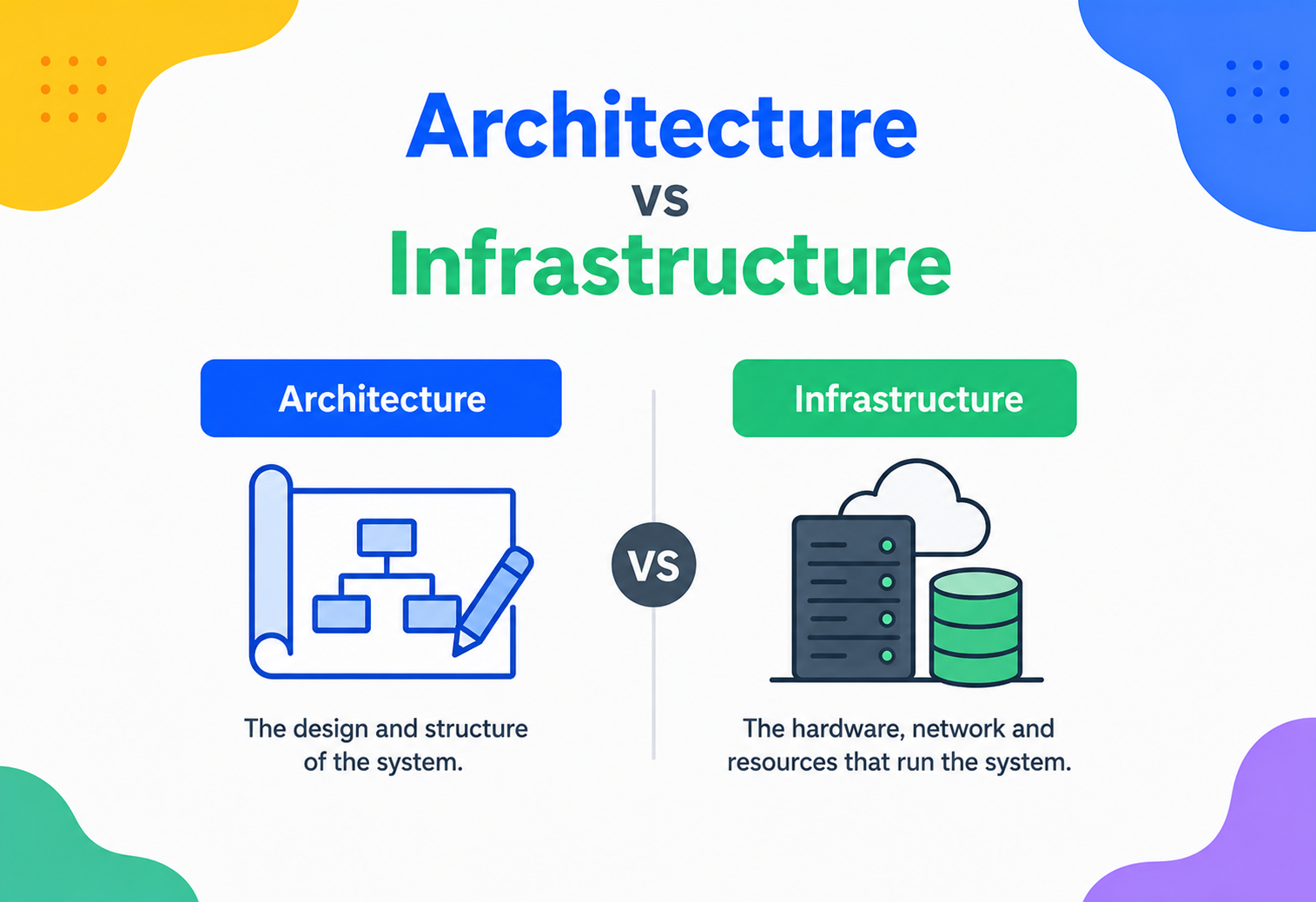
Architecture is the plan — the thinking and the decisions. Infrastructure is the concrete, wiring, and pipes the plan runs on. One is an idea; the other is a place for the idea to live.
Picture a family deciding to build a new house. First, someone sits down and sketches out a plan: how many rooms, where the kitchen goes, how the doors connect the hallways, where the sunlight will fall in the morning. That sketch is a set of decisions on paper — nothing has been built yet.
Then comes a completely different job: pouring the concrete, laying the bricks, running the electrical wiring, connecting the water pipes, and hooking the house up to the city’s power grid. That is a different kind of work entirely. It does not decide where the kitchen goes — it makes the kitchen physically possible to stand in.
Software works in almost exactly the same way. Architecture is the sketch. Infrastructure is the concrete, bricks, wiring, and pipes. Once you learn to hear the difference between the two words, meetings suddenly get shorter. “This is slow” stops being a single vague complaint and starts being one of two very different problems, each with its own kind of fix.

A recipe tells you what dish to cook and in what order to combine the ingredients — that is the architecture. The stove, the pots, the electricity, and the kitchen counter are what actually let you cook it — that is the infrastructure. Hand two cooks the same recipe: one might cook it on a campfire, the other on a fancy induction stove. Same plan, different infrastructure.
What Is Software Architecture, Really?
Big-picture decisions about how a program is put together — structure and reasoning, not wires or machines.
Software architecture is the set of big-picture decisions about how a piece of software is put together. It answers questions like: what are the major parts of this system, how do they talk to each other, what happens if one part gets very busy or breaks down, and should information move instantly or is it acceptable if it arrives a few seconds late?
None of these questions involve wires or machines. They are all about structure and reasoning — closer to a chess strategy than a toolbox. A software architect could describe an entire system on a whiteboard with boxes and arrows, without ever mentioning which company’s servers it will eventually run on.
“What is the architecture of this app?” is really asking “what are the major pieces, and how do they depend on each other?” — not “which company hosts it” or “how much memory does it use.”
Common architectural decisions include choosing whether an app should be one single connected program (a monolith) or a collection of small independent services (microservices), deciding how different parts should exchange information, and setting rules for how the system should behave when things go wrong. These choices shape a system’s future far more than any single line of code ever does.
Good architecture is invisible when it works. Users never see it, and even most developers rarely think about it — until the day it becomes hard to add a new feature without breaking three old ones. At that point, everyone suddenly remembers that architecture exists.
What Is Infrastructure, Really?
Everything physical or virtual a piece of software needs in order to exist and run — servers, networks, storage, and the operating layer that ties them together.
Infrastructure is everything physical or virtual that a piece of software actually needs in order to exist and run. Think of the computers that store and process information (servers), the cables and signals that let computers talk to each other (networks), the places where information is kept so it is not lost (storage), and the operating systems and tools that keep it all humming along.
Unlike architecture, infrastructure is something you could, in theory, walk up and touch — a server sitting in a data centre, a router blinking its lights, a hard drive spinning quietly in a rack. Even when infrastructure lives “in the cloud,” it is still built from real physical machines somewhere in the world; the cloud simply lets you rent time on those machines instead of owning them yourself.
Architecture is the “what” and “why.” Infrastructure is the “where” and “on what.” One lives in a design document; the other lives in a data centre.
Infrastructure decisions include which cloud provider to use, how many servers are needed, how those servers are connected, and how much storage space to set aside. These choices do not decide how the software behaves — they decide whether it can run at all, and how smoothly it holds up when many people show up at once.

The Core Difference, Side by Side
Neither idea is “better” than the other. They simply answer different questions, and a healthy piece of software needs both thought through carefully.
| Question | Architecture | Infrastructure |
|---|---|---|
| What does it answer? | What should the system do, and how should its parts connect? | Where will it run, and what will it run on? |
| Is it physical? | No — a design, a set of decisions | Often yes — servers, cables, storage |
| Who typically owns it? | Software or solutions architects | Infrastructure or platform engineers |
| Changes how often? | Occasionally, with major redesigns | Frequently, as usage and demand shift |
| Example decision | “We will split this app into smaller services.” | “We will run those services on three cloud servers.” |
| Typical lifespan | Years — big changes are rare and deliberate | Days to months — servers spin up and down constantly |
The Building Blocks of Infrastructure
Compute, networking, storage, and the operating layer — four bricks that make the ground the software actually stands on.
When people say “infrastructure,” they usually mean some combination of the following pieces. None of them, on their own, decide what an application does — they just make sure it has somewhere solid to stand.
Servers & processors
The machines that actually run the software’s code — from a single small computer under a desk to thousands of servers working together.
Cables, routers, signals
The roads that let information travel between servers, between services, and out to the people using the app on their phones or laptops.
Where data lives
Hard drives, databases, and cloud storage buckets that hold everything from user photos and account details to system logs and backups.
Operating systems & tools
The software beneath the software — operating systems, containers, and monitoring tools that keep everything running smoothly, hour after hour.
In a small project, all of this might be a single laptop under someone’s desk. In a large company, it might be thousands of servers spread across data centres on different continents, all wired together so carefully that most users never notice which one they are actually talking to.

How They Stack Together
Not rivals — layers. Each one leans on the one beneath it, from a person tapping a button all the way down to a machine in a data centre.
Architecture and infrastructure are not rivals — they are layers that sit on top of each other, each depending on the one below it. It helps to see the whole stack at once, from the person tapping a button on their phone all the way down to the physical machine humming in a data centre.
This is exactly why the two ideas get confused so often: they are always talked about together, and a healthy system needs both to be solid. But mixing them up in conversation causes real problems — telling an infrastructure team “just make it scale” when the true issue is an architectural flaw wastes weeks of effort and a healthy chunk of the budget on the wrong fix.
Types of Infrastructure
On-premises, cloud, hybrid — three broad approaches, and most companies today land somewhere on the spectrum.
Not all infrastructure looks the same. Over the years, three broad approaches have become common, and most companies today use some mix of them rather than picking just one.
On-Premises Infrastructure
This means owning and physically housing your own servers — in a room down the hall, or in a data centre you rent space in. It is the traditional approach, and it still makes sense for organisations with strict rules about where their data physically sits, such as banks, hospitals, and government agencies.

Cloud Infrastructure
Instead of owning machines, a company rents computing power from a provider like AWS, Microsoft Azure, or Google Cloud. It is a bit like renting an apartment instead of building a house — someone else worries about the plumbing and the roof, and you simply move in and use the space, paying for exactly what you use.
Hybrid Infrastructure
A blend of both — some systems stay on private, owned servers, while others run in the cloud. This is common for organisations that need tight control over certain sensitive data, but still want the flexibility of the cloud for everything else. In practice, most large companies land somewhere on this spectrum.
Why Cloud Is Popular
Trade-offs to Weigh
- Ongoing rental costs instead of a one-time purchase.
- Less direct physical control over where data sits.
- Depends on the provider’s own reliability and pricing.
- Bills can grow quietly if usage is not watched carefully.
“As Code” — Two Different Things Wearing Similar Names
Infrastructure as Code and Architecture as Code sound almost identical. They describe very different habits.
You may have come across two phrases that sound almost identical: Infrastructure as Code and Architecture as Code. They are easy to mix up, but they describe very different habits.
Infrastructure as Code
Describe servers, networks, and storage in a text file, so they can be recreated automatically every time.
Architecture as Code
Describe structural rules and decisions in a text file, so designs can be checked automatically before they slip.
Same underlying win
They replace fragile manual work with something repeatable, reviewable, and versionable in the same way source code is.
Infrastructure as Code means writing down, in a script or configuration file, exactly what servers, networks, and storage should exist — instead of clicking around in a control panel by hand. Run that script, and the entire infrastructure gets built automatically, the same way every time.
Architecture as Code is newer and less common: it means writing down architectural rules — such as “service A is never allowed to talk directly to service C” — in a way that tools can automatically check against the real codebase, flagging violations before they cause damage in production.
Automating your infrastructure does not automatically give you a good architecture, and a great architecture on paper still needs solid infrastructure underneath it to actually run reliably.
Who Does What?
Different kinds of work, often different people — and constant back-and-forth conversation between them.
Because architecture and infrastructure are different kinds of work, they are often handled by different people — though on smaller teams, one person may wear multiple hats and quietly stitch the two worlds together on their own.
Software / Solutions Architect
Designs how the parts of a system fit together, focusing on structure, patterns, and long-term maintainability rather than any particular server or vendor.
Infrastructure Architect
Designs the underlying servers, networks, and storage layout needed to support the software architecture reliably, at the required scale and cost.
DevOps / Platform Engineer
Builds and automates the day-to-day operation of that infrastructure, keeping deployments smooth, systems healthy, and developers unblocked.
Site Reliability Engineer (SRE)
Watches over the running system, responding to outages, tracking reliability numbers, and working to prevent the same failure from ever happening twice.
These roles talk to each other constantly. An architect might design a system assuming near-instant communication between two services, only to learn from the infrastructure team that the two data centres involved are on opposite sides of the world — a detail that quietly reshapes the design. Good systems come from that back-and-forth conversation, not from either side working in isolation.

Why the Difference Actually Matters
Mixing up architecture and infrastructure causes real, expensive problems — the kind that show up in invoices, in incident reports, and in tense post-mortem meetings.
This might all sound like a matter of vocabulary, but mixing up architecture and infrastructure causes real, expensive problems in practice.
The Wrong Fix for the Wrong Problem
Imagine an app that slows down badly whenever lots of people use it at once. If the real cause is a structural flaw — say, every request has to wait in a single line instead of being handled in parallel — then adding more servers will not help much. The team would be spending money on infrastructure to patch a problem that only a redesign can truly fix.
Blurred Ownership
When nobody is sure whether a slowdown is an architecture issue or an infrastructure issue, teams can spend days pointing fingers instead of fixing anything. Clear language about which is which speeds up every conversation that follows, and lets the right specialists get involved on day one.

Budget and Planning
Architecture decisions tend to be made once and live for years. Infrastructure costs, on the other hand, are ongoing — paid every month as servers keep running. Understanding which is which helps leaders plan spending realistically instead of being surprised by a bill three months into a project.
Growing Together Over Time
Neither layer is ever really “finished.” Both change as a system grows — but not always at the same pace, or for the same reason.
Neither architecture nor infrastructure is ever really “finished.” As a company gets more users, adds new features, or expands into new countries, both layers usually need to change — but not always at the same pace, and not always for the same reason.
A small app might start on a single, modest server with a simple, single-block architecture. As it becomes popular, the infrastructure usually grows first — more servers, more storage — because that is the fastest way to keep up with sudden demand. But if the underlying architecture was never designed to spread work across many machines, growth eventually hits a wall no amount of extra infrastructure can fix. At that point, an architectural redesign becomes necessary, not optional.
Revisit both layers on purpose, on a schedule — not just when something breaks. Teams that only think about architecture and infrastructure during a crisis tend to make rushed, expensive decisions.
The most resilient systems are the ones where architecture and infrastructure are reviewed together, regularly, by people who understand both — because a change in one very often quietly changes what the other one needs to do next.
Key Takeaways
A seven-line summary you can keep pinned near the whiteboard.
Remember this
- Architecture is the plan — the structural decisions about how a system’s parts fit together and behave.
- Infrastructure is the foundation — the real (or virtual) servers, networks, and storage the plan runs on.
- One answers “what should this system do and how,” the other answers “where and on what will it run.”
- They stack on top of each other, and a weakness in either layer eventually shows up as a problem for real users.
- “As Code” practices exist for both, but automating infrastructure does not replace good architectural thinking.
- Confusing the two wastes time and money — clear language about which is which speeds up every fix.
- Neither is ever fully “done.” Healthy systems review both layers on a regular schedule, not just during a crisis.