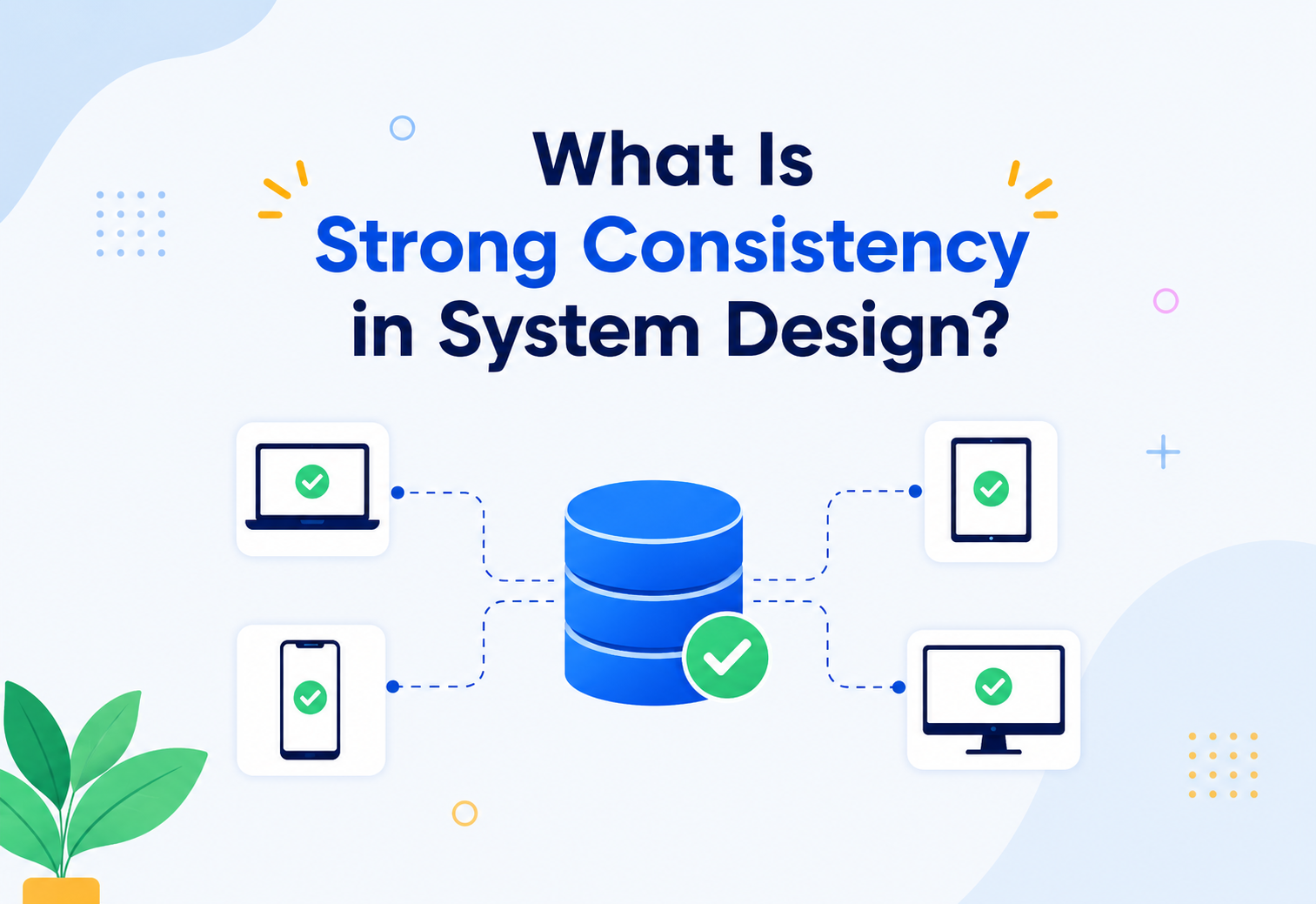
What Is Strong Consistency in System Design?
When you check your bank balance right after a payment, you expect the true, latest number — not a stale guess from a minute ago. Strong consistency is the guarantee that makes that expectation reliably true.
Introduction
Two friends editing the same shared shopping list, from two different phones, at the same second. When the second friend opens the app, does she see “milk” or not? Strong consistency is the guarantee that decides.
Picture two friends editing the exact same shared shopping list at the exact same time, from two different phones. One friend adds “milk.” A second later, the other friend opens the list. Does she see “milk” on it, or not? If the app guarantees she always sees the very latest version — no matter which phone or which server actually answers her request — that app is using what we call strong consistency.
Strong consistency is a guarantee in distributed systems that every single read of a piece of data returns the most recent, correct value — no matter which server in the system actually answers the request, and no matter how many copies of that data exist behind the scenes. It is one of the most important, and most debated, concepts in the entire field of system design.
This guide explains strong consistency completely from scratch. We assume no prior knowledge whatsoever. Every new term is explained clearly, with a simple everyday comparison first, before we get technical. By the end, you will understand this concept deeply enough to make real architectural decisions about it, and to discuss it confidently in any system design interview.
Complete beginners, students, engineers preparing for interviews, and working professionals who want to design systems that tell the truth, reliably, every single time. No prior knowledge required.
Before diving in, it is worth naming why this particular topic trips up so many people, even experienced engineers. The word “consistency” sounds simple in everyday English — it just means “staying the same,” or “being reliable.” In distributed systems it has a very precise, technical meaning that is easy to misjudge if you rely only on your everyday intuition about the word. Taking the time to build a correct, careful mental model here pays off enormously, since consistency decisions sit underneath nearly every serious system design conversation you will ever have.

A Little History
In the beginning, one machine held one copy of the data and nobody had to ask about consistency. Everything since is what happened when a second copy arrived.
In the earliest days of computing, when a program ran on a single machine with a single copy of its data, consistency was not really a question anyone needed to ask. There was only ever one copy of any piece of data, so of course reading it always gave you the truth — there was nothing else it could possibly be.
The problem emerged once computers started talking to each other, and especially once systems began keeping multiple copies of the same data on different machines, for speed and safety. This practice, called replication, solved one problem — what if a single machine breaks? — but created a brand new one: if there are several copies of the same data, and they can be updated independently, how do you make sure they all agree with each other, and agree quickly?
Through the 1980s and 1990s, as distributed databases became more common, researchers developed formal ways of describing exactly what kind of agreement a system promised. That work culminated in the early 2000s with Eric Brewer’s influential CAP theorem, which named and formalised the fundamental tension between consistency, availability, and network reliability in distributed systems — a tension that remains at the very centre of nearly every modern system design conversation about strong consistency today. Since then, technologies like Google Spanner and modern consensus algorithms have pushed the boundaries of what is practically achievable, making strong consistency workable at a genuinely global scale in ways that would have seemed nearly impossible only twenty years earlier.
It is genuinely worth appreciating how much this history shaped the vocabulary the entire industry now uses casually in everyday conversation. Terms like “quorum,” “leader election,” and “consensus” all trace directly back to decades of dense academic research into exactly these kinds of problems, later translated into practical, production‑ready systems by engineers building on that foundation. Understanding a little of this lineage helps explain why strong consistency is treated with such genuine respect and care in serious system design — it is not an arbitrary technical preference, but the hard‑won product of a long, rigorous effort to solve a problem that turned out to be far subtler than it first appears.
Problem & Motivation
A social‑media like‑count that is briefly wrong is a shrug. A bank balance that is briefly wrong is a lawsuit. Strong consistency exists exactly for the second kind of number.
Picture an online banking app that keeps three copies of your account balance, spread across three different data centres, purely for safety and speed. You transfer money out of your account. A moment later, you check your balance. If the app happens to read from a copy that has not received the update yet, you might see your old, higher balance — even though the money has genuinely already left your account.
For a social media “like” count, this kind of tiny, temporary disagreement between copies is a harmless shrug. For a bank balance, it is a serious, potentially costly problem — someone might see an outdated balance and spend money they no longer actually have, or a company might make an important financial decision based on stale, incorrect information.
Strong consistency exists to solve exactly this problem: guaranteeing that no matter how many copies of data a system keeps, or which one happens to answer a particular request, every reader always sees the same, genuinely up‑to‑date truth. It is the deliberate, engineered answer to the question “how do we keep multiple copies of the truth from ever disagreeing, even briefly?”
It is worth pausing on just how counterintuitive this problem can feel at first, precisely because most people’s everyday experience with information does not involve multiple, separately updated copies at all. When you check the time on your own phone, there is only one clock to consult. When a distributed system checks a piece of data, there might genuinely be three, five, or dozens of separate physical copies, potentially spread across different buildings or even different continents, each one theoretically capable of answering independently. The entire discipline of consistency exists because that multiplicity — something most people never have to think about in daily life — becomes an unavoidable, central engineering reality the moment a system needs to be both fast and resilient at scale.
The Big Analogy: The Shared Class Notebook
Keep one image in your head for the rest of this guide: a classroom’s single shared notebook. Every mechanism ahead is really just a way of making many physical copies of data behave like that one notebook.
Imagine a classroom with a single physical notebook that every student must write homework assignments into, and every student can read from to check what is due. Because there is only one notebook, and everyone has to actually walk up to it, write in it, and read directly from it, everyone always sees the exact same information — there is no possibility of confusion, because there is only one true copy, and everyone consults that same copy directly. That single, always‑current shared notebook is exactly what strong consistency feels like from the outside: no matter who checks, no matter when, they see the same, correct, current truth. Now imagine that same class instead used five separate notebooks, one kept by each of five different helpers, updated somewhat independently and only occasionally compared with each other. Two students checking two different helpers’ notebooks at the same moment might see two different answers about what homework is due. That is what a lack of strong consistency looks like — multiple copies that can, at least briefly, disagree.
Keep this single shared notebook in mind throughout this guide. Every technical mechanism ahead — quorums, consensus algorithms, synchronous replication — is really just a clever, carefully engineered way of making many separate physical copies of data behave as if they were really just one single, always‑current notebook, even though several real copies technically exist behind the scenes.
It is worth extending the analogy one step further to appreciate why the multi‑notebook version is actually the more realistic one for large systems. A single physical notebook is simple, but it has an obvious weakness: if it gets lost, damaged, or the one person keeping it is unavailable, the whole class loses access to important information. Real distributed systems keep multiple copies specifically to avoid this exact fragility — so losing any single copy does not mean losing the data entirely. The genuine engineering challenge, then, is not choosing between one notebook and many; it is figuring out how to keep the safety benefits of many notebooks while still preserving the simple, trustworthy behaviour of just one. That is precisely the problem strong consistency mechanisms are built to solve.
Basic Terminology
Eight terms that show up in every serious consistency conversation. Learn these, and the rest of the guide clicks together.
Consistency
A guarantee about whether different readers see the same version of data at the same time.
Replication
Keeping multiple copies of the same data on different machines, for safety and speed.
Replica
One individual copy of data, among potentially several kept by a system.
Quorum
The minimum number of replicas that must agree before a read or write is considered successful.
Consensus
The process by which multiple computers agree on a single, shared decision, even if some are slow or unreachable.
Latency
The delay between asking for something and receiving an answer.
Eventual Consistency
A weaker guarantee where copies will eventually agree, but might briefly disagree in the meantime.
Linearizability
The strongest, most precise form of consistency, making a distributed system behave exactly like a single, single‑copy system.
Core Concept: What It Really Is
Once a write completes, every read that follows sees the new value — no matter which replica answers. That is the entire promise.
Strong consistency guarantees that once a write operation completes successfully, every subsequent read — from any replica, by any client, immediately afterward — will return that new value, never an older one. There is no window of time where a reader might accidentally see stale, outdated data. From the outside, the system behaves as if there were only ever one single, true copy of the data, even though internally it might genuinely be spread across many machines.
Why does it exist? Because some data is simply too important to risk disagreement about, even briefly. Financial balances, inventory counts for the very last item in stock, medical dosage records, and access‑control decisions are all examples where a stale, incorrect answer could cause genuine, real‑world harm — not just mild confusion.
Where is it used? Banking and payment systems, inventory management for high‑demand or limited‑stock items, distributed locks and coordination services, configuration systems that many other services depend on, and any system where “probably correct” simply is not good enough.
If you transfer money between two of your own bank accounts and immediately check both balances, strong consistency is the reason you never see a confusing, temporarily “impossible” total — the system makes absolutely sure the transfer is fully, truthfully reflected everywhere before letting you see any part of it.
It is also worth being precise about what strong consistency does not promise. It does not promise a write will always succeed — a system might reasonably refuse a write if it cannot safely confirm it across enough replicas. It does not promise low latency — as we will see, the guarantee often costs real, measurable time. And it does not automatically make a system more available — in fact, as later sections explain, it can sometimes mean the opposite. What it promises, specifically and only, is correctness: whatever answer you do get back, you can trust it completely, without hesitation or doubt.
The Consistency Spectrum
Strong consistency is not the only option — it sits at one end of a whole spectrum of guarantees. Choosing the right point on that spectrum, dataset by dataset, is one of the most important recurring decisions in all of system design.
Strong consistency is not the only option — it sits at one end of a whole spectrum of possible guarantees, each offering a different trade‑off between correctness and performance.
| Consistency Model | What It Guarantees | Typical Use Case |
|---|---|---|
| Strong Consistency | Every read reflects the latest write, always, everywhere | Bank balances, inventory for scarce items, distributed locks |
| Read‑Your‑Writes | A user always sees their own recent changes, though others might briefly lag | Social media posts, profile edits |
| Causal Consistency | Related, cause‑and‑effect updates are seen in the correct order | Comment threads, chat conversations |
| Eventual Consistency | All copies will eventually agree, but might briefly differ | Like counts, view counts, product recommendation caches |
It is worth being clear that “eventual consistency” is not a lesser, sloppier version of strong consistency — it is a deliberate, thoughtful choice for situations where briefly stale data is genuinely harmless, in exchange for significant gains in speed and availability. Choosing the right point on this spectrum, dataset by dataset, is one of the most important, recurring decisions in all of system design.
It helps to think of this spectrum not as a single line from “bad” to “good,” but as a genuine menu of trade‑offs, each appropriate for different situations. Read‑your‑writes consistency, for example, solves a very specific, common frustration — the confusing experience of posting something and then not seeing your own post appear immediately — without paying the full cost of guaranteeing consistency for every other user simultaneously. Causal consistency solves a different, equally specific problem: making sure a reply to a comment never appears to arrive before the comment it is replying to. Each model on this spectrum earns its place by solving a real, identifiable problem efficiently, rather than existing simply as a weaker fallback when strong consistency was not achievable.
Architecture & Components
Six coordinated pieces work together to create the illusion of a single, unified copy of data — even though many separate machines lie behind it.
Achieving strong consistency in a real distributed system requires several coordinated pieces working together.
Replica Set
The group of servers holding copies of the same data, expected to stay in agreement.
Coordinator / Leader
Often a single, designated node that orders writes and ensures they are properly confirmed before acknowledging success.
Quorum Logic
The rules deciding how many replicas must confirm a read or write before it is considered valid.
Consensus Protocol
The algorithm, such as Raft or Paxos, that helps replicas agree on the correct order and content of updates.
Write‑Ahead Log
A durable, ordered record of every change, used to keep replicas synchronised and to recover after a failure.
Clock / Ordering Mechanism
A way of establishing a reliable order of events across multiple machines, essential for true consistency.
These pieces work together to create the illusion of a single, unified copy of data, even though the underlying reality is a group of separate machines that must constantly coordinate to maintain that illusion convincingly and correctly.
Internal Working: Quorums & Consensus
One simple piece of arithmetic — W + R > N — is what makes strong consistency work in the real world. It is one of the most elegant ideas in distributed systems.
The most common practical mechanism behind strong consistency is the quorum. Instead of requiring every single replica to confirm every operation — which would be painfully slow and fragile — a system requires only a majority of replicas to agree.
Here is the elegant mathematical trick that makes this work reliably: if a system has N total replicas, and requires W replicas to confirm every write, and R replicas to be checked on every read, strong consistency is guaranteed as long as W + R > N. That overlap guarantees that any read quorum and any write quorum must share at least one replica in common — meaning any read is mathematically guaranteed to touch at least one replica that has the absolute latest write, making it impossible to read genuinely stale data.
A common, simple configuration uses three total replicas, requiring two to confirm every write and two to be checked on every read (2 + 2 > 3), tolerating the failure of any single replica while still guaranteeing strong consistency. That same underlying quorum idea appears, in more sophisticated forms, inside formal consensus algorithms like Raft and Paxos, which additionally handle electing a reliable leader, ordering operations correctly, and recovering cleanly from various failure scenarios.
It is genuinely worth sitting with the quorum‑overlap math for a moment, because it is one of the more elegant ideas in all of distributed systems. Picture five replicas arranged in a circle, and imagine picking any group of three for a write and any group of three for a read. No matter which specific three you pick for each, because 3 + 3 is 6 and there are only 5 replicas total, those two groups of three are mathematically guaranteed to share at least one replica in common — there simply is not room for them not to overlap. That guaranteed overlap is the entire secret behind how quorum systems deliver strong consistency without needing every single replica to participate in every single operation, striking a careful balance between correctness and practicality.

Data Flow & Write / Read Lifecycle
Follow a single write from client to acknowledgement, then a later read back out. The step where the system pauses to wait for a quorum is exactly where strong consistency earns its cost.
A write request arrives
A client asks to update a piece of data, sending the request to the system.
The leader orders the write
A designated coordinator or leader assigns the write a definite position in the overall sequence of changes.
The write is sent to replicas
The new value is propagated to the other replicas in the group.
A quorum confirms
The write is only considered successful once enough replicas — the write quorum — have confirmed receiving it.
Success is acknowledged
Only now does the system tell the original client the write genuinely succeeded.
A later read arrives
Any subsequent read checks enough replicas — the read quorum — guaranteed to overlap with the write quorum.
The freshest value is returned
Among the replicas checked, the most recent value is identified and returned to the reader, guaranteeing correctness.
Notice that the write is not considered complete until enough replicas have genuinely confirmed it — that is precisely the step that costs strong consistency its speed advantage, since the system must wait for confirmation rather than immediately reporting success the instant a single replica receives the change.
Java Code Example
A small, illustrative Java class showing the core quorum‑based write and read logic that underpins strong consistency.
Here is a simplified Java example demonstrating quorum‑based writes and reads, showing the core logic behind strong consistency in a small, illustrative way.
public class QuorumStore {

    private final List<Replica> replicas;
    private final int writeQuorum;
    private final int readQuorum;

    public QuorumStore(List<Replica> replicas, int writeQuorum, int readQuorum) {
        this.replicas = replicas;
        this.writeQuorum = writeQuorum;
        this.readQuorum = readQuorum;
        // caller must ensure writeQuorum + readQuorum > replicas.size()
    }

    public boolean write(String key, String value, long timestamp) {
        int confirmations = 0;
        for (Replica r : replicas) {
            if (r.tryWrite(key, value, timestamp)) {
                confirmations++;
            }
            if (confirmations >= writeQuorum) {
                return true;   // quorum reached, write is now durable enough
            }
        }
        return false;          // not enough replicas confirmed, write failed
    }

    public String read(String key) {
        List<VersionedValue> responses = new ArrayList<>();
        for (Replica r : replicas) {
            responses.add(r.read(key));
            if (responses.size() >= readQuorum) break;
        }
        // among the replicas checked, return the one with the newest timestamp
        return responses.stream()
            .max(Comparator.comparingLong(VersionedValue::getTimestamp))
            .map(VersionedValue::getValue)
            .orElse(null);
    }
}write() only returns success once enough replicas — writeQuorum of them — have confirmed storing the new value. read() checks enough replicas — readQuorum of them — and returns whichever response carries the newest timestamp, guaranteeing the freshest confirmed value is returned. Because writeQuorum + readQuorum is designed to exceed the total replica count, any read is mathematically guaranteed to overlap with the most recent successful write. This simplified example skips important production concerns like handling replica failures mid‑operation and network retries, which real systems must handle carefully alongside this core quorum logic.
Advantages, Disadvantages & Trade‑offs
Strong consistency buys correctness with a currency of latency and availability. The bill is real, and the speed of light is what sets its price.
Advantages
- Guarantees correctness — no stale or conflicting reads, ever.
- Simplifies application logic, since developers do not need to reason about staleness.
- Essential for genuinely critical data like money and access control.
- Prevents entire categories of subtle, hard‑to‑debug data bugs.
Disadvantages
- Adds real latency, since writes must wait for quorum confirmation.
- Can reduce availability during network partitions, by design.
- More complex to implement and operate correctly.
- Does not scale as effortlessly across very distant geographic regions.
The central trade‑off is unavoidable and well worth understanding deeply: strong consistency trades some speed and some availability for absolute correctness. That is precisely the tension the CAP theorem describes formally, and it is a trade every distributed system must navigate deliberately, dataset by dataset, rather than pretending it does not exist.
It is worth spelling out why this trade‑off cannot simply be engineered away with cleverness or better hardware. The core cost — waiting for confirmation from multiple, physically separate machines before declaring a write complete — is fundamentally limited by the speed of light and the physical distance data must travel, not by how well‑written the code is. No amount of software optimisation can make a confirmation message travel faster than physics allows. That is precisely why experienced system designers treat the strong‑consistency trade‑off with respect rather than treating it as a solvable engineering inefficiency; it is a genuine, physical constraint, and the best a team can do is decide thoughtfully where paying that cost is truly worth it.
Performance & Scalability
Latency scales with distance. That is why serious systems reserve strong consistency for the data that truly needs it, and let everything else run faster.
Strong consistency’s biggest practical cost is latency. Because a write must wait for confirmation from multiple replicas — sometimes located in entirely different data centres or even different continents — every single write operation takes noticeably longer than it would in a system that simply confirms locally and replicates later.
That cost grows directly with geographic distance. A quorum spread across replicas in the same building might add only a fraction of a millisecond of extra latency. A quorum spread across replicas on different continents might add tens or even hundreds of milliseconds to every single write, since the confirmation genuinely has to travel that physical distance and back before the write can be considered complete.
That is precisely why many real systems apply strong consistency selectively rather than universally — using it only for the specific pieces of data that truly require it, like account balances or inventory counts for scarce items, while using faster, more relaxed consistency models for everything else, like view counts or recommendation caches, where a small amount of staleness genuinely does not matter.
It is also worth understanding how this latency cost interacts with a system’s overall throughput, not just individual request speed. Since a strongly consistent write must hold certain coordination resources open until quorum confirmation arrives, a system under heavy write load can see that coordination overhead compound, reducing the total number of writes it can process per second compared to a system that acknowledges writes locally and replicates afterward. Careful capacity planning for strongly consistent systems therefore needs to account for this compounding effect directly, rather than assuming throughput will scale in a simple, linear way as more replicas or more traffic are added.

High Availability & Reliability
A strongly consistent system would rather say “I do not know, please try again” than risk telling you something confidently wrong. That is a feature, not a bug.
Strong consistency and high availability sit in genuine, unavoidable tension with each other, especially during a network partition — a situation where some replicas temporarily cannot communicate with others. If a system insists on strong consistency, and a quorum simply cannot be reached because too many replicas are unreachable, the honest, correct behaviour is to refuse the operation entirely, rather than risk returning an incorrect answer.
That means a strongly consistent system can become less available during certain failure scenarios — by design, rather than by accident. It is not a flaw; it is a deliberate, principled choice: such a system would rather say “I do not know, please try again” than risk telling you something confidently wrong.
Reliability in a strongly consistent system, therefore, is not just about staying online — it is about staying correct, even if that occasionally means staying unavailable for a brief moment instead. That distinction matters enormously when explaining system behaviour to stakeholders who might otherwise assume “reliable” simply means “always responds quickly.”
This is also a genuinely useful distinction to bring into any conversation about setting realistic expectations with a product or business team. A strongly consistent payment system that occasionally shows a brief “please try again” message during a rare network issue is not broken — it is behaving exactly as designed, refusing to guess rather than risk telling someone an incorrect balance. Framing this clearly, in advance, helps prevent the confusing, frustrating situation where a team assumes any momentary unavailability automatically signals a bug, when in fact it might be the system correctly, deliberately protecting the integrity of the data it is responsible for.
CAP Theorem, Consensus Algorithms & Failure Recovery
Three pieces of theory sit under every strongly consistent system in production: the CAP theorem, the Paxos/Raft family of consensus algorithms, and a disciplined story for what happens when the leader dies.
The CAP theorem
The CAP theorem states that a distributed system can only fully guarantee two of three properties at once: Consistency (every replica shows the same data), Availability (the system always responds), and Partition tolerance (the system survives network splits between replicas). Since network partitions are simply an unavoidable fact of life in real, large‑scale distributed systems, the genuine choice most systems face is between prioritising consistency or prioritising availability during a partition — a system claiming strong consistency has essentially chosen consistency over availability whenever the two conflict.
Consensus algorithms: Raft and Paxos
Paxos, developed in the late 1980s, was one of the first rigorously proven algorithms for helping a group of unreliable, distributed machines agree on a single value, even amid failures and message delays. It is famously correct but notoriously difficult to fully understand and implement correctly. Raft, developed later specifically to be more understandable, achieves the same fundamental goal — electing a leader, replicating a log of changes in order, and safely handling failures — through a design explicitly built to be easier for engineers to reason about and implement correctly. Both algorithms are, at their core, formalised, rigorously tested versions of the same quorum idea explored earlier in this guide.
It is worth appreciating why so much serious academic and engineering effort has gone into these algorithms over the decades, rather than everyone simply building their own quorum logic from scratch each time. Getting distributed agreement genuinely correct, especially handling every possible edge case — a leader crashing mid‑operation, two nodes both briefly believing they are the leader, messages arriving out of order or getting lost entirely — turns out to be extraordinarily easy to get subtly wrong. Real engineering history is full of home‑grown consensus implementations that seemed to work fine in testing, only to fail in rare, hard‑to‑reproduce ways once deployed at real scale. That is exactly why relying on a well‑tested, widely reviewed implementation of Raft or Paxos is considered such an important best practice, rather than a shortcut — it is standing on the shoulders of a genuinely difficult problem that has already been solved carefully, publicly, and repeatedly verified.
Failure recovery
When a leader or coordinator in a strongly consistent system fails, the remaining replicas must safely elect a new leader before continuing to accept new writes. That election process itself typically requires a quorum, ensuring the newly elected leader is guaranteed to have seen every previously confirmed write — preventing any risk of silently losing already‑acknowledged data during the transition.
Imagine our classroom’s single notebook‑keeper suddenly leaving the room. Before anyone else is allowed to take over writing in the notebook, the class needs to confirm the new notebook‑keeper has actually seen every entry the old one already wrote down — otherwise, some homework assignments might accidentally get lost or forgotten in the handover.
Security Considerations
Access permissions, audit trails, and distributed locks all fall on the “wrong answer is dangerous” side of the consistency spectrum — which is exactly why they belong under strong consistency.
Strong consistency intersects with security in a few genuinely important ways.
- Access control decisions: Permissions and authorisation data often benefit from strong consistency — a user whose access was just revoked should not still be able to get in simply because a stale replica had not caught up yet.
- Audit trails: Systems recording who did what, and when, often need strong consistency to guarantee the recorded order of events is genuinely trustworthy and cannot be disputed later.
- Distributed locks: Security‑sensitive coordination, like ensuring only one process can perform a critical action at a time, relies fundamentally on strong consistency to prevent two processes from both believing they hold the same lock simultaneously.
Using eventual consistency for security‑sensitive data, like access permissions, can create a genuine window where an already‑revoked user retains access simply because the update has not fully propagated yet. That is exactly the kind of situation where the extra cost of strong consistency is clearly justified.
Monitoring, Logging & Metrics
Three signals matter above all others: write latency (as a distribution), quorum failure rate, and leader election frequency. Watch them per replica, not just system‑wide.
Operating a strongly consistent system well requires watching several specific signals closely. Write latency deserves close attention, since it directly reflects how long quorum confirmation is genuinely taking, and any sudden increase often signals a struggling or unreachable replica. Quorum failure rate — how often writes or reads fail to gather enough confirmations — is an important early warning sign of reduced availability, sometimes well before it becomes visible to end users.
Leader election frequency, in systems using a consensus algorithm with a designated leader, is also worth tracking; frequent, unexpected elections often point to network instability or an unhealthy replica repeatedly falling out of the group.
Track write latency as a distribution, not just an average. A strongly consistent system’s average latency might look perfectly healthy while a meaningful fraction of writes are quietly taking far longer than acceptable, hidden by that averaging.
It is also valuable to monitor the health and connectivity of individual replicas independently, not just the system’s overall behaviour. A quorum‑based system can continue operating correctly even while one or more replicas are quietly unhealthy, simply because the remaining healthy replicas still form a valid quorum — which means a genuinely serious, worsening problem can hide in plain sight if the team only watches aggregate, system‑wide metrics. Per‑replica dashboards, showing exactly which specific machines are healthy, lagging, or unreachable at any given moment, often reveal a slow‑building problem well before it grows severe enough to threaten the quorum itself.

Deployment & Cloud
Where you place your replicas is an architectural decision, not an infrastructure detail. Closer means faster; further means safer — and you cannot have both for free.
Modern cloud providers offer managed databases with built‑in strong consistency, removing much of the deep implementation complexity from individual engineering teams. Google’s globally distributed database, for instance, uses precisely synchronised clocks across data centres worldwide to achieve strong consistency at a genuinely global scale — a technical achievement that would have been extraordinarily difficult for most organisations to build entirely from scratch.
When deploying strongly consistent systems in the cloud, region placement becomes a genuinely important architectural decision. Placing replicas closer together reduces the latency cost of quorum confirmation, but also reduces protection against a large‑scale, region‑wide disaster; placing them further apart improves that protection but increases the latency cost of every write. That is a real, concrete trade‑off engineering teams must weigh deliberately, matched to how critical each specific dataset genuinely is.
Managed coordination services, often built specifically around consensus algorithms like Raft or Paxos internally, are commonly used as a trustworthy, strongly consistent foundation for tasks like distributed locking, leader election, and shared configuration — letting application teams rely on a well‑tested, already‑solved implementation rather than building this genuinely tricky machinery themselves.
Databases, Caching & Load Balancing
Three infrastructure layers, three different conversations with strong consistency — and one of them (caching) is a natural adversary.
Databases
Traditional relational databases have historically defaulted toward strong consistency within a single machine, and many modern distributed databases now offer configurable consistency levels, letting engineers choose strong consistency for specific critical tables while allowing more relaxed consistency elsewhere in the same system.
Caching
Caching and strong consistency are naturally in tension, since the entire point of a cache is usually to serve data quickly, often without checking back with the true source every single time — which risks serving stale data. Systems needing both speed and strong consistency for the same data often use careful cache invalidation strategies, deliberately clearing cached values the instant the true underlying data changes, rather than relying on caching for that specific data at all.
Load balancing
In a strongly consistent system with a single designated leader handling writes, load balancers typically need to route all write requests specifically to that current leader, rather than spreading them evenly across every replica — an important architectural detail that differs from how load balancing usually works for simpler, stateless services.
APIs & Microservices
Strong consistency inside one service is achievable. Strong consistency across ten independent services, each with its own database, is a much harder, much more expensive problem — and one many architectures deliberately choose to solve differently.
In a microservices architecture, strong consistency becomes especially tricky once data ownership is spread across many independent services, each with its own database. Achieving strong consistency across service boundaries — for example, ensuring an order service and a payment service agree perfectly, instantly, on the state of a transaction — often requires either careful, explicit coordination protocols, or a deliberate architectural decision to relax that requirement in favour of eventual consistency plus compensating actions if something goes wrong.
Many mature microservices architectures reserve strong consistency for within a single service’s own data, where it is genuinely achievable and reasonably efficient, while using patterns like eventual consistency and asynchronous messaging for coordination that spans multiple services — accepting a brief, managed window of temporary disagreement in exchange for much better overall scalability and resilience.
A single service keeping its own strongly consistent ledger is very achievable. Getting ten separate services, each with their own database, to agree instantly and perfectly on every shared fact is a much harder, more expensive problem — one many architectures deliberately choose to solve differently.
A pattern worth knowing here is the saga pattern, commonly used specifically to handle transactions that span multiple services without requiring true, cross‑service strong consistency. Instead of demanding instant, perfect agreement across every involved service, a saga breaks a larger operation into a sequence of smaller local transactions, each with a defined compensating action if a later step fails — for example, refunding a payment if inventory turns out to be unavailable after the charge already succeeded. That accepts a brief window of temporary inconsistency across services, in exchange for avoiding the significant complexity and cost of true distributed strong consistency spanning independent systems.
Design Patterns & Anti‑Patterns
Four habits that consistently produce healthy strongly consistent systems — and four that quietly wreck them.
Helpful patterns
- Selective Consistency: Applying strong consistency only to the specific data that genuinely requires it, rather than universally.
- Quorum‑Based Replication: Using well‑tested quorum logic, rather than inventing custom, unproven agreement mechanisms.
- Leader‑Based Writes: Routing all writes through a single, clearly designated leader to simplify ordering and avoid conflicting updates.
- Leveraging Managed Consensus Services: Relying on well‑tested coordination infrastructure rather than building consensus algorithms from scratch.
Anti‑patterns to avoid
- Applying Strong Consistency Everywhere: Paying the latency and complexity cost even for data that genuinely does not need it, like view counts or non‑critical logs.
- Assuming Consistency Without Verifying It: Believing a system is strongly consistent without actually confirming the quorum math or consensus protocol genuinely guarantees it.
- Ignoring the Availability Cost: Failing to plan for, or communicate, that a strongly consistent system may become temporarily unavailable during a network partition, by design.
- Building Custom Consensus from Scratch: Attempting to hand‑roll a novel agreement protocol rather than relying on decades of rigorously proven, well‑tested algorithms.
Best Practices & Common Mistakes
A short checklist of habits that keep strongly consistent systems both correct and healthy over time — plus the mistakes that quietly undermine them.
Best practices
Common mistakes
Assuming all databases are strongly consistent by default
Many popular distributed databases default toward weaker consistency for better performance, unless explicitly configured otherwise.
Confusing consistency with availability
Assuming a “reliable” system always responds quickly, rather than understanding it might deliberately refuse to respond incorrectly.
Applying it too broadly
Slowing down an entire system unnecessarily by using strong consistency for data that never actually needed it.
Under‑provisioning quorum size
Choosing replica and quorum counts that cannot actually tolerate the number of simultaneous failures the system needs to survive.
One final, easy‑to‑overlook mistake deserves mention: forgetting that consistency requirements can change as a product evolves. A feature that started out genuinely low‑stakes, comfortably served by eventual consistency, can quietly grow into something users depend on far more seriously than originally anticipated — at which point the original consistency choice deserves an honest second look, rather than being treated as a decision made once and never revisited.
Real Industry Examples
Four production stories from the same underlying playbook: strong consistency, reserved deliberately for the data where being briefly wrong would cause real harm.
Global strong consistency
Google’s globally distributed database achieves strong consistency across continents using precisely synchronised clocks — a genuinely landmark achievement in distributed systems engineering.
Account balances and transfers
Financial institutions rely on strong consistency to guarantee that balances and transfers are always accurate and never briefly contradictory.
Distributed locks and configuration
Widely used coordination tools, often built on Raft or Paxos‑style consensus, provide strongly consistent building blocks for distributed locking and shared configuration across many other systems.
Inventory for limited‑stock items
For genuinely scarce inventory, strong consistency helps prevent overselling the very last unit of a product to multiple customers simultaneously.
Across every one of these examples, the same underlying principle repeats: strong consistency is reserved deliberately for the data where being wrong, even briefly, would cause genuine, meaningful harm — and relaxed everywhere else in favour of speed and availability.
It is worth reflecting on just how much invisible engineering effort sits behind these seemingly simple guarantees. When a bank app shows you a balance, or an inventory system correctly refuses to sell the last unit of a product twice, the calm, ordinary simplicity of that experience hides a genuinely deep, carefully engineered foundation — replication, quorum math, leader election, and consensus protocols, all working together, constantly, just to make sure the single number you are looking at is actually, truthfully, the right one. That gap between how simple the guarantee feels and how much genuine engineering it requires is part of what makes this topic so rewarding to understand deeply.
Frequently Asked Questions
Six honest answers to the questions that come up most often about strong consistency — in interviews, in design reviews, and in production incidents.
No. It is the right choice specifically when correctness genuinely matters more than speed or availability for that particular data. For much of the data in a typical system, a more relaxed consistency model is a perfectly reasonable, often better, choice.
No — quite the opposite in some situations. A strongly consistent system may deliberately become unavailable during a network partition rather than risk returning incorrect data, trading availability for correctness by design.
They are very closely related; linearizability is often considered the strictest, most precisely defined form of strong consistency, guaranteeing that operations appear to happen instantaneously at some single point in time, in an order consistent with real time — essentially the gold standard within the broader strong consistency family.
Yes, and this mixed approach is extremely common and generally considered a best practice, applying the stronger, more expensive guarantee only where it is genuinely needed.
No. Strong consistency is specifically a distributed systems concept, describing how multiple replicas behave together. A single server with only one copy of data is trivially consistent, since there is nothing else for it to disagree with — the real engineering challenge, and the reason this concept exists at all, only appears once multiple copies enter the picture.
A useful test is to imagine the worst‑case consequence of a user briefly seeing slightly stale data. If the answer is genuinely harmless — a like count that is off by a few, a recommendation that is a moment out of date — eventual consistency is likely fine and will perform much better. If the answer involves real financial loss, safety risk, legal exposure, or a fundamentally broken user experience, like double‑spending money or overselling the last available seat on a flight, that is a strong signal the data genuinely needs strong consistency.
Summary & Key Takeaways
Seven ideas worth carrying with you into any conversation, design review, or interview about strong consistency.
Wrapping It Up
- Strong consistency guarantees that every read reflects the latest confirmed write, no matter which replica answers, making a distributed system behave like a single, unified copy of the truth.
- It is typically achieved through quorum‑based reads and writes, where write and read quorums are sized to always overlap, guaranteeing freshness.
- Consensus algorithms like Raft and Paxos provide rigorously proven, production‑ready implementations of this same underlying quorum idea.
- It sits at the “consistency” end of the CAP theorem’s trade‑off, often accepting reduced availability during network partitions as a deliberate, principled choice.
- It costs real latency, since writes must wait for confirmation across multiple replicas — making it best applied selectively rather than universally.
- Real‑world systems — from global databases to banking platforms to distributed coordination services — reserve strong consistency specifically for the data where being wrong, even briefly, would cause genuine harm.
- Understanding where your data truly sits on the consistency spectrum, and why, is one of the most valuable, recurring skills in all of system design.