Composition vs. Aggregation: The “Has-A” Relationship
Two objects can be connected in more than one way. Sometimes one object truly owns the other, and sometimes it just borrows it for a while. Knowing the difference is one of the quiet skills that separates a shaky class design from a sturdy one — and it’s much easier to grasp than it sounds.
The Big Idea, in One Breath
Picture a school backpack. Inside it, there’s a pencil case, and inside the pencil case there are pencils. Now picture that same student borrowing a library book for the week. Both the pencil case and the library book are “inside” the student’s world in some sense — one is carried around, the other is held for a while — but they don’t belong to the student in the same way. If the backpack gets lost, the pencil case is lost with it. If the student returns the library book, the book goes right on existing on a library shelf somewhere, waiting for the next reader.
That small difference — between something that truly belongs to you and something you’re simply holding onto for now — is exactly what separates two important ideas in object-oriented programming: composition and aggregation. Both describe a situation where one object contains, or is made up of, other objects. Both are usually described using the same simple phrase: a “has-a” relationship, as opposed to the “is-a” relationship you get with inheritance. But the strength of that “has-a” bond is where the two ideas quietly split apart.
Think about your own body and your own backpack. Your heart is part of your body in the deepest possible sense — it was built along with you, and it cannot be handed to someone else while you keep living. Your backpack, on the other hand, is something you carry. You could set it down, swap it for a different one, or lend it to a friend, and you would still be completely, fully you. Software objects can relate to each other in both of these ways, and giving each way its own name helps everyone building the system stay on the same page.
This guide walks through both ideas slowly and carefully, using plenty of pictures, tables, and stories rather than dense jargon. By the end, you’ll be able to look at almost any pair of connected objects — in a diagram, in a chunk of code, or even in the real world around you — and correctly name what kind of relationship is holding them together.
It’s worth pausing on why this even matters. Every time a software team sits down to design a system — a shopping app, a hospital record system, a game — they eventually have to decide how the different “things” in that system connect to one another. Does an order own its line items, or does it just reference them? Does a car own its engine, or should engines be swappable parts that exist on a shelf somewhere, ready to be installed into any car that needs one? Every one of those decisions shapes how the resulting program behaves: how much memory it uses, how safely it can be changed later, and how confusing (or how clear) it will be to the next engineer who opens the file.
None of this requires memorizing complicated formulas. Once you can picture a backpack, a pencil case, a library book, and a heartbeat, you already have everything you need to understand the difference between these relationships. The rest of this guide simply gives that intuition a proper vocabulary, so it can be written down, discussed with a team, and drawn on a whiteboard without any confusion.
First, the Parent Idea: Association
Before composition and aggregation can make sense, it helps to meet their parent concept: association. An association is simply a link between two classes — a sign that objects of one kind know about, talk to, or use objects of another kind. It doesn’t say anything about ownership, and it doesn’t say anything about who lives longer. It just says: these two things are connected somehow.
Think of a teacher and a student. A teacher can know about many students, and a student can be taught by many teachers over the years. Neither one owns the other. If a particular teacher retires, the students don’t vanish. If a student graduates and moves away, the teacher carries on teaching other classes. They are connected — there’s clearly a relationship — but neither one’s existence depends on the other.
Association is the loosest, friendliest kind of connection between two objects. It’s the “we know each other” relationship. Aggregation and composition are both special, stricter versions of this same basic idea — which is why some guides describe them as association’s two stricter children.
Associations can point in one direction or both. A one-directional (or “unidirectional”) association might mean a Driver object knows about the Car it’s driving, but the Car object has no idea who’s behind the wheel. A two-directional (or “bidirectional”) association means both sides know about each other — the driver knows the car, and the car object also keeps a reference back to its driver. Neither direction changes ownership; it only changes who can “see” whom when the code runs.
Associations also carry what’s called multiplicity — a fancy way of saying “how many.” A single teacher might be linked to thirty students (a “one-to-many” relationship), while a single student might be linked to six different teachers across their subjects (making the whole thing “many-to-many” once you look at it from both sides). Multiplicity doesn’t change the family of relationship either; it just describes the shape of the connection.
Another everyday example of a plain association is a customer and a store. A customer can shop at many different stores over their lifetime, and a store serves countless different customers every single day. Neither one is created by the other, and neither one’s existence depends on the other in any way. The moment a customer stops shopping somewhere, the relationship simply fades — no object needs to be destroyed, no cleanup has to happen. That gentle, low-stakes nature is what makes plain association the right default whenever two classes simply need to talk, without any deeper structural commitment.
It’s also worth knowing that these three ideas — association, aggregation, and composition — trace back to the Unified Modeling Language standard that software engineers began settling on during the 1990s, as teams tried to agree on a shared visual vocabulary for describing object-oriented systems. The vocabulary has stuck around for decades since, not because it’s fancy, but because it solves a very real, very common communication problem: two engineers can stare at the exact same pair of connected classes and walk away with two completely different assumptions about who owns what, unless the relationship is named clearly up front.
With that foundation in place, the next two sections zoom into the two special, stricter members of the association family — the two relationships that actually describe one object being made up of, or holding onto, others.
What Is Aggregation? The “Has-A, But Loosely” Relationship
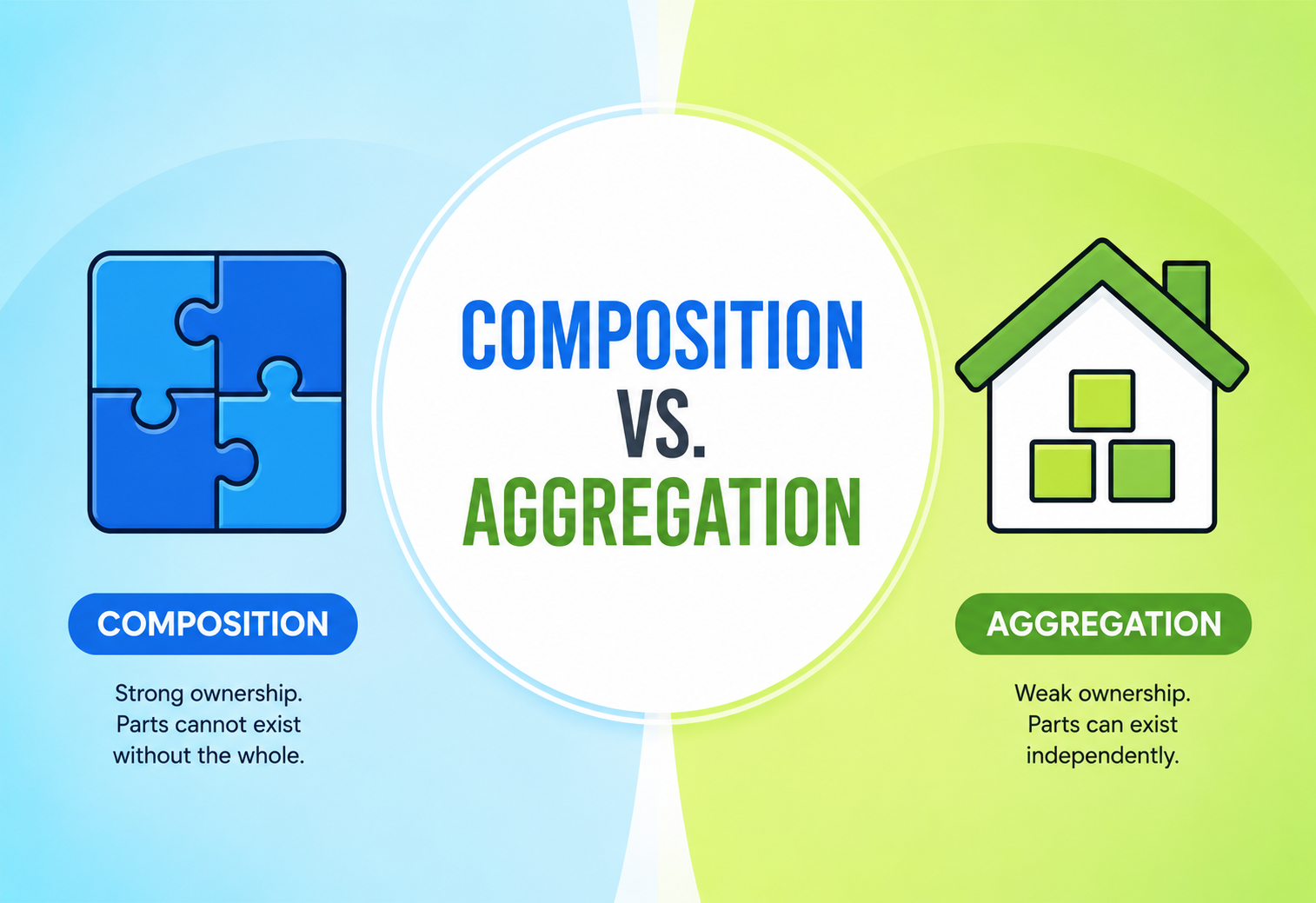
Aggregation describes a whole-and-part relationship where the parts can happily exist on their own, both before the whole comes together and after it falls apart. The whole object gathers up, groups, or organizes the parts — but it doesn’t create them, and it doesn’t control when they stop existing. It’s ownership in the loosest, most borrowed sense: more like membership than possession.
A classic example is a school and its teachers. A School object might keep a list of Teacher objects who currently work there. But a teacher is a fully independent person with a life outside that school — the teacher existed before joining, has a name, qualifications, and a career, and if the school were to close down tomorrow, every single teacher would still exist, ready to go teach somewhere else. The school groups them together while they’re employed there, but it never “creates” a teacher, and closing the school never deletes a teacher from existence.
Think of a sports team and its players. A cricket team lists eleven players on its roster for a match. Those players existed long before they joined the team, and if the team disbands at the end of the season, every player goes right on living their life — maybe they even join a different team next year. The team “has” players, but it doesn’t own their existence.
The Two Fingerprints of Aggregation
- Independent lifecycle. The part object can be created before the whole exists, and it will happily keep existing after the whole is gone.
- Shareable. The very same part can often belong to more than one whole at the same time. A teacher can work part-time at two different schools; a book can sit on more than one reading list.
In code, aggregation usually looks like an object receiving a reference to another already-built object — often through its constructor or a setter method — rather than building that object itself from scratch. The whole simply keeps a pointer to something that exists independently, somewhere else in the program’s memory.
Ask yourself: “If I deleted the whole object right now, would the part object still make sense on its own?” If the honest answer is yes, you’re almost certainly looking at aggregation.
Consider one more example: a shopping cart on an online store, and the products sitting inside it. The shopping cart gathers products together temporarily while a customer browses. But the products themselves — say, a particular pair of shoes — were already created by the store long before this customer ever added them to a cart, and they’ll keep existing on the store’s shelves whether this particular cart is checked out, abandoned, or emptied. The cart organizes and displays them for a while, but it never owns their existence, and the exact same shoe can sit in a hundred different customers’ carts at once. That’s aggregation working exactly as intended: convenient grouping, zero exclusive ownership.
This is also why aggregation tends to show up so often in reporting, dashboards, and organizational structures — anywhere a system needs to group already-existing things for a purpose, without taking on responsibility for their birth or death. A company’s Department object aggregating Employee objects is a good example: employees exist as people with their own records long before joining a department, and a company reorganization that dissolves a department doesn’t dissolve the employees along with it — they simply get reassigned somewhere else.

What Is Composition? The “Has-A, and Truly Owns It” Relationship
Composition is the tighter, stricter sibling of aggregation. Here, the whole object doesn’t just group the parts — it actually creates them, controls them, and is fully responsible for their entire life. The part has no independent existence outside the whole. It is born when the whole is born (or shortly after, at the whole’s request), and it dies the moment the whole dies. There is no scenario where the part is floating around on its own, disconnected from its owner.
A textbook example is a house and its rooms. A House object might build its own Room objects — a kitchen, a bedroom, a bathroom — right when the house itself is constructed. A room doesn’t make sense by itself, hovering in the air with no house around it. And critically, if the house is demolished, its rooms are demolished right along with it. Nobody salvages “the bedroom” and moves it, intact, into a different house.
Think about the human body and the heart inside it. The heart isn’t handed to a person from the outside world the way a backpack is; it develops as part of that body, does its work only inside that body, and cannot be casually swapped or shared with someone else while both people go on living normal lives. Whatever happens to the body, happens to the heart. That tight, inseparable bond is exactly what composition is describing.
The Two Fingerprints of Composition
- Dependent lifecycle. The part is created by (or immediately for) the whole, and it is destroyed automatically when the whole is destroyed. Their lifespans move together, like two clocks wound by the same key.
- Exclusive ownership. A part belongs to exactly one whole at a time. It cannot quietly belong to two different owners simultaneously.
In code, composition usually shows up as one object constructing another object internally — often right inside its own constructor — and never handing out a direct way for outside code to grab that inner object and keep it alive independently. The part’s memory and lifetime are entirely managed from the inside.
Ask yourself: “If I deleted the whole object right now, would it even make sense for the part to keep existing on its own?” If the honest answer is no, you’re looking at composition.
Here’s one more useful example: an invoice and the individual line items printed on it. When an Invoice is generated for a purchase, it builds its own InvoiceLine objects, one per product bought, capturing the exact price and quantity at that specific moment in time. Those line items don’t float around independently anywhere in the system, and they certainly don’t get shared with a different invoice — even if the customer buys the exact same product again tomorrow, that second invoice creates a brand-new line item of its own. Cancel or delete the invoice, and its line items are gone too, because they only ever existed to describe that one particular invoice.
This same pattern shows up constantly in real software: a form and its individual input fields, a document and its paragraphs, a game character and its inventory slots. In every one of these pairs, the part is not just conceptually “inside” the whole — it was purpose-built for that exact whole and has no independent reason to exist anywhere else.
Reading the Diamonds: How UML Draws These Relationships
Software architects often sketch these relationships using UML class diagrams, and the whole story of “how tightly are these two things bound together” is captured in one tiny shape: a diamond, sitting on the end of a connecting line, right beside the “whole” class.
- A plain line with no diamond at all means a simple association — two classes that know about each other, nothing more.
- A hollow (unfilled) diamond pointing to the whole means aggregation — a loose, shareable, independently-living connection.
- A filled (solid) diamond pointing to the whole means composition — a tight, exclusive, life-and-death connection.
A handy memory trick: an empty (hollow) diamond is like an empty box — it can be opened, and whatever’s inside can be taken out and used somewhere else. A filled (solid) diamond is like a sealed box — what’s inside stays inside, permanently, for the life of that box.
It’s worth noting that not every team draws every relationship this precisely in day-to-day work. Many engineers use a plain line for almost everything and only reach for the diamonds when the ownership question genuinely matters to the design — for instance, when deciding how deletion should cascade, or when documenting a tricky part of the system for someone joining the team later. Overusing the notation on every single line in a diagram can actually make it harder to read, since the eye stops noticing the diamonds as meaningful once they’re everywhere. A good diagram highlights the relationships that matter and stays quiet about the ones that don’t.
Some diagramming tools also let you attach multiplicity numbers right next to each end of the line — a small “1” near the whole and a “0..*” (meaning “zero or more”) near the part, for example. Combined with the diamond, this tells a very complete story in a tiny amount of space: “exactly one house owns zero or more rooms, and each room belongs to exactly one house.” Reading UML fluently is really just reading these small symbols and numbers as a compact sentence.
Side-by-Side: Association, Aggregation, and Composition
With all three relationships now introduced, here’s a single table that lines them up so the differences are easy to scan at a glance.
| Aspect | Association | Aggregation | Composition |
|---|---|---|---|
| Relationship type | General connection | Whole-part (weak) | Whole-part (strong) |
| Ownership | None | Loose / grouping | Strict / exclusive |
| Lifecycle | Fully independent | Independent | Dependent — tied together |
| Can the part be shared? | Yes, freely | Often, yes | No, exactly one owner |
| UML notation | Plain line | Hollow diamond | Filled diamond |
| Everyday example | Teacher & Student | Team & Player | House & Room |
| What happens if the whole is deleted? | Nothing changes for either side | The part lives on | The part is destroyed too |
Aggregation and composition are both special cases of association — never a completely separate category. It’s perfectly correct to describe an aggregation relationship as “an association with grouping and no shared lifecycle,” and a composition relationship as “an association with exclusive ownership and a shared lifecycle.”
One more detail worth spelling out: the “part” in aggregation or composition doesn’t have to be a single object. Most real systems use collections — a House composing a whole list of Room objects, or a School aggregating a whole list of Teacher objects. The relationship type doesn’t change just because there are many parts instead of one; the diamond and the ownership rules apply the same way whether the whole holds one part or a thousand of them.
It’s also useful to remember that these three relationships sit on a spectrum of increasing strength, rather than being three completely separate ideas with hard walls between them. Association is the loosest — barely more than “these two classes are aware of each other.” Aggregation tightens that into a recognizable whole-part shape, while still respecting the part’s independence. Composition tightens it one notch further, binding the part’s very existence to the whole. Thinking of them as three points along one continuum, rather than three unrelated boxes to memorize, makes the whole topic far easier to hold in your head.
Seeing It in Code
Diagrams are lovely, but relationships like these become much clearer once you see how they actually show up in a working program. The two snippets below use a Java-like style, since it reads clearly even for someone newer to programming, but the same pattern appears in Python, C#, JavaScript, and nearly every object-oriented language.
Aggregation in Code
Notice how the Teacher objects are built completely outside the School class, and then simply handed in. The school never creates a teacher itself — it only receives and stores a reference to one that already exists.
Aggregation — the part is built outside, then handed inclass Teacher {
    String name;
    Teacher(String name) { this.name = name; }
}

class School {
    List<Teacher> teachers = new ArrayList<>();

    void hire(Teacher t) {
        teachers.add(t);   // just stores a reference
    }
}

// Usage — the teacher exists on its own, before joining a school
Teacher priya = new Teacher("Priya");
School greenwood = new School();
greenwood.hire(priya);

// If "greenwood" is deleted, priya still exists and can join another school
Composition in Code
Now compare that with a House class. Here, the Room objects are created inside the house’s own constructor. There is no way for outside code to build a lone Room and hand it to the house — the house is entirely responsible for bringing its rooms into existence.
Composition — the part is built inside, and owned exclusivelyclass Room {
    String type;
    Room(String type) { this.type = type; }
}

class House {
    private final Room kitchen;
    private final Room bedroom;

    House() {
        // rooms are created here, by the house itself
        this.kitchen = new Room("Kitchen");
        this.bedroom = new Room("Bedroom");
    }
}

// Usage — you cannot create a Room without first creating a House
House cottage = new House();

// If "cottage" is deleted, kitchen and bedroom are deleted with it
The real tell isn’t the syntax — it’s the question “who calls new?” If the outside world builds the part and passes it in, that’s aggregation. If the whole builds the part itself, quietly, inside its own walls, that’s composition.
A Worked Case Study: Designing a Library System
Reading about relationships in the abstract only gets you so far. Let’s actually design something — a small library management system — and make deliberate decisions about which relationship fits where, thinking out loud the way an architect would in a real design meeting.
Step One: List the Nouns
Every early design starts by writing down the “things” the system needs to know about. For our library, that’s a Library, a Book, a Member, a LibraryCard, and a Loan record that tracks who currently has which book.
Step Two: Ask “Who Creates Whom?” for Each Pair
- Library and Book. Does the library create books out of thin air? No — publishers create books, and the library simply acquires copies. Books can also be donated elsewhere or moved to a different branch. This is aggregation: the library groups books, but books have an independent existence.
- Member and LibraryCard. When someone joins the library, the library issues them a card specifically tied to their membership — a card with no member behind it doesn’t mean anything, and it’s cancelled the moment the membership ends. This is composition: the card is built for, and destroyed with, that specific membership.
- Loan and Book, Loan and Member. A loan record connects one specific book to one specific member for a period of time, but it doesn’t own either of them — it just describes a temporary relationship between two independently existing things. This is a plain association, with the loan itself acting almost like a connector object that links the two together.
Step Three: Sanity-Check with the Deletion Test
Running the “what if I delete the whole” test on each pair confirms the design holds up. Close the entire library branch, and its books get transferred to another branch rather than destroyed — consistent with aggregation. Cancel a member’s account, and their library card is immediately voided and has no further purpose — consistent with composition. Delete a loan record after a book is returned, and neither the book nor the member is affected in any way — consistent with plain association.
This is exactly the kind of reasoning a technical architect walks through dozens of times while designing any real system, and it’s a habit worth building early: for every pair of connected classes, ask who creates whom, whether sharing makes sense, and what should happen on deletion. The answers almost always sort the relationship into the right bucket.
Notice too how this small design exercise naturally produced a mixed diagram — one aggregation, one composition, and one plain association, all living comfortably side by side in the same system. That’s completely normal and, honestly, expected. A well-designed system rarely uses just one type of relationship everywhere; it uses whichever relationship honestly matches each individual pair of classes. Forcing every connection in a system into the same mold — treating everything as composition, or everything as loose association — almost always signals that the relationships weren’t examined carefully enough during design.
Composition and Aggregation Across Languages
These relationships aren’t tied to any single programming language — they’re a way of thinking about object design that applies everywhere objects exist. Here’s how the same “House owns Rooms, School aggregates Teachers” idea looks in a few other popular languages, just to show the pattern is universal.
Python — Compositionclass Room:
    def __init__(self, kind):
        self.kind = kind

class House:
    def __init__(self):
        self.kitchen = Room("Kitchen")
        self.bedroom = Room("Bedroom")
# Rooms are born with the house,
# and there's no way to build a
# Room without going through House.
Python — Aggregationclass Teacher:
    def __init__(self, name):
        self.name = name

class School:
    def __init__(self):
        self.teachers = []

    def hire(self, teacher):
        self.teachers.append(teacher)
# Teacher objects are created
# completely outside School.
C# — Compositionpublic class Room {
    public string Kind;
    public Room(string kind) { Kind = kind; }
}

public class House {
    private readonly Room kitchen;
    public House() {
        kitchen = new Room("Kitchen");
    }
}
C# — Aggregationpublic class Teacher {
    public string Name;
    public Teacher(string name) { Name = name; }
}

public class School {
    private List<Teacher> teachers = new();
    public void Hire(Teacher t) {
        teachers.Add(t);
    }
}
Notice the exact same signature repeats itself in every language: composition means the constructor of the whole builds the part directly, while aggregation means the part arrives from the outside as a ready-made object, passed into a method or constructor. Whatever syntax a language uses, that underlying pattern of “who calls the constructor” is what to look for.
JavaScript — Compositionclass Room {
  constructor(kind) { this.kind = kind; }
}

class House {
  constructor() {
    this.kitchen = new Room("Kitchen");
    this.bedroom = new Room("Bedroom");
  }
}
// House builds its own Rooms internally.
JavaScript — Aggregationclass Teacher {
  constructor(name) { this.name = name; }
}

class School {
  constructor() { this.teachers = []; }
  hire(teacher) { this.teachers.push(teacher); }
}
// Teacher objects are created elsewhere
// and simply handed to the school.
Even in a dynamically typed, flexible language like JavaScript, where there’s technically nothing stopping you from reaching in and grabbing a supposedly “private” part, the design intention stays exactly the same. Composition is a statement of purpose and structure, not merely a wall enforced by the compiler — good discipline and clear naming carry the intent even when the language itself doesn’t strictly enforce it.
More Everyday Analogies
The best way to make these ideas stick is to collect a handful of examples and sort each one into its proper bucket. Here’s a small gallery to build that instinct.
Car & Engine
A specific car’s engine is bolted in and built for that car. Scrap the car and, in the model sense, that engine’s working life ends with it.
Book & Pages
The pages of a printed book are bound into it. Destroy the book, and those particular pages go with it — you can’t lift them out into a different book.
Library & Books
A library holds books, but the books existed before the library acquired them and will exist after being donated elsewhere.
Playlist & Songs
A playlist groups songs together, but deleting the playlist never deletes the songs — they still live in the music library.
Human & Heart
A heart is built as part of a body and cannot be casually detached and kept alive as a separate, independent entity in daily life.
Orchestra & Musicians
An orchestra brings musicians together for performances, but each musician has their own independent life and career outside it.
Order & Order-Lines
The individual line items on a shopping order (2 pencils, 1 eraser) only make sense as part of that specific order and vanish if it’s cancelled.
Folder & Files
A folder organizes files, but many systems let the same file be referenced from more than one folder, and deleting a folder needn’t destroy the files.
Try running a few objects from your own daily life through this same test the next time you have a spare minute — your phone and its battery, your school and its playground, your family and your pet. You’ll likely find that your intuition was already sorting these relationships correctly long before you had names like “aggregation” and “composition” to describe them.

Where This Idea Shows Up Again
Once this distinction clicks, you’ll start noticing it everywhere in software design conversations — not just when someone is explicitly drawing a class diagram.
Composition Over Inheritance
There’s a famous piece of design advice that says: prefer building objects by combining smaller, focused pieces (composition) rather than by stacking up layers of inheritance (“is-a” relationships). A Car that “has an” Engine, “has” Wheels, and “has a” Transmission is usually easier to change and extend than a Car that tries to inherit behavior from a tangled family tree of parent classes. This isn’t the same topic as aggregation-versus-composition, but it borrows the very same word for a reason — both describe the strength and structure of “has-a” relationships between objects, just at a bigger, architectural scale.
Database Design
The same instinct appears when designing database tables. A “foreign key with cascade delete” — where deleting a parent row automatically deletes its child rows — mirrors composition almost exactly. A foreign key without cascading delete, where child rows are simply orphaned or reassigned, mirrors aggregation.
Memory Management
In languages that manage memory automatically, composition often means an object’s inner parts are cleaned up the instant the outer object is no longer needed, while aggregation means the inner parts might keep living in memory long after the outer object is gone, simply because something else still holds a reference to them.
Everyday Organizing, Outside of Software
You don’t need a computer to see this pattern at work. Think about how a school organizes itself. A classroom aggregates students for the school year — students existed before joining that particular classroom and will move on to a new one next year. But a single desk, with its own drawer and nameplate, might be assigned so specifically to one student’s daily routine that when that student leaves, the desk’s identity as “their” desk is retired along with them, even though the physical furniture is reused. Businesses, families, and even nature itself are full of these same two flavors of “belonging” — some things are borrowed and grouped, and other things are truly, permanently part of a bigger whole.
Strengths and Trade-offs of Each
Neither relationship is “better” in some absolute sense — each is a tool suited to a different situation. Here’s an honest look at what each one buys you, and what it costs.
It helps to think of this the way a carpenter thinks about screws versus glue. Screws (aggregation) let you take furniture apart and reuse the pieces elsewhere; glue (composition) creates a bond so permanent that the joined pieces essentially become one single object. Neither the screw nor the glue is the “correct” choice in general — it depends entirely on whether you’ll ever need to separate those pieces again.
Aggregation
What aggregation buys you
Parts can be reused and shared across multiple wholes. Looser coupling — the whole and the part can change somewhat independently. Easier to test parts on their own, without needing to build a whole first.
What it quietly costs
The whole has less control — a part might change unexpectedly if something else also holds it. You must think carefully about who is responsible for cleaning up a part when it’s genuinely no longer needed anywhere. Can sometimes hide the real relationships in a system if used too loosely.
Aggregation tends to be the right instinct in systems where the same underlying data or object genuinely needs to be viewed, grouped, or organized from multiple angles at once — think of how the same product might appear in a search results page, a “recently viewed” list, and a wish list, all at the same time, without three separate copies of that product being created.
Composition
What composition buys you
Very predictable lifecycle — no orphaned or dangling parts left behind. Strong encapsulation — outside code cannot fiddle with the internal parts directly. Communicates intent clearly: this piece truly belongs to that piece.
What it quietly costs
Parts cannot be reused or shared elsewhere without being rebuilt. Tighter coupling — changes to the whole can more easily ripple into the part. Testing the part in isolation usually requires constructing the whole first.
Composition tends to shine wherever data integrity and predictable cleanup matter most — financial records, medical charts, anything where a stray, disconnected fragment left behind after deletion could cause real confusion or even real harm. The tighter the consequences of a mistake, the more composition’s strict, no-surprises lifecycle earns its trade-offs.
Which One Should You Pick? A Simple Decision Guide
When you’re staring at two classes and trying to decide how to connect them, walking through a short checklist usually settles it quickly.
Does the part make sense without the whole?
If yes, lean toward aggregation or plain association. If the part is meaningless on its own, lean toward composition.
Could the same part belong to more than one whole?
If sharing is genuinely useful in your situation, that points toward aggregation. Composition assumes exactly one owner.
Who should be responsible for creating the part?
If the whole naturally builds its own parts as it comes into being, that’s composition. If parts are built elsewhere and simply supplied, that’s aggregation.
What should happen when the whole is deleted?
If the part should be cleaned up automatically, use composition. If the part should be left alone, use aggregation.
When you’re genuinely unsure, start with plain association — it’s the safest, loosest default. Only tighten the relationship to aggregation or composition once your design clearly calls for grouping or true ownership. Adding structure later, once the need is proven, is far easier than untangling an over-committed design.
Let’s put the checklist to work on a fresh example: a Playlist and its Song objects in a music app. Does a song make sense without the playlist? Clearly yes — it’s a complete piece of music sitting in the app’s library regardless of any playlist. Could the same song appear on more than one playlist? Also yes — that’s one of the whole points of playlists. Who creates the song? The music library does, when it’s first added to the catalogue, long before any user builds a playlist around it. What should happen if the playlist is deleted? Nothing at all should happen to the song — it remains fully intact in the library. Every single answer points the same direction: this is aggregation, not composition, and building it any other way would create a confusing, overly rigid app where deleting a playlist accidentally destroyed someone’s favorite song.
Common Mix-Ups Worth Avoiding
Even after the core ideas click, a handful of habits can quietly lead a design astray. Here are the mix-ups that show up most often, along with why each one causes real trouble down the line.

Thinking Aggregation Means “No Relationship at All”
Aggregation still represents a real, meaningful whole-part connection — it’s just a looser one than composition. It’s easy to mistake it for a plain association, but the grouping and “part of a bigger structure” idea is still present; only the strict ownership and shared lifecycle are missing.
Assuming Composition Always Means “Cannot Be Changed”
Composition is about the part’s lifecycle and exclusivity, not about whether the part’s contents can change over time. A House can absolutely renovate one of its Room objects, repainting it or resizing it, while the ownership relationship stays exactly the same.
Believing the Difference Is “Just Academic”
In real systems, mixing these up has consequences. If code deletes a “whole” object assuming its parts will be cleaned up automatically, but the relationship was actually aggregation, those parts can be left behind, quietly wasting memory or leaving orphaned data in a database — sometimes called a memory leak or an orphaned record.
Forgetting That the Same Pair of Classes Can Relate Differently in Different Systems
A Book and a Chapter might be composition in an e-book reader (chapters only exist inside that one book file) but could be modeled as aggregation in a publishing system where chapters are drafted separately and later assembled into different book editions. Context always matters more than the class names alone.
Don’t pick composition just because it “sounds stronger” or more impressive in a design review. Choosing composition where sharing was actually needed can make a system rigid and hard to extend later.
Modeling Every Relationship as Composition “Just to Be Safe”
Some newer designers default to composition everywhere, reasoning that tighter control feels safer. In practice, this backfires the moment a genuine need for sharing or independent lifetimes shows up later, forcing a painful redesign. It’s usually healthier to start with the loosest relationship that honestly describes the situation, and tighten it only when the evidence clearly calls for it.
Confusing “Contains a Reference To” with “Owns”
Just because one class stores a variable pointing to another object doesn’t automatically mean composition. A DeliveryRoute class might store a reference to a Driver object purely so it knows who to notify — that’s association, not composition, even though the code “contains” a reference. Ownership is about lifecycle and responsibility, not about which class happens to hold the variable.
Taken together, these mix-ups share one root cause: reasoning from surface appearance — how the code looks, or how “strong” a word sounds — rather than from the actual lifecycle question underneath. Anchoring every design decision back to that simple deletion test is the single most reliable way to avoid all four of these traps at once.
Why This Small Idea Matters at a Bigger Scale
It’s tempting to file “composition versus aggregation” away as a small, textbook-only detail — something you learn for a quiz and then forget. In practice, this exact distinction quietly shapes decisions in far bigger, real-world systems than a house-and-rooms example might suggest.
Consider a large e-commerce platform built from many independent services — one for orders, one for payments, one for inventory. When an Order service needs to reference a customer, it almost always uses something closer to aggregation: it stores an identifier pointing to a customer that lives, and continues to live, inside a completely separate customer service. Deleting an order should never delete the customer. But within the order service itself, the individual line items that make up that one order behave like composition — they’re created with the order, they only make sense next to that order, and clearing the order clears them too.
Getting this distinction right at a large scale prevents some genuinely painful, expensive mistakes: services that accidentally destroy shared data they don’t actually own, databases full of orphaned records nobody remembers creating, and brittle systems where a tiny, unrelated cleanup operation somehow cascades into deleting things it never should have touched. A technical architect reviewing a new system design will very often ask, almost as a reflex, “does this component own that data, or does it just reference it?” — and the answer to that one question shapes how safely, and how independently, different teams can build and change their parts of the system without breaking each other’s work.
This same reasoning also guides decisions about how a system should be split apart in the first place. Pieces that are tightly composed together — created together, destroyed together, meaningless apart — are usually strong candidates for staying inside the same service or module, since separating them would mean coordinating their lifecycles across a network, which adds real complexity. Pieces that merely aggregate one another, by contrast, are often safe to split into independent services, precisely because their independent lifecycles were already designed to allow it. In this way, a concept that starts out looking like a small UML detail ends up quietly influencing decisions about the entire shape of a large software system.
The house-and-rooms story and the enterprise e-commerce platform are really telling the exact same story, just at two different sizes. Once the underlying idea clicks at the small scale, it transfers almost perfectly to the big, messy, real-world systems that professional engineers build every day.
Frequently Asked Questions
Is aggregation just a weaker version of composition?
That’s a fair way to think about it, though it’s more accurate to say they represent two different points on the same spectrum of “has-a” strength. Both describe a whole grouping parts, but aggregation leaves the parts free to live independently and be shared, while composition binds the part’s entire existence to the whole.
Can a single class diagram use both aggregation and composition?
Absolutely, and most real systems do. A Library might aggregate Book objects (books outlive the library), while a Book composes its own TableOfContents object (which only makes sense as part of that specific book).
Does composition mean the two classes must be in the same file or module?
No. Composition is about ownership and lifecycle, not about physical code organization. A House class and its Room class can live in completely separate files; what matters is that the house creates and controls the rooms’ existence.
Is association always weaker than both aggregation and composition?
Yes — association is the broadest, loosest category, and both aggregation and composition are considered specialized, stricter forms of it. Every aggregation and every composition is technically also an association, but not every association qualifies as aggregation or composition.
Why does this distinction matter if my code works either way?
Code that “runs” isn’t the same as code that clearly communicates intent. Naming the relationship correctly helps the next engineer — or you, six months later — instantly understand who is responsible for cleaning things up, whether sharing an object is safe, and how deleting one object will ripple through the rest of the system.
Can an object be part of an aggregation with one class and a composition with another, at the same time?
Yes, that’s common. A Musician might be aggregated by an Orchestra (loosely grouped, independent life) while, in the same program, that musician’s Instrument object is composed by the musician (built specifically for them and discarded if the musician object is removed).
How does this relate to “composition over inheritance”?
They share a word but answer different questions. Aggregation vs. composition asks “how tightly does this whole own its parts?” Composition over inheritance asks a bigger architectural question: “should I build behavior by combining small has-a pieces, or by stacking is-a class hierarchies?” Both ideas value flexible, well-defined “has-a” relationships, which is why the terminology overlaps.
Is this concept only useful for interviews, or does it matter in real jobs?
It matters well beyond interviews. Correctly identifying ownership and lifecycle shapes real decisions about memory cleanup, database cascade rules, thread safety, and how safely two teams can work on connected parts of a large codebase without stepping on each other. That said, it’s also a very common interview topic precisely because it reveals whether someone actually understands object relationships, rather than just memorizing syntax.
What’s the simplest possible way to remember the difference?
Picture a backpack and a library book. The backpack’s pencil case is composition — it goes wherever the backpack goes and is thrown away with it. The library book is aggregation — it’s temporarily inside your bag, but it belongs to, and will return to, a world outside you entirely.
Does the direction of the arrow in an association tell me anything about ownership?
No — navigability (which side “knows about” the other) and ownership are two completely separate questions in UML. An association can be one-directional or two-directional regardless of whether it’s a plain association, an aggregation, or a composition. The diamond symbol communicates ownership; the arrow, if one is drawn at all, only communicates which side can “see” or reach the other in code.
Glossary
Here’s a quick-reference collection of every important term used throughout this guide, gathered in one place so you can look any of them up again later without having to scroll back through the whole article.
| Term | Definition |
|---|---|
| Association | A general connection between two classes showing that objects of one kind interact with objects of another, with no implied ownership. |
| Aggregation | A whole-part association where the part can exist independently of the whole and may be shared across multiple wholes. |
| Composition | A whole-part association where the part’s entire lifecycle is controlled by, and tied to, exactly one whole. |
| Has-A Relationship | A relationship where one object contains or is made up of another, as opposed to an “is-a” relationship formed through inheritance. |
| Multiplicity | The number of instances of one class that can be linked to a single instance of another class in a relationship. |
| Lifecycle | The span of time from when an object is created to when it’s destroyed or no longer needed by the program. |
| Encapsulation | The practice of hiding an object’s internal details so outside code can’t directly reach in and change them. |
| Coupling | How tightly connected two pieces of code are — tighter coupling means a change in one is more likely to require a change in the other. |
| UML Diamond Notation | The visual symbol placed at the “whole” end of a relationship line in a class diagram — hollow for aggregation, filled for composition. |
| Orphaned Object | An object that’s no longer referenced or needed by anything meaningful, often left behind by an incorrectly modeled aggregation relationship. |
Key Takeaways
We’ve covered a lot of ground — diamonds, deletion tests, code snippets in three different languages, and a small library system built from scratch. If only a handful of ideas stick with you after reading this, let it be the ones gathered below.
Remember This
- Association is the broad “these two things know each other” relationship, with no ownership implied at all.
- Aggregation is a whole-part relationship where the part can exist independently and may be shared — like a team and its players.
- Composition is a whole-part relationship where the part’s lifecycle is tied entirely to the whole — like a house and its rooms.
- UML draws these with a hollow diamond for aggregation and a filled diamond for composition, always placed at the “whole” end of the line.
- In code, the giveaway is usually “who calls
new?” — outside code building the part points to aggregation; the whole building its own parts points to composition. - The simple deletion test — “if I remove the whole, does the part still make sense?” — settles the question correctly almost every time.
- Neither relationship is better in every case — choose based on whether the part should be shareable and independently long-lived, or exclusively owned and tightly bound to its whole.
The next time you’re sketching out a new class, a new database table, or even just describing two connected ideas to a teammate, try running through the same quiet checklist this guide walked through: who creates whom, can it be shared, and what happens when one is gone. That small habit, repeated often enough, is exactly how a solid instinct for object design gets built. It’s a small piece of vocabulary, but like most good vocabulary, it ends up doing far more work than its size would suggest.