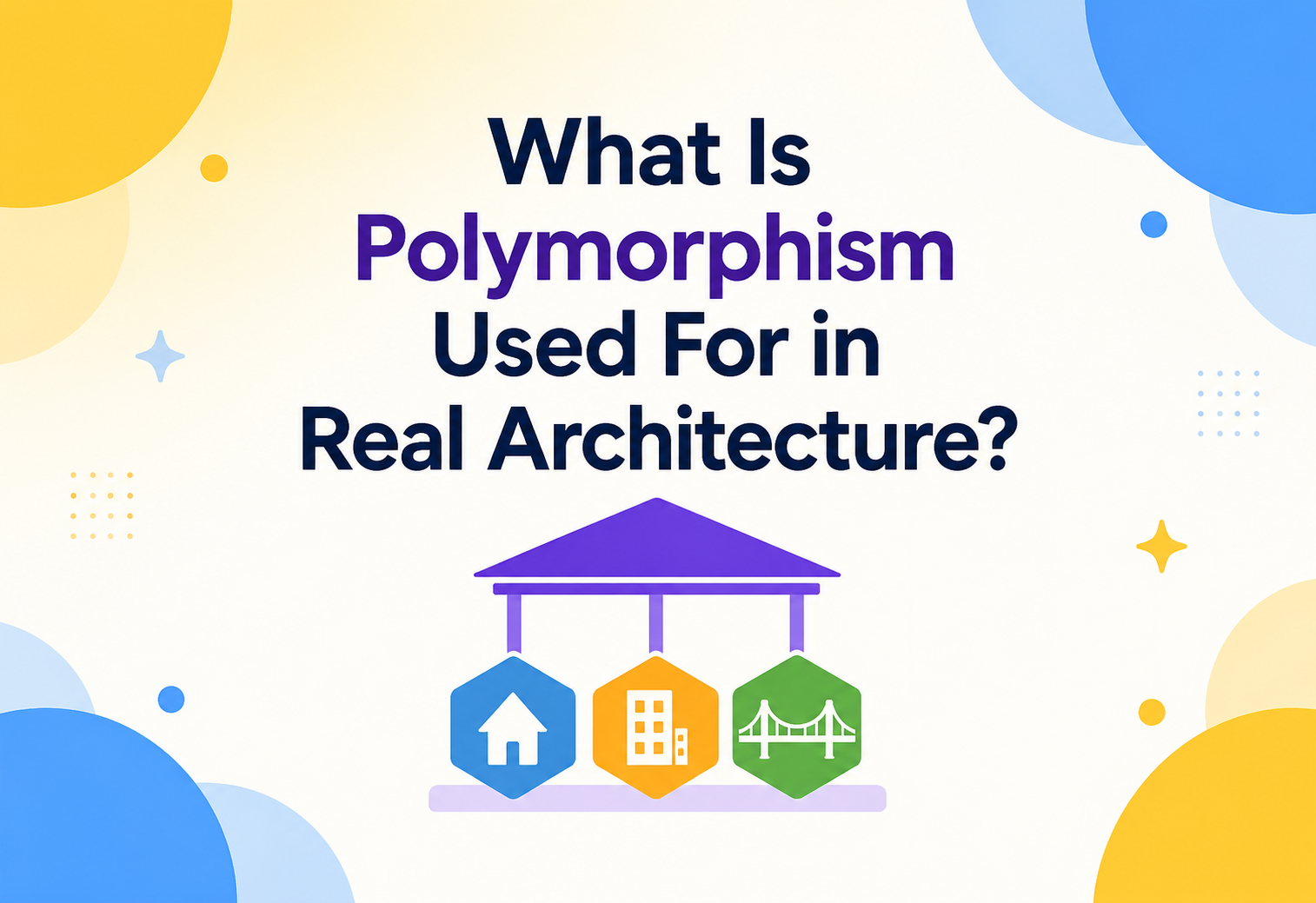
What Is Polymorphism Used For in Real Architecture?
One word, “play,” and one button that means something completely different on a music app, a video app, and a game console. That single idea — one command, many meanings — is the heart of polymorphism, and it quietly powers some of the biggest, most flexible systems in software.
The Big Idea, in One Breath
Press the “play” button on a music app, and a song starts. Press the exact same-looking “play” button on a video app, and a movie starts instead. Press “play” on a game console, and a whole world loads up. Three completely different things happen, triggered by what feels like the same simple command: play.
Now think about a TV remote control. One single “power” button turns on a television, a soundbar, or a set-top box, depending on which device you’re pointing it at and which mode the remote is currently set to. The button doesn’t change. The word printed on it doesn’t change. But what actually happens when you press it changes completely, depending on the object receiving the command.
That is exactly the idea behind polymorphism in software design — a single instruction, method name, or interface that produces different, specific behavior depending on which object is actually handling it. The word comes from Greek: poly meaning “many,” and morph meaning “form” or “shape.” Put together, it simply means “many forms.” One name, many behaviors, chosen automatically based on who’s actually doing the work.
Think about the instruction “make a sound,” given to different animals. Tell a dog to make a sound, and you get a bark. Tell a cat, and you get a meow. Tell a bird, and you get a chirp. The instruction stays exactly the same in every case — “make a sound” — but each animal answers it in its own particular way, without you needing a separate, differently worded instruction for every single animal on the planet.
This idea might sound small, almost too simple to matter. But it turns out to be one of the most powerful tools available for building software that can grow, change, and welcome new features without constantly rewriting old code. This guide walks through exactly what polymorphism is, how it actually works underneath the surface, and — most importantly — where real, professional software architecture leans on it every single day.
Here’s why this matters so much in practice: software rarely stays still. A shopping app that only supports one payment method today will almost certainly need to support three or four more within a year. A notification system that only sends emails will eventually need to send text messages and app alerts too. Every time a new variation shows up, a team has two very different paths available to them. One path means digging back into old, already-working code and carefully editing it, hoping nothing breaks. The other path — the one polymorphism opens up — means simply adding something new alongside what’s already there, leaving the old, tested code completely untouched. Architects overwhelmingly prefer the second path, and polymorphism is the main tool that makes it possible.
It’s also worth saying plainly, right at the start, that you don’t need to be an expert programmer to follow the ideas in this guide. Every technical example is paired with a plain-language explanation and a familiar, everyday comparison, so the underlying logic stays clear even if some of the code syntax feels unfamiliar at first glance. By the end, the goal is for “polymorphism” to feel less like an intimidating vocabulary word and more like a simple, sensible habit you already half-understood from everyday life — the same habit that lets one remote control run three different devices, and one “play” button mean three different things.
What Polymorphism Really Means
At its heart, polymorphism lets different objects respond to the exact same message, method call, or instruction, each in its own appropriate way. It’s one of the four foundational ideas of object-oriented programming, standing alongside encapsulation, inheritance, and abstraction — and it’s the one most directly responsible for making software feel flexible rather than rigid.
Imagine a drawing app that supports circles, squares, and triangles. Each of these shapes needs to know how to draw itself on the screen. Without polymorphism, the app’s code might need a long, clunky checklist: “if it’s a circle, draw it this way; if it’s a square, draw it that way; if it’s a triangle, draw it yet another way” — and that checklist would need updating every single time a new shape gets added. With polymorphism, every shape simply understands the same basic instruction, draw(), and each one quietly knows how to carry it out correctly on its own. The rest of the program never needs to ask “what kind of shape is this?” — it just says “draw yourself,” and trusts the shape to handle the details.
Polymorphism means you can write code that talks to a whole family of related objects using one shared vocabulary, without needing to know, or care, exactly which member of the family it’s talking to at that moment.
It’s worth being precise about one more thing: polymorphism isn’t about objects magically changing what they are. A Dog never secretly turns into a Cat. What actually changes is which specific piece of code runs in response to a shared instruction, based on which specific object received that instruction. The object’s identity stays completely fixed and honest throughout; it’s the calling code’s understanding of “what kind of thing am I even talking to right now” that stays deliberately general and flexible.
This works because of a deeper idea called substitutability: if a Circle and a Square both belong to the same broader family — say, they’re both a kind of Shape — then anywhere the program expects a Shape, you can hand it a Circle or a Square instead, and the program will work correctly without modification. The specific shape “stands in” for the general shape, and the program trusts each one to behave sensibly when asked to do shape-like things.
Here’s a second, slightly different example to help this idea settle in. Imagine a music streaming app with a playlist containing songs, podcast episodes, and audiobook chapters, all mixed together. Each of these is a genuinely different kind of content, stored differently and behaving a little differently internally. Yet the playlist itself only ever needs to say one simple thing to whatever’s currently playing: “play yourself.” A song plays itself as three minutes of music. A podcast episode plays itself with an introduction and an ad break. An audiobook chapter plays itself starting exactly where the listener left off last time. The playlist doesn’t need three separate lists, or three separate “play” buttons — one shared instruction, understood and carried out appropriately by each different kind of content.
This is precisely the quality that makes polymorphism so valuable architecturally: it lets the “outer” parts of a program — the playlist, the checkout screen, the notification sender — stay blissfully simple and unaware of exactly how many different kinds of “inner” objects they might be dealing with, now or in the future.
The Two Main Types
Polymorphism generally shows up in two different flavors, separated by one simple question: does the program decide which behavior to use while it’s being written and compiled, or does it decide while it’s actually running?
This distinction turns out to matter quite a bit in practice, because each flavor solves a genuinely different kind of problem. Compile-time polymorphism is mostly about convenience and clarity — letting a single, sensible method name handle several closely related situations, like adding two whole numbers versus adding two decimal numbers. Runtime polymorphism, on the other hand, is about handling genuine uncertainty that only resolves once the program is actually in use — situations where the exact object involved literally cannot be known in advance, such as which specific payment method a customer happens to choose during checkout, or which specific plugin a user happens to have installed.
Compile-time polymorphism (sometimes called static polymorphism or early binding) happens when a program can figure out, just by reading the code, exactly which version of a method to run. This is typically achieved through method overloading — writing several methods with the same name but different inputs — or through operator overloading, where a familiar symbol like + is taught to behave sensibly for new kinds of data.
Runtime polymorphism (sometimes called dynamic polymorphism or late binding) happens when the program can only figure out which version of a method to run once it’s actually executing, based on the real, concrete type of object it’s holding at that exact moment. This is achieved through method overriding, where a subclass provides its own specific version of a method that its parent class already defined in a more general way.
Ask yourself: “Could I know exactly which method will run just by reading the source code, without running the program?” If yes, that’s compile-time polymorphism. If the honest answer is “it depends on what happens while the program is actually running,” that’s runtime polymorphism.
The next two sections dig into each type individually, with full working examples, before we look at how runtime polymorphism actually gets carried out behind the scenes by the computer.
It’s worth briefly mentioning that some references also describe a third and fourth flavor: parametric polymorphism, where a single piece of code is written generically enough to work correctly across many different data types (often called “generics” or “templates” in modern languages), and coercion polymorphism, where a value is automatically converted from one type to another so an operation can proceed, such as a whole number being quietly treated as a decimal number during a calculation. These are real and useful ideas in their own right, but the two workhorses that show up constantly in everyday architecture — and the two this guide focuses on — remain overloading and overriding.
Compile-Time Polymorphism: Method Overloading
Method overloading lets a class offer several methods that share the same name, but differ in the number, order, or type of the values they accept. The program looks at exactly what you’re passing in and automatically picks the matching version — all figured out before the program even starts running.
Method Overloading — same name, different inputsclass Calculator {

    int add(int a, int b) {
        return a + b;
    }

    double add(double a, double b) {
        return a + b;
    }

    int add(int a, int b, int c) {
        return a + b + c;
    }
}

// The compiler picks the right version automatically:
calculator.add(2, 3);          // uses the first version
calculator.add(2.5, 3.5);      // uses the second version
calculator.add(2, 3, 4);       // uses the third version
Notice that nothing about this depends on what happens while the program runs — the compiler can look at the exact values being passed in, right there in the source code, and immediately know which add method matches. That’s the defining feature of compile-time polymorphism: the decision is locked in early, before a single line actually executes.
Operator overloading works on a similar principle. In many languages, the + symbol already knows how to add two numbers together, but it can also be extended to know how to combine two pieces of text (string concatenation), or even how to add together two custom objects, like combining two Vector objects in a physics simulation, or two Money objects representing currency amounts. The symbol stays the same; its behavior adapts to the type of data on either side of it.
Overloading is like a single word in a language that has multiple, closely related meanings depending on context — “run” a mile, “run” a business, “run” a program. English speakers instantly pick the right meaning based on context, the same way a compiler picks the right overloaded method based on the values being passed in.
It’s worth noting that overloading, while genuinely useful for readability, is generally considered the “smaller” of the two forms of polymorphism in terms of architectural impact. It mostly helps a single class offer a friendlier, more convenient set of options to whoever is calling it. Runtime polymorphism, covered next, is where the real architectural leverage shows up — the ability to add entirely new behavior to a growing system without ever touching what already works.
Operator Overloading — teaching a familiar symbol a new trickclass Money {
    double amount;
    Money(double amount) { this.amount = amount; }

    // Teach "+" how to combine two Money objects
    Money plus(Money other) {
        return new Money(this.amount + other.amount);
    }
}

Money rent = new Money(15000);
Money groceries = new Money(4500);
Money total = rent.plus(groceries);  // total.amount == 19500

// In languages that support true operator overloading,
// this could instead be written simply as: rent + groceries
Some languages, like C++ and Python, let developers redefine the + symbol itself so that rent + groceries reads naturally, rather than requiring a separate method call. Other languages, including Java, deliberately avoid this feature to keep code predictable — the tradeoff between elegant, natural-reading syntax and simple, unsurprising behavior is itself a small architectural decision language designers have to make.
Runtime Polymorphism: Method Overriding
Method overriding is where polymorphism really starts to earn its reputation as an architectural superpower. Here, a parent class defines a general method, and each child class provides its own specific, customized version of that exact same method — same name, same inputs, but genuinely different behavior underneath.
Method Overriding — same signature, different behavior per subclassclass Animal {
    void makeSound() {
        System.out.println("Some generic animal sound");
    }
}

class Dog extends Animal {
    @Override
    void makeSound() {
        System.out.println("Woof!");
    }
}

class Cat extends Animal {
    @Override
    void makeSound() {
        System.out.println("Meow!");
    }
}

// The magic moment:
Animal myPet = new Dog();
myPet.makeSound();     // prints "Woof!"

myPet = new Cat();
myPet.makeSound();     // prints "Meow!"
Look closely at that last block. The variable myPet is declared as a general Animal, but it can hold a Dog at one moment and a Cat the next — and each time, calling makeSound() automatically triggers the correct, specific version. The calling code never had to ask “what kind of animal is this?” It simply trusted the object to know how to make its own sound correctly.
This is what makes runtime polymorphism so valuable for growing systems. If a Bird class gets added six months later, with its own makeSound() method that prints “Tweet!”, none of the existing code that calls myPet.makeSound() needs to change at all. The new bird simply slots into the existing pattern and works correctly the very first time it’s used.
If you can add a brand-new subclass to your program without touching a single line of the code that already uses the parent class, and everything still works correctly — that’s runtime polymorphism doing its job properly.
This quick test connects to a well-known architectural principle called the Liskov Substitution Principle, which essentially formalizes the idea: a subclass should always be usable anywhere its parent class is expected, without surprising or breaking the calling code. If a Penguin subclass of Bird overrides a fly() method by throwing an error, because penguins can’t actually fly, that breaks the promise every other Bird subclass was making, and calling code that trusted “every bird can fly” would suddenly fail unexpectedly. Well-designed polymorphic hierarchies are built carefully enough that every subclass can be trusted to honor the same basic promises as its siblings.
How It Works Under the Hood
It can feel a little like magic that calling the same line of code, myPet.makeSound(), produces different results depending on what’s actually stored inside myPet. There’s no magic involved — just a clever, well-understood bit of bookkeeping that most modern programming languages handle automatically.
When a program runs, each object quietly carries around a note about its own real, specific type — a Dog knows it’s a Dog, even while it’s being stored inside a variable labeled as the more general Animal. When a method like makeSound() is called, the program doesn’t blindly use the method attached to the label on the box (Animal); instead, it checks what’s actually inside the box, and runs that specific object’s own version of the method. This lookup process is often called dynamic dispatch, or late binding, because the final decision about which code to run is “bound” late — while the program is running — rather than early, while it’s merely being written.
The diagram below traces exactly this moment: the same line of calling code, sent to two different objects, quietly resolving to two different, correct outcomes.
Under the surface, many languages implement this using something like a small lookup table attached to each type of object — often nicknamed a “vtable,” short for virtual method table. Whenever a polymorphic method gets called, the program briefly consults this table to find the correct version to run. This entire process happens extremely fast; on modern hardware, the tiny overhead of that lookup is essentially unnoticeable, even though it’s doing something that feels, from the outside, remarkably intelligent.
It helps to compare this with the simpler, faster lookup that happens during compile-time polymorphism. When a method is overloaded rather than overridden, the compiler can settle the question permanently while reading the code, essentially writing a direct, fixed instruction: “always run exactly this version.” There’s no runtime lookup involved at all, because there’s no uncertainty left to resolve — the compiler already knows everything it needs to know. Runtime polymorphism trades away that small amount of speed and certainty in exchange for something valuable: the ability to make decisions based on information that simply doesn’t exist yet while the code is being written, like which specific subclass a user’s action, a network response, or a plugin happens to create while the program is actually in someone’s hands.
None of this bookkeeping is something a developer typically has to manage by hand — it’s one of the quiet conveniences that modern languages and runtimes handle automatically, freeing engineers to think in terms of “what should each object do” rather than “how does the computer know which code to run.” That gap between the simple, human-friendly mental model and the efficient machinery running underneath is, in many ways, exactly what good abstraction in software is supposed to achieve.
Polymorphism Through Interfaces
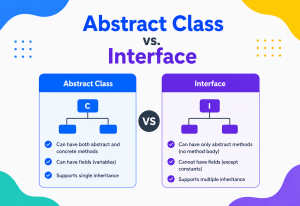
So far, every example has used inheritance — a child class overriding a method from its parent. But polymorphism doesn’t strictly require a family tree of parent and child classes at all. Many languages let completely unrelated classes share polymorphic behavior simply by agreeing to implement the same interface — a sort of contract that says “any class claiming to be this must provide these particular methods.”
This distinction matters more than it might first appear. Inheritance ties classes together in a strict, singular family line — in most languages, a class can only inherit directly from one parent. Interfaces are far more relaxed: a single class can honor several different interfaces at once, the same way a person can simultaneously be a parent, an employee, and a volunteer, fulfilling a different “contract” in each role without those roles needing to be related to one another at all. This flexibility is a big part of why modern architecture increasingly favors interfaces over deep inheritance chains when the goal is purely to enable polymorphic behavior.
Polymorphism via an Interface — no shared parent class requiredinterface Payable {
    void pay(double amount);
}

class CreditCardPayment implements Payable {
    public void pay(double amount) {
        System.out.println("Charged $" + amount + " to credit card");
    }
}

class PayPalPayment implements Payable {
    public void pay(double amount) {
        System.out.println("Sent $" + amount + " via PayPal");
    }
}

// Both classes can be treated identically, despite being unrelated:
Payable method = new CreditCardPayment();
method.pay(49.99);

method = new PayPalPayment();
method.pay(49.99);
CreditCardPayment and PayPalPayment don’t inherit from each other at all — they simply both agree to honor the Payable contract. This style of polymorphism is enormously popular in real architecture because it avoids forcing unrelated classes into an awkward, artificial family tree just to gain polymorphic behavior.
Some languages take this even further with an idea called duck typing, memorably summarized as: “if it walks like a duck and quacks like a duck, it’s treated as a duck.” In these languages, an object doesn’t even need to formally declare that it implements a particular interface — as long as it happens to have the right methods available, it can be used polymorphically, no formal contract required. Python is a well-known example of a language that embraces this looser, more flexible style.
Polymorphism Across Different Languages
The underlying idea of polymorphism is universal, but different languages express it with slightly different syntax and philosophy. Seeing the same “many animals, one sound instruction” example implemented a few different ways helps confirm that the pattern, not the punctuation, is the important part.
Python — Duck Typing, No Formal Interfaceclass Dog:
    def make_sound(self):
        return "Woof!"

class Cat:
    def make_sound(self):
        return "Meow!"

def announce(animal):
    print(animal.make_sound())

announce(Dog())   # Woof!
announce(Cat())   # Meow!
# Dog and Cat share no common parent class —
# they simply both happen to have make_sound().
C# — Explicit Interfaceinterface IAnimal {
    string MakeSound();
}

class Dog : IAnimal {
    public string MakeSound() => "Woof!";
}

class Cat : IAnimal {
    public string MakeSound() => "Meow!";
}

void Announce(IAnimal animal) {
    Console.WriteLine(animal.MakeSound());
}
JavaScript — Prototype-Based Polymorphismclass Dog {
  makeSound() { return "Woof!"; }
}

class Cat {
  makeSound() { return "Meow!"; }
}

function announce(animal) {
  console.log(animal.makeSound());
}

announce(new Dog());   // Woof!
announce(new Cat());   // Meow!
// JavaScript doesn't require a formal interface
// declaration at all — if the method exists, it works.
Notice how the strictness varies. C# insists, at compile time, that any class claiming to be an IAnimal must genuinely provide a MakeSound method, catching mistakes early. Python and JavaScript take a far more relaxed stance, trusting the object to have the right method available and only discovering a problem if it doesn’t, while the program is actually running. Neither approach is universally “better” — statically-typed languages tend to catch certain mistakes earlier, at the cost of a little more upfront ceremony, while dynamically-typed languages trade some of that early safety for faster, more flexible writing.
A Worked Case Study: A Notification System
Let’s design something real: a notification system for an app that needs to alert users through email, SMS text messages, and push notifications — and will very likely need to support new channels, like WhatsApp or Slack, sometime in the future.
Spot the repeating shape
Every channel needs to do fundamentally the same job — take a message and deliver it somewhere — even though the delivery mechanics differ completely underneath.
Name the shared contract
Define a single interface,
Notifier, with one method,send(message), that every channel agrees to honor.Let each channel implement it independently
Email, SMS, and push each get their own small class, focused only on their own specific delivery logic.
Write the calling code once, generically
The rest of the app only ever talks to the shared
Notifiercontract, never to any specific channel by name.
The Problem Without Polymorphism
A tempting first attempt might write one big function with a long chain of checks: “if the channel is email, do this; if it’s SMS, do that; if it’s push, do this other thing.” This works at first, but every single time a new channel gets added, that same central function has to be reopened and edited — a risky, error-prone habit, since it means old, already-tested code keeps getting disturbed.
This kind of long, ever-growing chain of checks has a well-known nickname among engineers — it’s often called a “switch statement smell” or an “arrow anti-pattern,” because the code visually creeps further and further to the right as more conditions pile up, and because it tends to accumulate small, easy-to-miss bugs every time someone squeezes in one more branch. Worse, every engineer who needs to add a new channel first has to read and fully understand the entire existing chain before safely adding to it, which slows the whole team down more and more as the chain grows longer over time.
The Polymorphic Redesign
Instead, we define one shared contract, Notifier, with a single method, send(message). Every channel — EmailNotifier, SmsNotifier, PushNotifier — implements that contract in its own way.
Notification System — designed around polymorphisminterface Notifier {
    void send(String message);
}

class EmailNotifier implements Notifier {
    public void send(String message) {
        System.out.println("Emailing: " + message);
    }
}

class SmsNotifier implements Notifier {
    public void send(String message) {
        System.out.println("Texting: " + message);
    }
}

class PushNotifier implements Notifier {
    public void send(String message) {
        System.out.println("Push alert: " + message);
    }
}

// The rest of the application stays untouched, forever:
void alertUser(Notifier channel, String message) {
    channel.send(message);
}

alertUser(new EmailNotifier(), "Your order shipped!");
alertUser(new SmsNotifier(), "Your order shipped!");
The alertUser function never needs to know or care which specific channel it’s handed — it just calls send() and trusts the object to do the right thing. Adding WhatsApp support later means writing one brand-new class, WhatsAppNotifier, that follows the same contract. No existing, already-tested code has to be reopened, re-read, or risked.
This exact pattern — a shared contract, with each real implementation plugged in independently — is precisely how professional architecture keeps large systems easy to extend, safely, over years of ongoing changes.
There’s a quieter benefit here too: testing gets easier. Because alertUser only ever depends on the general Notifier contract, it’s straightforward to create a lightweight, fake notifier purely for automated tests — one that simply records what it was asked to send, rather than actually emailing or texting anyone — and use that fake notifier to verify the rest of the application behaves correctly. This ability to swap in a test-only substitute, without changing the code being tested, is one of polymorphism’s most underrated everyday benefits, and it’s a big part of why well-architected systems tend to be so much easier to test thoroughly. Teams that build this habit early tend to spend far less time, months later, untangling code that was never designed to be tested in isolation in the first place.
Where Real Architecture Actually Uses This
Polymorphism isn’t just a tidy textbook idea — it’s genuinely load-bearing infrastructure inside some of the most widely used software in the world. Here are places it shows up constantly, often without anyone using the word “polymorphism” out loud.
One checkout, many processors
An e-commerce checkout calls a shared “charge” method, while Stripe, PayPal, and local bank processors each quietly handle the details their own way.
One operating system, many printers
Your computer’s “print” command works identically no matter which brand or model of printer is plugged in, because every driver honors the same shared contract.
One render() call, many widgets
Buttons, sliders, checkboxes, and dropdowns can all be told to “render yourself,” and each draws its own appropriate shape on screen.
One host app, endless plugins
Browsers, code editors, and design tools let outside developers write plugins that all honor a shared interface, so the host app never needs to know about each one specifically.
One query language, many databases
The same application code can often run against MySQL, PostgreSQL, or SQL Server with minimal changes, because each database driver implements a shared connection contract.
One update() loop, many characters
Every enemy, ally, and object in a game might share an “update yourself each frame” method, while each one moves and reacts in its own unique way.
One “open file” command, many formats
A document editor’s “open” button can hand off to a PDF handler, a Word handler, or an image handler, all triggered by the exact same click.
One login button, many identity systems
Signing in with Google, Apple, or a plain email and password all funnel through one shared “authenticate” contract behind the scenes.
Notice how consistently the same shape repeats across every one of these examples: some outer piece of the system — a checkout page, an operating system, a document editor — needs to work with a whole family of related-but-different things, and it would be genuinely impractical to hardcode knowledge of every single variation directly into that outer piece. Polymorphism is what allows the outer piece to stay simple and stable while the family of specific implementations grows and changes freely underneath it.
The same principle scales all the way up to distributed systems and microservices architecture. An API gateway sitting in front of a dozen backend services often treats every one of them polymorphically, routing a request based on a shared contract — a common request and response format — without needing bespoke logic for each individual service behind it. When a new service is added to the system, it simply needs to honor that same shared contract, and the gateway can route to it correctly without any changes to its own routing logic. At this scale, polymorphism stops being just a small coding technique and becomes a genuine organizing principle for how entire teams and services agree to communicate with one another.
A particularly elegant architectural pattern built almost entirely on this idea is called the Strategy Pattern. It lets a program swap out an entire algorithm — a sorting method, a pricing rule, a route-finding technique — at runtime, simply by handing it a different object that honors the same shared contract, with zero changes to the surrounding code. Ride-sharing apps use exactly this trick to swap between different pricing or routing strategies depending on the time of day, traffic conditions, or promotional campaigns running at that moment.
It’s worth pausing on just how much this quiet trick underpins the modern software you interact with daily, often without realizing it. Every time you plug a new accessory into your laptop and it “just works,” every time an app adds support for a new file type without an entirely new update, and every time a website supports logging in with Google, Apple, or a regular email and password using the exact same “login” button — there’s very likely a polymorphic design sitting underneath, quietly treating a family of genuinely different things as interchangeable, as long as they all agree to honor the same basic contract.
Everyday Analogies
Polymorphism is one of those ideas that’s genuinely everywhere once you start looking for it. Here’s a gallery of situations that all share the same underlying shape — the same instruction, or the same physical connector, producing appropriately different results depending on who or what is on the receiving end.
“Get Ready for School”
A parent gives the same instruction to every child, but each child interprets “get ready” a little differently based on their own age and habits.
USB Port
A single USB port accepts a mouse, a keyboard, or a flash drive — completely different devices, all honoring the same physical and electrical “contract.”
The Word “Book”
“Book a flight,” “book a table,” “read a book” — the same word takes different, specific meanings depending on the words surrounding it.
Traffic Signals
Every driver responds to the same red light with “stop,” but a cyclist, a car, and a bus each stop in their own particular way, suited to their own vehicle.
Electrical Wall Socket
A lamp, a phone charger, and a vacuum cleaner all plug into the same standard socket shape, even though what happens after plugging in is completely different for each.
A Coach’s Whistle
One short whistle blast might mean “stop,” while two blasts mean “huddle up” — the same tool, producing different meanings depending on how it’s used.
Job Titles
Tell an employee to “prepare the report,” and a designer, a writer, and an analyst will each carry out that same instruction using their own particular skills.
Vending Machine Buttons
Every button follows the same “press me and get a snack” contract, even though behind each button sits a completely different snack.
Notice a pattern across nearly all of these: the “interface” analogies (the plug shape, the whistle, the vending machine button) tend to describe situations with genuinely unrelated things sharing a physical or procedural contract, while the “overriding” analogies (the traffic signal, the parent’s instruction) describe a family of related things each interpreting a shared instruction through their own particular nature. Both patterns show up constantly in real software architecture, sometimes within the very same system, and recognizing which flavor you’re looking at is often the fastest way to decide whether inheritance or a plain interface is the better fit for a new piece of code.
Polymorphism vs. Its Sibling Pillars
Polymorphism is often introduced right alongside encapsulation, inheritance, and abstraction, and it’s easy to blur the four together. Each one answers a genuinely different design question, and confusing them tends to lead to muddled explanations in interviews and muddled designs in real projects alike. Here’s a clean way to separate them.
| Pillar | What It Really Answers | Quick Example |
|---|---|---|
| Encapsulation | How do I hide an object’s messy internal details? | A BankAccount hides its balance behind safe deposit and withdraw methods. |
| Inheritance | How do I reuse and extend an existing class? | A SavingsAccount reuses everything a general BankAccount already knows how to do. |
| Abstraction | How do I hide unnecessary complexity behind a simple interface? | A driver just calls startEngine(), without knowing anything about pistons or fuel injection. |
| Polymorphism | How do I let different objects respond to the same message in their own way? | Calling makeSound() produces a bark, a meow, or a chirp, depending on the real object. |
A particularly common mix-up is confusing polymorphism with inheritance. Inheritance is about a class reusing and extending another class’s structure and behavior — a family-tree relationship. Polymorphism is about what happens when a message gets sent to an object of an uncertain, general type — a behavior-at-the-moment-of-calling relationship. Inheritance is very often the mechanism that makes runtime polymorphism possible, but as the interface examples earlier in this guide showed, polymorphism can absolutely exist without any inheritance involved at all.
Don’t assume every subclass automatically means polymorphism is “happening.” Polymorphism specifically refers to the moment a shared method call resolves to different behavior depending on the actual object — not simply to the existence of a class hierarchy on its own.
A helpful way to hold all four pillars in mind at once: encapsulation protects an object’s privacy, inheritance lets one class borrow another’s blueprint, abstraction hides complexity behind a simple front door, and polymorphism lets many different objects walk through that same front door and each do their own appropriate thing once inside. They’re four separate tools, but in a well-designed system, they almost always show up working together rather than in isolation — a polymorphic interface is usually also nicely encapsulated, and often built on top of an inheritance relationship, all in service of a clean, abstracted design. Understanding each pillar on its own, and then seeing how naturally they cooperate, is really the whole journey of learning to think like an architect rather than just a programmer.

Strengths and Trade-offs
Like every architectural tool, polymorphism is a trade-off, not a free win. Understanding both sides helps you use it deliberately, rather than reaching for it out of habit.
It helps to picture this the way a professional kitchen thinks about specialized versus general-purpose tools. A single well-designed chef’s knife (a clean, polymorphic interface) can chop, slice, and dice almost anything you hand it, adapting its use case without needing a dozen separate, single-purpose gadgets cluttering the drawer. But that same flexible knife takes a bit more skill to wield well than a single-purpose tool built for exactly one job — and if it’s poorly balanced or poorly designed in the first place, its flexibility stops being an advantage and starts being a liability.
What polymorphism buys you
New behavior can be added by writing new classes, without touching or risking existing, tested code. Calling code becomes shorter and simpler, since it no longer needs long chains of type-checking logic. Systems become easier to extend by outside developers, through shared interfaces and contracts. Encourages designs that are naturally organized around what things can do, rather than what they technically are.
What it quietly costs
Can make it harder to trace, at a glance, exactly which specific method will run for a given line of code. Overusing inheritance purely to gain polymorphism can create deep, tangled class hierarchies that are hard to reason about. Slightly more indirection can make debugging feel less direct for newer engineers. Poorly designed interfaces can force unrelated classes into an awkward, ill-fitting shared contract.
In practice, most experienced teams find the benefits heavily outweigh the costs once a system grows past a certain size — the moment a codebase needs to support more than a handful of variations of the same basic idea, the long “if this type, then that behavior” chains that polymorphism replaces become genuinely painful to maintain by hand.
A useful rule of thumb for deciding when polymorphism earns its keep: if you can already picture at least two or three genuinely different variations of the same underlying idea, and you suspect more will show up over time, a shared interface and polymorphic design is very likely worth the small upfront investment. If there’s truly only ever going to be one way something behaves, adding polymorphism purely for its own sake tends to add ceremony without adding real value.
Common Mix-Ups Worth Avoiding
Even once the core idea clicks, a handful of habits can quietly undercut the benefits polymorphism is supposed to bring. Here are the ones worth watching for.
Thinking Polymorphism Means “Anything That Uses Classes”
Simply having multiple classes doesn’t automatically mean polymorphism is at work. The defining moment is specifically when the same method call, made through a general reference or interface, produces different behavior depending on the real underlying object.
Forgetting to Actually Override, and Accidentally Overloading Instead
A very common beginner slip is writing a method in a subclass that looks similar to the parent’s method but has a slightly different signature — different parameter types or count. Rather than overriding the parent’s behavior, this quietly creates a brand-new overloaded method instead, and the intended polymorphic behavior silently fails to happen. Most modern languages offer an explicit “override” marker specifically to catch this mistake early.
Building Deep Inheritance Chains Just to Enable Polymorphism
It’s tempting to reach for a long chain of parent, grandparent, and great-grandparent classes to share behavior. In most real systems, a flatter design built around small, focused interfaces tends to age far better than a deep inheritance tree, which can become fragile and confusing as it grows.
Assuming Polymorphism Always Requires Inheritance
As covered earlier, interfaces and duck typing prove this isn’t true. Two completely unrelated classes can be fully polymorphic with each other simply by honoring the same shared contract, with no shared ancestor class required at all.
Reaching for polymorphism on a problem that genuinely only has one or two fixed variations, and is unlikely to ever grow more, can add unnecessary structure. Simple problems sometimes deserve simple, direct solutions.
Most of these mix-ups share a common root: reaching for a technique because it’s familiar or feels sophisticated, rather than because the actual problem in front of you calls for it. A good habit is to ask, honestly, whether the variations you’re designing for are real and likely, or merely hypothetical. Designing flexibility for possibilities that never actually arrive is its own quiet form of wasted effort.
The healthiest approach, in nearly every case, is to let real, observed variation drive the design rather than imagined, future-proofed variation. Once you’ve genuinely seen two or three different versions of the same underlying idea show up in your codebase, that’s usually the right moment to introduce a shared interface and let polymorphism take over — not before, and not much later either.
Frequently Asked Questions
A few more questions that tend to come up once the core idea starts to feel familiar.
Is polymorphism the same thing as method overriding?
Method overriding is one specific technique used to achieve runtime polymorphism, but it’s not the entire concept. Polymorphism is the broader idea; overriding, overloading, and interface-based dispatch are all specific tools used to make it happen.
Does polymorphism slow programs down?
There’s a very small amount of extra work involved in runtime polymorphism’s dynamic lookup, but modern compilers and runtimes are heavily optimized for exactly this pattern. In the overwhelming majority of real applications, this cost is completely unnoticeable compared to the flexibility and maintainability it provides.
Can a method be both overloaded and overridden at the same time?
Yes. A class can offer several overloaded versions of a method, and a subclass can separately override one or more of those specific versions with its own implementation. The two techniques operate independently and can be combined freely.
What’s the difference between polymorphism and generics or templates?
Generics (or templates) let a single piece of code work with many different data types safely, often decided at compile time. Polymorphism, especially the runtime kind, is about different objects responding differently to the same call, decided while the program runs. The two ideas frequently work together but are solving slightly different problems.
Why is polymorphism considered so important for large systems specifically?
Large systems change constantly — new payment methods, new device types, new notification channels, new user roles. Polymorphism allows those additions to happen by introducing new, self-contained classes rather than editing shared, already-tested code, which dramatically lowers the risk of accidentally breaking something that used to work.
Do all programming languages support polymorphism the same way?
No — the core idea is universal, but the mechanics differ. Some languages lean heavily on class inheritance and explicit interfaces, while others, like Python, favor a more relaxed “duck typing” style where an object simply needs the right methods available, with no formal contract required.
Is polymorphism only useful in large, professional codebases?
Not at all — even small personal projects benefit the moment they need to handle more than one variation of the same idea. A simple to-do list app that supports both “personal tasks” and “work tasks” with slightly different behavior is already a small, perfectly reasonable use of polymorphism, well before the project grows into anything large.
What’s a simple way to explain polymorphism to someone completely new to programming?
Tell them to imagine giving the same instruction — “introduce yourself” — to a doctor, a chef, and a teacher at a party. Each one says “hi, I’m so-and-so” using the exact same instruction, but each answer sounds a little different because of who’s actually answering. That’s the whole idea, minus the code.
Glossary
A quick-reference collection of every important term used throughout this guide, gathered in one place so you can look any of them up again later without scrolling back through the whole article.
| Term | Definition |
|---|---|
| Polymorphism | The ability for different objects to respond to the same method call or message, each in its own specific way. |
| Method Overloading | Defining multiple methods with the same name but different parameters, resolved at compile time. |
| Method Overriding | A subclass providing its own specific version of a method already defined by its parent class, resolved at runtime. |
| Dynamic Dispatch | The process of deciding, while a program is running, which specific version of a method to actually execute. |
| Late Binding | Another name for dynamic dispatch — the method to run is “bound” late, during execution, not early, during compilation. |
| Interface | A contract that specifies which methods a class must provide, without dictating how those methods are implemented. |
| Duck Typing | A flexible style where an object can be used polymorphically simply by having the right methods, without formally declaring an interface. |
| Substitutability | The principle that a more specific object can safely stand in anywhere a more general type is expected. |
| Strategy Pattern | A design pattern that swaps entire algorithms at runtime by handing in different objects that honor the same shared interface. |
| Vtable (Virtual Method Table) | An internal lookup table many languages use to quickly find the correct overridden method to run for a given object. |
| Liskov Substitution Principle | A design guideline stating that subclasses should always be usable wherever their parent class is expected, without breaking expected behavior. |
| Parametric Polymorphism | Writing a single piece of code generic enough to correctly handle many different data types, often called generics or templates. |
Key Takeaways
We’ve covered a lot — barking dogs, notification systems, vtables, and vending machines. If just a few ideas stay with you, let it be these.
Remember This
- Polymorphism means one shared method name or interface can trigger different, specific behavior depending on the real object handling it.
- Compile-time polymorphism (overloading) is decided by reading the code alone; runtime polymorphism (overriding) is decided while the program actually runs.
- Runtime polymorphism works through dynamic dispatch — the program checks an object’s real type and runs that object’s own version of the method.
- Interfaces and duck typing prove polymorphism doesn’t strictly require inheritance or a shared family tree of classes.
- Real architecture leans on this constantly — payment gateways, device drivers, UI components, plugin systems, and database drivers all depend on it.
- The core payoff is extensibility: new behavior can usually be added by writing new, self-contained classes, without touching or risking code that already works.
The next time you’re designing a system that needs to support several similar-but-different variations of the same idea — payment types, notification channels, shapes, vehicles, file formats — pause and ask whether a shared contract and a bit of polymorphism could replace a long, brittle chain of “if this, then that” checks. More often than not, it can, and the resulting design will thank you the very first time someone needs to add just one more variation.
And the very next time you press “play” on any device, or plug anything into a USB port, or watch a “sign in with Google” button sit comfortably next to a plain email login form, take a small moment to notice it: that’s polymorphism, quietly working exactly as intended, asking nothing more of the thing it’s talking to than “can you do this one thing for me?” — and trusting it to answer in its own way.