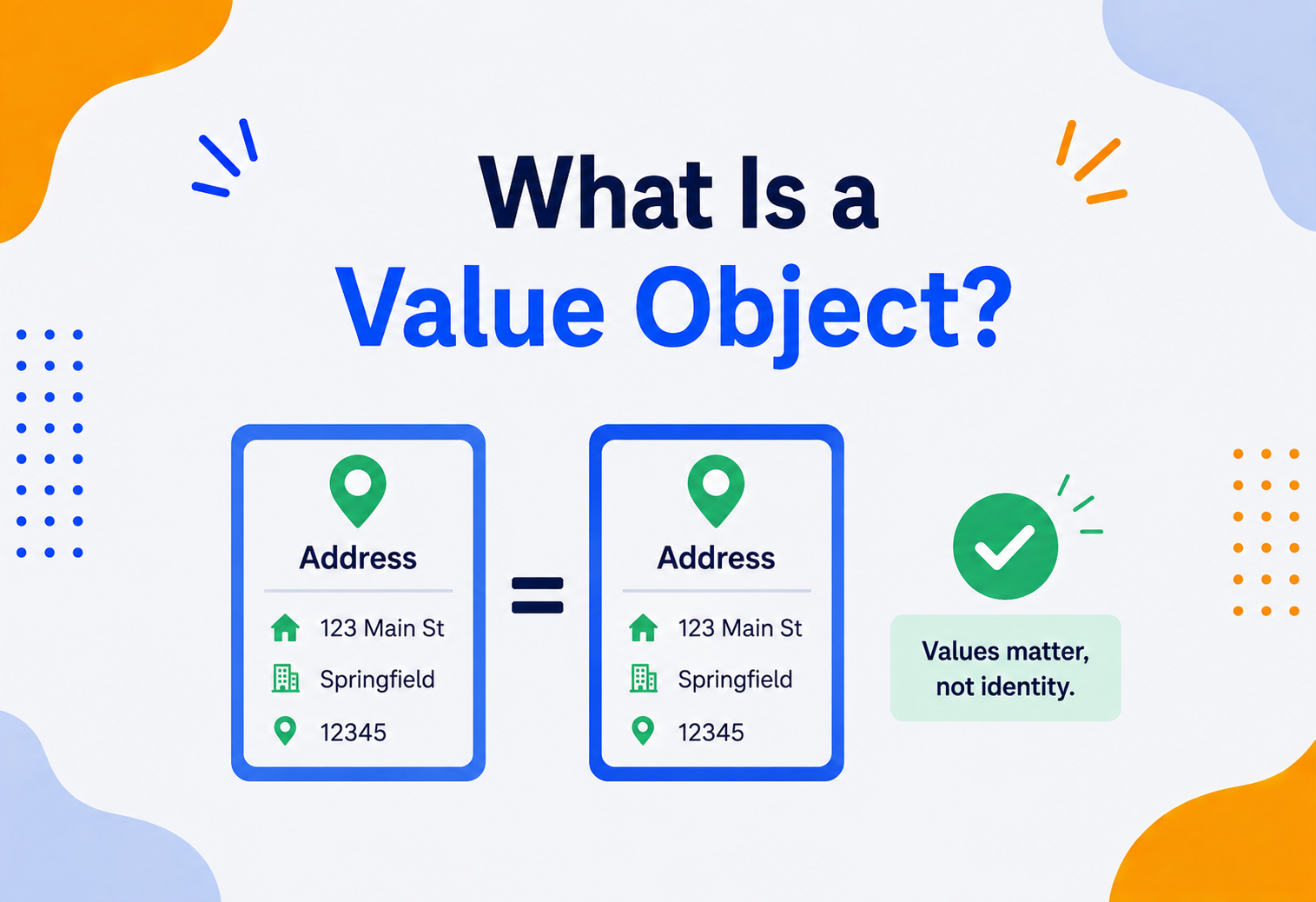
What Is a Value Object?
A calm, thorough walk through one of the most quietly powerful ideas in domain-driven design — objects that matter for what they say, not for who they are, and why that small distinction reshapes how well a system holds together.
The Big Idea, in One Breath
Picture two five-rupee coins sitting side by side on a table. Are they “the same coin”? In one very real sense, no — they are two separate, physical objects, minted at different times, perhaps carrying tiny scratches unique to each. But for absolutely every purpose that matters when you’re paying for something, the answer is a confident yes. Nobody checks a coin’s serial number before accepting it at a shop. Nobody cares which specific coin they get back in change. What matters is only the amount the coin represents — five rupees is five rupees, no matter which physical disc of metal happens to be carrying that value at the moment.
Now picture your own passport. Unlike the coin, your passport very much does have a specific identity — it belongs to you, uniquely, and even if someone printed an identical-looking passport with the exact same photo and details, it would still not be your passport. It has a history, a lifecycle, a specific document number that ties it to you and only you, through time.
That difference — a coin that only matters for the amount it represents, versus a passport that matters because of who it specifically, continuously belongs to — is exactly the distinction software designers draw between two different kinds of objects in their systems: value objects, which matter only for what they say, and entities, which matter for who or what they specifically, continuously are. This guide is entirely about the first kind, the coin-like objects, and about why treating them properly turns out to prevent a surprising number of bugs and a surprising amount of everyday confusion in real software.
Think about the number “seven.” There is only one number seven, conceptually — you don’t ask “which seven do you mean, the one from Monday or the one from Tuesday?” Seven is seven, everywhere, always, defined completely by what it equals. A value object works the same way: two value objects holding the exact same information are considered the very same thing, for every practical purpose, even though they might technically be two separate objects sitting in two separate places in a computer’s memory.
This distinction might sound almost too obvious to matter, the kind of thing that hardly seems worth a whole guide. And yet, in practice, an enormous number of real, everyday bugs in software trace directly back to blurring this exact line — treating something that should behave like the coin as though it behaves like the passport, or the other way around. Learning to spot the difference quickly, and to build code that reflects it honestly, turns out to be one of the more quietly powerful skills a software architect can develop.

What a Value Object Really Is
A value object is a small object in a software system that represents a piece of information purely through its attributes, with no separate identity of its own. Two value objects holding identical attributes are treated as completely, interchangeably equal — not merely similar, not merely “close enough,” but genuinely, fully equal, in exactly the same way that the number seven written in one place is equal to the number seven written somewhere else.
This stands in contrast to the more familiar habit, common in many codebases, of representing every piece of information as either a raw, primitive value — a plain number, a plain string of text — or as a full-blown object tracked by a unique identifier. A value object occupies a deliberate, useful middle ground: it is richer and more meaningful than a raw primitive, since it can carry its own rules and its own behavior, but it carries none of the weight of identity and lifecycle that comes with being tracked as a distinct, ongoing thing over time.
Matters for “What,” Not for “Which”
A useful shorthand, worth keeping in mind throughout this guide: a value object answers the question “what does this represent?” while deliberately never needing to answer the question “which specific one is this?” A sum of money, a date range, a set of geographic coordinates, a color, a physical measurement — none of these need their own unique tracking number to be useful. They simply need to correctly and completely describe what they are.
A value object doesn’t ask “am I the same object as you?” It asks “do we say the same thing?” If the answer is yes, they are equal, full stop, regardless of where in memory or in the system each one happens to live.
It is worth noting that many languages, especially those with roots in functional programming, treat this kind of value-based thinking as their natural default, rather than something a programmer needs to deliberately construct. In more traditional object-oriented languages, however, the default behavior usually leans the other way, comparing objects by their location in memory unless a programmer explicitly steps in and says otherwise. Understanding a value object, in large part, means understanding exactly which of these two defaults your particular language and tools are quietly assuming, and deliberately overriding that default whenever a genuine value concept is being represented.
Value Objects vs. Entities
The clearest way to understand a value object is to see it standing directly next to its natural counterpart: the entity. Where a value object is defined entirely by its attributes, an entity is defined by a persistent identity that continues through time, even as its attributes change around it.
| Question | Value Object | Entity |
|---|---|---|
| What defines equality? | Having the same attributes | Having the same identity |
| Can two “different” instances be equal? | Yes, if attributes match exactly | No, never — identity is unique |
| Does it have a lifecycle? | No — it simply exists, fully formed | Yes — it is created, changes, and eventually ends |
| Can it change after creation? | No — it is immutable | Yes — its attributes can change over time |
| Typical examples | Money, a date range, an email address | A customer, an order, a bank account |
A helpful test, echoing language used by the very people who popularized this distinction, is to notice how a requirement is phrased. If a requirement sounds like “this object should be considered the same as another if all of its attributes match,” that is a strong, direct signal you are dealing with a value object. If a requirement instead sounds like “we need to be able to track this specific one, even as its details change over time,” that is an equally strong signal you are dealing with an entity.
A customer named Priya Sharma who moves to a new address is still the exact same customer — her identity as an entity persists even though one of her attributes changed. A five-hundred-rupee amount, on the other hand, has no “self” that could move house. It simply is what it is.
This distinction turns out to matter far more than it might first appear, because it determines a genuinely practical, everyday engineering question: how should two instances of this concept be compared, stored, and cached throughout a system? Getting the answer wrong in either direction causes real trouble. Treating a genuine entity as though it were a value object risks accidentally treating two distinct customers as interchangeable simply because their current details happen to match. Treating a genuine value object as though it were an entity risks adding unnecessary identity tracking to something that never needed it, along with all the extra bookkeeping that tracking requires.
Where the Term Came From
The concept of the value object, as it is understood and taught today, was popularized in the early 2000s through two closely related, highly influential books. Martin Fowler introduced and described the pattern in his 2002 book on refactoring the architecture of enterprise applications, and the idea gained even wider recognition the following year, in 2003, when Eric Evans published his landmark book on domain-driven design, which classified every object in a software system’s domain model into a small handful of clear roles — among them, value objects and entities, standing in direct contrast to one another.
Evans’ framing proved especially influential because it tied the value-object concept directly to the deeper discipline of understanding a business domain properly before writing code. In his view, correctly recognizing which concepts in a system are values and which are entities was not just a technical implementation detail — it was a meaningful act of listening carefully to how a business actually talks about and thinks about the things it manages.
There is one small, historical wrinkle worth knowing, mostly so you are not confused if you encounter it in older material: in the late 1990s and early 2000s, a different, unrelated use of the same phrase, “value object,” circulated in some enterprise Java literature, referring instead to a simple object used to transfer data between different layers of a system. That older usage has mostly faded from common use today, largely replaced by the clearer term “data transfer object” for that particular purpose — but it is worth knowing the phrase once carried two different meanings, in case an older document or a longtime colleague still uses it that way.
It is worth appreciating just how much groundwork these two books did for the broader software industry, well beyond the specific value-object pattern this guide focuses on. Both books emerged from a shared, practical frustration with software systems that grew tangled and hard to reason about not because any single decision was obviously wrong, but because nobody had taken the time to carefully distinguish the different kinds of things a system was actually modeling. Naming the value-object pattern clearly, and giving engineers a shared vocabulary to discuss it, turned what had previously been a vague, half-formed instinct many experienced developers already had into something that could be taught, discussed, and deliberately applied by an entire team, rather than relying on one senior engineer‘s private intuition.

The Building Blocks, Side by Side
A picture makes this contrast easy to hold in mind. Below, the left side shows an entity — a customer — surrounded by a few value objects it depends on. The right side zooms in on how two separately created value objects, holding identical information, are considered fully equal.
Notice how the entity on the left is really just a stable, ongoing identity with a collection of value objects attached to it. If the customer moves house, the Address value object gets swapped out for a brand-new one — the old address is simply discarded, and a fresh one takes its place. The customer’s identity, Customer #4471, never changes through any of this. This is one of the most common, natural, and useful shapes a well-designed domain model takes: a small number of long-lived entities, each surrounded by a cluster of value objects describing their current state.
On the right side of the diagram, notice something equally important: nothing about the connection between the two Money instances requires them to have ever met, or to know anything about each other’s existence. One might have been created moments ago by a payment service; the other might have been sitting in a database record for months. Neither history matters at all to the comparison — only the content, at the moment of comparison, matters. This complete independence from history and origin is part of what makes value objects so pleasant to work with across large, distributed systems, where two pieces of data describing the same underlying fact might genuinely arrive from entirely different places.
The Defining Traits
Four traits, taken together, are what make an object a genuine value object rather than something merely value-object-shaped.
Equality by Value
Two value objects are equal exactly when all of their attributes match, regardless of whether they are, technically, two separate objects sitting in two separate places in memory. This is usually implemented by deliberately overriding a language’s default equality check, which normally only asks “are these the exact same object in memory?”
Immutability
A value object never changes after it is created. Any “update” produces a brand-new value object, leaving the original completely untouched — the same discipline covered in detail in this series’ dedicated guide on immutability, and one of the most important traits a value object carries.
No Conceptual Identity
A value object has no unique tracking number, no lifecycle, and no sense of “which one.” It simply exists, fully described by its attributes, the moment it is created.
Self-Validation
A well-built value object refuses to be created in an invalid state at all. Rather than allowing a nonsensical value — a negative amount of money, an impossible date range — to exist and be discovered as broken later, the value object’s own constructor checks and enforces its rules the moment it is built.
These four traits reinforce one another. Because a value object cannot change, its validity only ever needs to be checked once, at creation. Because it has no identity, comparing two of them is as simple as comparing their contents directly.
It is worth treating these four traits as a checklist rather than a loose collection of nice-sounding ideas. In practice, missing even one of them tends to unravel the benefits of the others. A value object with equality by value but no immutability can silently become invalid for a comparison that succeeded a moment earlier. A value object that is immutable and self-validating but still compared by memory location loses the very equality guarantee that made it worth building in the first place. All four traits, working together, are what actually deliver the reliability this pattern promises.
Why Value Objects Matter So Much
It helps to be concrete about what disciplined use of value objects actually earns a team, since the benefits are easy to nod along to abstractly and far more convincing spelled out plainly.
Impossible values become impossible
Once a value object enforces its own rules at creation, an invalid instance of it simply cannot exist anywhere in the system.
Code that reads like the business talks
A method that accepts an EmailAddress rather than a plain string of text communicates its intent far more clearly, to both readers and reviewers.
Related logic lives in one place
Rules about how money should be added, or how two date ranges overlap, live inside the value object itself, rather than being scattered across every place that happens to use raw numbers or strings.
No unexpected shared changes
Because value objects are immutable, they can be freely passed around a system without any risk of one part accidentally changing something another part still depends on.
There is also a subtler, longer-term benefit worth naming directly: a codebase that uses value objects consistently tends to make entire categories of bugs structurally impossible, rather than merely less likely. A raw floating-point number representing money can be added, subtracted, or compared against a completely unrelated raw number with no warning at all, since the language has no way of knowing those numbers were never meant to mix. A properly built Money value object can refuse, outright, to be combined with a different currency, catching a whole category of financial bugs at the exact moment they would otherwise be introduced.
There is a genuine business case underneath all of this worth stating plainly, particularly for anyone who needs to justify the extra design effort to people outside engineering. Bugs caused by mishandled money, addresses, or dates are rarely small — they tend to surface as refund disputes, misdelivered shipments, or compliance failures, each carrying real cost and real reputational risk. A small amount of upfront discipline in modeling these concepts properly, as value objects with built-in rules, is a remarkably inexpensive form of insurance against exactly this category of expensive, embarrassing mistake.

A value object doesn’t just hold data — it holds the rules that make that data trustworthy.
A Worked Example: Feeling the Difference
Let’s walk through a small, realistic scenario twice — once representing money as plain, raw numbers, and once wrapping that same idea in a proper value object — so the contrast becomes something you can actually feel while reading code.
Money as Raw Primitives
Money represented as plain numbers and stringsclass Invoice {
    double amount;
    String currency;

    void addLateFee(double feeAmount, String feeCurrency) {
        // Nothing stops someone from accidentally mixing currencies here.
        this.amount = this.amount + feeAmount;
        // feeCurrency is silently ignored - a real bug waiting to happen.
    }
}

// Elsewhere in the codebase, completely unrelated code:
double total = invoice.amount + shippingCost;  // shippingCost might be a different currency!
if (total < 0) { /* how did a negative invoice even get created in the first place? */ }
Money as a Proper Value Object
Money that enforces its own rulesfinal class Money {
    private final long minorUnits;   // stored in the smallest unit, e.g. paise
    private final String currency;

    Money(long minorUnits, String currency) {
        if (minorUnits < 0) throw new IllegalArgumentException("Money cannot be negative");
        if (currency == null) throw new IllegalArgumentException("Currency is required");
        this.minorUnits = minorUnits;
        this.currency = currency;
    }

    Money add(Money other) {
        if (!this.currency.equals(other.currency)) {
            throw new IllegalArgumentException("Cannot add different currencies");
        }
        return new Money(this.minorUnits + other.minorUnits, this.currency);
    }

    @Override
    public boolean equals(Object obj) {
        if (!(obj instanceof Money)) return false;
        Money m = (Money) obj;
        return this.minorUnits == m.minorUnits && this.currency.equals(m.currency);
    }
}

class Invoice {
    private Money amount;
    void addLateFee(Money fee) {
        this.amount = this.amount.add(fee);   // impossible to silently mix currencies
    }
}
In the first version, nothing in the code itself prevents a currency mismatch, a negative total, or a silently dropped currency code — every one of those mistakes is left entirely to the discipline of whoever happens to be writing code that touches an invoice, today or five years from now. In the second version, the Money class itself refuses to allow any of those mistakes to happen. The rules live exactly once, inside the value object, rather than needing to be remembered and re-implemented correctly everywhere money is handled throughout the codebase.
This is a direct, practical instance of the DRY principle discussed elsewhere in this series — the knowledge of “what makes a valid amount of money” lives in exactly one authoritative place, rather than being repeated, and potentially forgotten, everywhere money is touched.
It is also worth noticing how much more the second version communicates simply by existing. A reviewer glancing at the Money class’s constructor immediately understands every rule an amount of money in this system must satisfy, without needing to trace through every place money happens to be used across the codebase. This kind of self-documenting clarity is one of the quieter, easy-to-overlook benefits of building proper value objects — the rules are not just enforced, they are also visible, gathered together in one obvious place for anyone who needs to understand them.
Techniques for Building Value Objects
Building a solid value object is a repeatable, learnable habit. A few concrete techniques show up again and again across languages and codebases.
Override Equality Based on Attributes
Most languages default to comparing objects by their location in memory, not their contents. Overriding this default, so two value objects compare equal exactly when their attributes match, is the single most essential technical step in building one.
Make Every Field Immutable
Every field should be set once, at construction, and never changed afterward. Any operation that would traditionally “modify” the value object should instead return a brand-new instance, as shown in the Money.add example above.
Validate Everything in the Constructor
Since a value object can never be repaired after the fact, every rule it must satisfy needs to be checked completely, once, at the moment it is created. This guarantees that every instance of the value object that exists anywhere in the system is, by construction, valid.
Give It Behavior, Not Just Data
A well-designed value object is not merely a bundle of fields — it carries the operations that naturally belong with the concept it represents, such as adding two amounts of money together, or checking whether one date range overlaps with another.
Name It After the Domain Concept, Not the Data Type
Calling something EmailAddress rather than String immediately communicates intent to every future reader, and gives the compiler a chance to catch mistakes, like accidentally passing a phone number where an email address was expected, that raw primitive types simply cannot catch.
Building a value object is really about taking a concept that used to be a loose, unguarded primitive, and giving it a proper home — one with rules, behavior, and a name that actually says what it means.
Many modern languages have also begun offering built-in shortcuts for much of this ceremony, recognizing just how common the value-object pattern has become in everyday software design. Features that automatically generate value-based equality, or that make immutable data structures simple to declare with minimal boilerplate, have quietly lowered the cost of doing this properly, which is part of why the pattern has continued spreading well beyond its original home in domain-driven design circles into everyday, mainstream software engineering.
Value Objects and Immutability
Immutability is not merely a nice-to-have feature of value objects — it is close to the very core of what makes the pattern work at all. Because a value object is compared by its content, allowing it to change after creation would quietly undermine the entire idea of equality it is built around: an object that was equal to another a moment ago could silently stop being equal, or start being equal to something new, with no clear signal to anyone relying on that comparison.
There is a particularly dangerous version of this problem worth calling out directly: many collections and lookup structures rely on an object’s content staying fixed once the object has been added, in order to find it again quickly later. A value object that were allowed to change after being placed into such a structure could become permanently, invisibly lost — still technically present, but no longer findable, because its content no longer matches what the structure expects to see. Strict immutability closes this danger completely, by making the scenario impossible in the first place.
A “value object” with a setter method quietly bolted onto it. The moment a value object can be changed after creation, it has stopped being a genuine value object and become something closer to a small, disguised entity — with all of the coordination hazards that come with mutable, shared state.
This close relationship between value objects and immutability is precisely why the two topics naturally sit side by side in a well-rounded understanding of software design. Immutability, covered in its own dedicated guide elsewhere in this series, is a broad discipline that applies to many kinds of data throughout a system. Value objects are, in a sense, one of the most natural and productive places to apply that broader discipline — a category of object where immutability is not merely helpful, but genuinely load-bearing for the pattern’s core promise of trustworthy, content-based equality.

Common Value Object Examples
Once you start looking for them, potential value objects tend to appear in nearly every domain a piece of software might model.
An amount and a currency
Carries its own rules about adding, comparing, and formatting, and refuses to mix incompatible currencies.
A start and an end
Can check overlap with another range, calculate its own duration, and refuses to allow an end date earlier than its start.
Street, city, postal code
Two addresses with identical details are the same address, regardless of which order or database record they came from.
Latitude and longitude
Can calculate distance to another coordinate, and refuses values outside the valid geographic range.
A validated string, with meaning
Refuses to be constructed from text that doesn’t look like a genuine email address, catching a whole class of bad data at the door.
Red, green, blue values
Two colors with identical component values are the same color, and the object can offer useful behavior like blending or contrast checking.
Notice a common thread running through every example: none of them need a unique tracking number to be useful, and all of them benefit meaningfully from carrying their own validation and behavior, rather than being passed around as loose, unguarded primitive values scattered throughout a codebase.
It is worth noticing, too, how often these examples appear in more than one domain at once. A Money value object built for an e-commerce checkout might be equally useful in a payroll system, a budgeting tool, or a donation platform, since the underlying rules of what makes an amount of money valid rarely change from one business context to another. This reusability is a quiet, secondary benefit of investing in a well-designed value object once, carefully, rather than reinventing similar validation logic separately in every new project that happens to need it.
Value Objects Inside Entities
In practice, value objects rarely stand entirely alone — they are most often found living inside entities, describing some aspect of that entity’s current state. An Order entity, tracked over time by a unique order number, might hold a Money value object for its total, a DateRange value object for its delivery window, and an Address value object for where it should be shipped.
This combination is one of the most productive, natural shapes a well-designed domain model takes. The entity provides the stable, ongoing identity a business genuinely needs to track — “this specific order, from creation to delivery” — while the value objects inside it provide rich, self-validating, well-behaved descriptions of the entity’s current state, each one free to be swapped out for a new version entirely whenever that particular aspect of the entity changes.
When an order’s delivery address changes, the Order entity’s identity does not change at all — only the Address value object it currently holds gets swapped out for a new one. The entity stays the same order throughout, even as several of the values inside it come and go.
This pattern also explains why value objects are often described as forming the descriptive “flesh” around an entity’s stable identity “skeleton.” The skeleton persists through the entity’s entire lifecycle, giving the business a reliable way to keep track of a particular thing over time, while the flesh — the value objects — can be entirely replaced, piece by piece, as the entity’s real-world state genuinely evolves.
This layered structure also has a practical benefit worth calling out for anyone designing how such a system persists its data: because value objects have no identity of their own, they typically do not need their own separate storage record, tracked independently from the entity that holds them. They can usually be stored directly alongside the entity’s own data, embedded as part of it, which keeps the overall data model simpler than it would be if every small descriptive detail were mistakenly promoted to its own independently tracked entity.
When Something Should Be an Entity Instead
Not every concept in a domain deserves to be a value object, and recognizing the boundary matters just as much as recognizing a genuine value object when you see one.
A lifecycle that matters
If a business genuinely needs to say “this is the same one as before, even though its details have changed,” that is a strong signal pointing toward an entity.
Past states matter
If understanding how something got to its current state — not just what that state currently is — matters to the business, an entity’s persistent identity is usually the better fit.
Twins are still two people
Two customers who happen to share the exact same name and address are still two distinct customers, which is the clearest possible sign of entity behavior rather than value behavior.
One shared, evolving thing
If many different parts of a system need to refer to the exact same, specific instance of something, and expect to see the same updates reflected everywhere, that points toward an entity.
A genuinely useful habit, echoing the advice of domain-driven design’s own practitioners, is to stay alert for requirement language that quietly reveals which kind of object you are dealing with. Watch especially for status fields — “pending,” “active,” “cancelled” — or words like “current” and “latest,” since these almost always signal that an object has a lifecycle worth tracking, and therefore probably deserves to be an entity rather than a value object.
It is worth remembering that this decision is not always permanent or obvious on the first attempt. Domain understanding tends to deepen over the life of a project, and a concept initially modeled as a value object sometimes turns out, once real requirements become clearer, to actually need identity tracking after all — or the reverse, where something initially given an identity turns out to have never needed one. Treating this classification as a considered, revisitable design decision, rather than a one-time judgment carved in stone, tends to serve a project far better over its full lifetime.

The Primitive Obsession Trap
The habit value objects exist to cure has its own well-known name: primitive obsession, the tendency to represent every piece of domain information using only a language’s basic built-in types — plain numbers, plain strings, plain booleans — even for concepts that genuinely deserve their own dedicated, meaningful representation.
Primitive obsession feels harmless at first, because each individual use of a raw number or string looks perfectly reasonable in isolation. The trouble accumulates slowly: a phone number represented as a plain string can be assigned an email address by mistake, since both are just strings to the compiler. A discount percentage represented as a plain number can be accidentally added to a price instead of multiplied, since both are just numbers with no memory of what they were supposed to represent. None of these mistakes trigger any warning, because the underlying type system has no way of knowing these values were never meant to be interchangeable.
A function signature with several consecutive parameters of the exact same primitive type — several strings in a row, or several numbers in a row. This is one of the clearest, most common signs of primitive obsession, since it becomes trivially easy to accidentally pass arguments in the wrong order without any error being raised.
Value objects cure this directly, by giving each distinct concept its own dedicated type. A function that accepts an EmailAddress and a PhoneNumber, rather than two plain strings, makes it structurally impossible to accidentally swap the two — the mistake is caught immediately, often before the code is even run, rather than discovered later as a confusing, hard-to-trace bug in production.
Recognizing primitive obsession in an existing codebase often starts with a simple exercise: pick any function with several plain string or number parameters, and ask, honestly, whether a future teammate unfamiliar with the code could reliably call it correctly on the first try, based purely on the parameter list, with no comments to guide them. If the honest answer is no, that function is very likely a candidate for one or more value objects, and addressing it sooner rather than later tends to save real, measurable debugging time down the road.
A Recipe for Extracting a Value Object
When you notice primitive obsession creeping into an existing codebase, here is a calm, methodical way to introduce a proper value object without disrupting everything at once.
As with most of the refactoring recipes throughout this series, the emphasis here is on gradual, verified progress rather than a single sweeping rewrite. Extracting a value object touches many call sites across a codebase, and moving through them steadily, with tests confirming correctness at each step, keeps the effort low-risk even in a large, actively developed system.
Name the concept clearly
Give the scattered primitive values a proper domain name —
Money,EmailAddress,DateRange— based on what the business actually calls the concept.Create the class with validation built in
Write the new value object’s constructor to enforce every rule the concept must always satisfy, rejecting anything invalid immediately.
Add equality based on content
Override the default equality behavior so two instances with matching attributes are treated as fully equal.
Move related behavior into the class
Find logic scattered elsewhere in the codebase that really belongs to this concept — adding two amounts, checking overlap — and relocate it into the new value object.
Replace primitive usages one at a time
Gradually update function signatures and fields across the codebase to use the new value object instead of the raw primitive, verifying with tests at each step.
Delete the now-redundant scattered checks
Once every usage has been updated, remove the duplicated validation logic that used to be scattered across the codebase, since it now lives in exactly one place.
This recipe rarely needs to happen all at once. Most teams extract one value object at a time, starting with the concept causing the most visible pain, and let the pattern spread gradually as its benefits become obvious.
Side-by-Side Comparison
After walking through so many angles of this idea, it helps to see the practical differences summarized together in one place.
| Aspect | Raw Primitive | Value Object |
|---|---|---|
| Validation | Scattered, easy to forget in one spot | Centralized in one constructor |
| Accidental misuse | Easy to mix up with similar primitives | Caught immediately by the type system |
| Related behavior | Scattered across many unrelated functions | Lives inside the value object itself |
| Readability | Intent must be inferred from names and comments | Intent is stated directly by the type |
| Equality | Compares raw values with no domain meaning | Compares meaningfully, as the domain concept |
| Best suited for | Genuinely simple, low-risk, rarely reused values | Meaningful domain concepts with real rules attached |
As with the balanced guidance offered throughout this series, this table is not an argument for wrapping every last variable in a dedicated class. It is a reflection of where the pattern earns its keep most clearly: concepts that carry genuine business rules, genuine risk of confusion, or genuine reuse across a codebase, all of which are common in real, growing systems far more often than they might first appear.
Common Pitfalls
Even teams genuinely convinced of the pattern’s value run into a handful of recurring traps when actually applying it. Knowing them in advance makes them far easier to avoid.
Forgetting to Override Equality
A class that looks like a value object but still relies on a language’s default, identity-based equality check will quietly fail every comparison that should have succeeded, since two objects with identical content will not be recognized as equal without this step explicitly implemented.
Letting Mutability Sneak In
A single setter method added “just for convenience” quietly breaks the equality guarantees a value object is meant to provide, as discussed earlier in this guide.
Turning Every Value Object Into a Tiny Entity
Adding an internal, hidden identifier to a value object “just in case,” even though nothing in the domain actually requires tracking a specific instance over time, undermines the simplicity the pattern is meant to provide.
Over-Applying the Pattern to Genuinely Simple Values
Not every single number or string in a codebase needs to become a dedicated value object. Wrapping a value that carries no real rules and no real risk of confusion, purely for the sake of following the pattern, can add unnecessary ceremony without a matching benefit.
A value object that has grown its own internal identifier field, seemingly “just to be safe.” That single addition quietly transforms it from a true value object into something closer to a disguised entity, undoing much of the simplicity the pattern was meant to provide.
What unites all four of these pitfalls is a shared theme: the value-object pattern is precise, and its benefits depend on that precision being maintained consistently. A slight drift in any one direction — a missing equality override, a stray setter, an unnecessary identifier, or ceremony applied where it isn’t needed — quietly erodes the very qualities that made the pattern worth adopting in the first place. Treating the four defining traits from earlier in this guide as a firm checklist, rather than a loose set of suggestions, is the most reliable way to avoid all four pitfalls at once.
A Few More Real-World Analogies
Two hundred-rupee notes
Two separate hundred-rupee notes are worth exactly the same amount — nobody cares which specific physical note they end up with in change.
Paint chips at a hardware store
Two paint chips labeled with the exact same shade code represent the exact same color, no matter which specific chip you happen to be holding.
A measurement of flour
Two cups of flour are two cups of flour, regardless of which bag they came from — the measurement itself carries all the meaning that matters.
Three o’clock in the afternoon
Three o’clock today and three o’clock, described the same way, on any other day both represent the identical concept of “three in the afternoon” — a time of day has no ongoing identity of its own.
Think about a shipping label describing a package’s weight and size. Two entirely different packages could carry identical labels — “two kilograms, thirty by twenty by ten centimeters” — and for the purposes of calculating shipping cost, they are treated as exactly, interchangeably equal, even though the actual packages inside are completely different physical objects sitting in different warehouses. The label is a value. The package itself, tracked by its own unique tracking number from the moment it is created to the moment it is delivered, is an entity. Software built around value objects makes this same, natural distinction explicit in code.
What ties every analogy in this section together is the same underlying pattern this entire guide has circled back to again and again: the world outside of software already sorts things naturally into “what it says” and “who it specifically is,” long before any of us learned to write code. Value objects simply give that same, deeply familiar sorting a proper, disciplined home inside a software system, rather than leaving it as an unspoken, easily forgotten assumption.
Frequently Asked Questions
Do value objects need to be immutable, or is that just a best practice?
Immutability is considered essential, not optional. Without it, the equality-by-content guarantee that defines a value object can be silently undermined, since a value object’s content could change after it has already been compared or stored somewhere relying on that content staying fixed.
Can a value object contain other value objects?
Yes, and this is common. A larger value object, like an Address, might be composed of smaller value objects, like a PostalCode, each with its own validation and behavior.
How is a value object different from a data transfer object?
A data transfer object exists purely to carry data between different layers or systems, usually with little or no behavior and no strong equality guarantees. A value object represents a genuine domain concept, carries meaningful behavior, and enforces equality based on its content. The two names were sometimes confused in older literature, but today they refer to different things.
Is it ever acceptable to give a value object an internal ID for database purposes?
This is a common practical tension, since many databases expect every row to have a primary key. A frequent solution is to let the database use a technical, internal identifier purely for storage purposes, while keeping the value object’s actual equality and behavior based entirely on its real attributes, never on that internal storage identifier.
Where did the term “value object” actually come from?
It was introduced by Martin Fowler in his 2002 book on enterprise application architecture, and it became far more widely known the following year through Eric Evans’ influential 2003 book on domain-driven design, which formally classified domain objects into value objects and entities.
Do value objects have any downsides?
They introduce a small amount of additional code and a little more upfront design thought compared to simply using raw primitives. For genuinely simple, low-risk values with no real rules attached, this extra structure may not be worth the effort — the pattern earns its keep most clearly for concepts that carry real business rules or real risk of confusion.
Glossary
A short reference of the terms used throughout this guide, useful to revisit whenever a design conversation with your own team turns to modeling domain concepts.
| Term | Definition |
|---|---|
| Value Object | An object defined entirely by its attributes, equal to any other value object with matching attributes, and immutable once created. |
| Entity | An object defined by a persistent identity that continues through time, even as its attributes change. |
| Equality by Value | Comparing two objects based on whether their attributes match, rather than whether they are the exact same object in memory. |
| Primitive Obsession | The habit of representing meaningful domain concepts using only raw, basic types like plain numbers and strings. |
| Domain-Driven Design | An approach to software design centered on closely modeling the real concepts and rules of a business domain, formalized by Eric Evans. |
| Aggregate | A cluster of related entities and value objects treated as a single unit for the purposes of data changes. |
| Self-Validation | The practice of an object enforcing its own rules at the moment of creation, preventing an invalid instance from ever existing. |
| Data Transfer Object | A simple object used to carry data between layers or systems, distinct from a true value object, though the two names were once confused. |
Key Takeaways
This guide has traveled from a simple coin-versus-passport analogy through domain-driven design history, immutability, and primitive obsession, all circling the same underlying distinction. The list below distills everything into what’s most worth carrying forward.
Remember This
- A value object is defined entirely by its attributes — two value objects with matching attributes are considered fully, interchangeably equal.
- Value objects were popularized by Martin Fowler in 2002 and formalized by Eric Evans in his 2003 domain-driven design work, standing in direct contrast to entities.
- Entities are defined by a persistent identity that continues through time; value objects are defined purely by what they currently say.
- Immutability is essential to a value object, not optional — it protects the equality-by-content guarantee the whole pattern depends on.
- Value objects cure “primitive obsession,” the habit of representing meaningful domain concepts with unguarded raw numbers and strings.
- Well-built value objects validate themselves completely at creation, making invalid instances structurally impossible rather than merely unlikely.
- Value objects and entities work together naturally — entities provide stable identity, while value objects describe their current, ever-replaceable state.
- Not every value in a system needs to become a dedicated value object; the pattern earns its keep for concepts that carry real business rules or real risk of confusion.