What Is Spaghetti Code?
Picture a plate of spaghetti — pull on one strand, and three others move with it, looping under and over each other in ways you can’t quite trace back to their start. Now imagine that plate is actually a piece of software. That tangled, impossible-to-follow mess has a name every programmer knows on sight: spaghetti code.
The Big Idea, in One Breath
Think about a drawer full of tangled headphone cables and phone chargers, all knotted together after months of being tossed in without a second thought. Untangling just one cable means following it back and forth through the whole knotted mess, looping under three other cords before you finally find its other end. Nobody planned for the drawer to end up this way — it happened one quick, careless toss at a time.
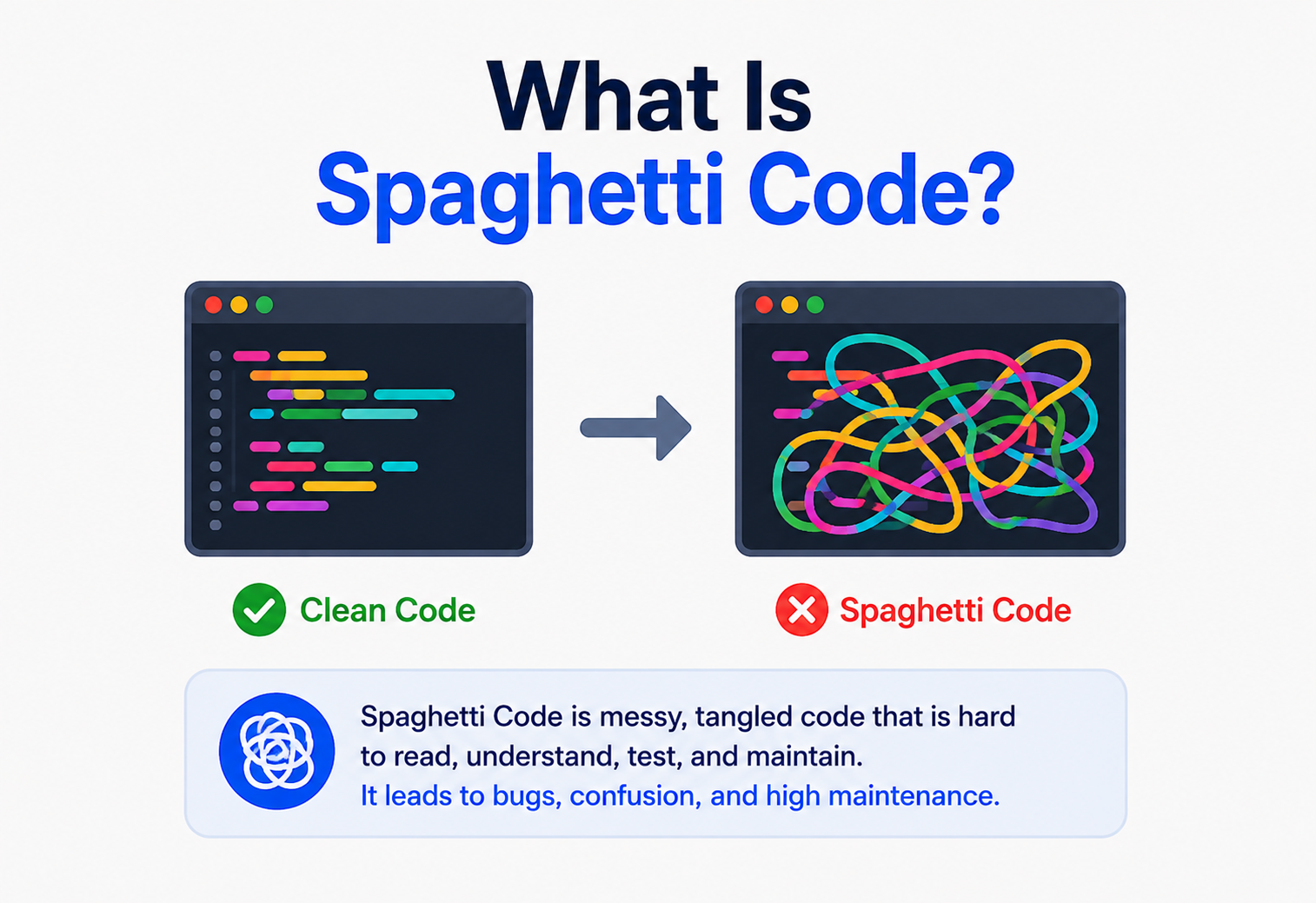
Spaghetti code is that tangled drawer, written in a programming language. It’s a nickname for source code with such a messy, disorganized structure that following the logic from start to finish feels like tracing one strand of spaghetti through an entire tangled plate — technically possible, but exhausting, error-prone, and never quite as simple as it should be.
Picture a choose-your-own-adventure book where, instead of clean page references like “turn to page 42,” the instructions constantly send you flipping backward, forward, and sideways — “go to page 12, unless you already read page 30, in which case skip to page 88, but only if you haven’t already visited page 5.” Reading it in order tells you almost nothing, and following any single thread means constant, dizzying jumps all over the book. That’s the reading experience of spaghetti code — the logic exists, but it refuses to sit still long enough to be followed comfortably.
Importantly, spaghetti code isn’t about a program being wrong or broken — plenty of spaghetti code runs perfectly well and has for years. The problem is entirely about how hard it is for a human being to read, trust, and safely change. It’s a mess of structure, not necessarily a mess of correctness, which is exactly what makes it so easy to accumulate without anyone noticing until it’s already deeply tangled.
There’s a reason the food metaphor stuck so well, beyond just being memorable. Spaghetti on a plate isn’t inherently bad — it’s delicious, and every strand individually cooked correctly. The problem only appears the moment you try to follow one single strand from end to end, which is exactly the moment a programmer needs to trace one specific piece of logic through a tangled codebase. The metaphor captures something genuinely precise: the issue was never any single ingredient, it’s how everything got wound together.
What Spaghetti Code Really Is
Formally speaking, spaghetti code is source code with a complex, tangled control flow, so poorly structured and so densely interconnected that it becomes extremely difficult to trace, understand, test, or safely modify. The “control flow” part of that definition matters — it refers to the path a program actually takes as it runs, jumping between conditions, loops, and function calls. In spaghetti code, that path twists unpredictably, with little regard for a clean, logical structure a reader could follow at a glance.
Two ideas anchor this concept, and they’re worth holding onto through the rest of this guide:
- It’s about structure, not correctness. Spaghetti code can technically work correctly for years — the harm lies entirely in how difficult it is to read, trust, and safely change.
- The tangle is what defines it. A single long function isn’t automatically spaghetti code. It becomes spaghetti code specifically when its internal logic jumps around unpredictably, with unclear, criss-crossing dependencies.
If someone asks “what’s spaghetti code?”, the honest short answer is: it’s code so tangled that even the person who wrote it struggles to explain, six months later, exactly how one part connects to another.
It’s worth noting that spaghetti code and the God Object anti-pattern often show up together, but they describe two genuinely different problems. A God Object is about one class carrying too many unrelated responsibilities. Spaghetti code is about the internal flow of logic being tangled and hard to trace, which can happen inside a small function just as easily as inside a giant class. A codebase can have one problem without the other, though in practice, a sufficiently messy system often develops both at once.
It’s also worth being fair to the term’s limits. “Spaghetti code” is a genuinely useful, widely understood description, but it’s an informal one — there’s no official test a piece of code has to fail to earn the label, unlike a specific measurable metric. Two experienced engineers can occasionally disagree about whether a particular function has crossed the line into spaghetti territory or is merely a bit complex for a legitimately complex problem. That fuzziness doesn’t make the term useless — it just means it works best as a shared, intuitive description rather than a precise, objective measurement.

Where the Term Came From
The phrase “spaghetti code” traces back to the early days of programming, when a now-infamous instruction called GOTO let a program jump directly from any line of code to almost any other line, anywhere else in the program, with no requirement to explain why or follow any predictable structure. Used sparingly, GOTO was a genuinely useful tool. Used liberally — which, in the fast-moving early decades of programming, it very often was — it produced exactly the kind of tangled, jump-all-over-the-place logic that earned the “spaghetti” nickname.
The problem became famous enough that a Dutch computer scientist named Edsger Dijkstra wrote a short, pointed letter in 1968 titled “Go To Statement Considered Harmful,” arguing that the GOTO instruction made programs significantly harder to reason about, and that programming languages and habits should move toward clearer, more structured alternatives instead — the kind of well-organized loops, functions, and conditionals most languages favor by default today. That letter is widely credited with helping push the entire software industry toward what’s now called “structured programming,” and the term “spaghetti code” has stuck around ever since as the enduring nickname for exactly the kind of tangled mess Dijkstra was warning against.
Even though the literal GOTO instruction has become rare in modern programming, spaghetti code never actually went away — it simply found new ways to form, through deeply nested conditionals, tangled function calls, and shared global state instead of a single jarring jump instruction.
It’s a genuinely interesting piece of software history that a problem named after a jump instruction has so thoroughly outlived that instruction’s popularity. Modern languages actively discourage, or entirely remove, the kind of unrestricted jumping that originally inspired the term, and yet nearly every working programmer still recognizes “spaghetti code” instantly, because the underlying human behavior that creates tangled logic — reasonable shortcuts, taken repeatedly, without stepping back to reconsider the whole — was never really about the GOTO instruction specifically. It was always about how software grows under pressure, and that pressure hasn’t gone anywhere.
How Spaghetti Code Actually Forms
Nobody sets out to write a tangled mess on purpose. Spaghetti code almost always accumulates gradually, the result of the same kind of individually reasonable decisions that create most anti-patterns.
“Just make it work for now”
A quick conditional gets bolted onto existing logic to handle one more edge case, without stepping back to reconsider the overall structure.
Code grows without a plan
Features get added one at a time, in whatever order requests arrive, with no shared structural plan guiding how they should fit together.
Different styles, same file
Several engineers touch the same code over the years, each with their own habits, none stepping back to unify the overall shape.
Never circling back to clean up
Teams under constant feature pressure rarely get dedicated time to reorganize logic that’s already technically working.
Notice a familiar theme running through all four causes: each individual decision was locally reasonable. Adding one more condition to handle one more edge case is a perfectly sensible five-minute task. It’s only after that decision repeats dozens of times, across months or years, without anyone stepping back to reconsider the whole, that a codebase crosses from “a little messy” into genuine spaghetti territory.
Warning Signs to Watch For
Spaghetti code tends to show a recognizable cluster of symptoms, even though it can look slightly different from one codebase to the next.
Conditions inside conditions inside conditions
Logic buried five or six levels deep inside nested if-statements, each layer changing the meaning of everything inside it.
One function doing a dozen things
A single function stretching hundreds of lines, mixing unrelated steps together with no clear internal sections.
Control flow that’s hard to trace
Logic that jumps between functions and conditions in an order that’s genuinely difficult to predict just by reading it.
Variables everyone can secretly change
Widely shared variables that many different, unrelated parts of the program can read and quietly modify.
The same logic, slightly different, everywhere
Near-identical blocks of logic repeated in many places, each one drifting slightly further from the others over time.
Everything blends together
No obvious boundaries between different responsibilities — it’s genuinely hard to tell where one job ends and another begins.
A particularly telling, informal test: hand a piece of code to an engineer who’s never seen it before, and time how long it takes them to confidently answer “what happens if I change this one line?” In healthy, well-structured code, that answer usually comes quickly and confidently. In spaghetti code, it often takes a genuinely long time, accompanied by a lot of hesitant scrolling back and forth — and even then, the answer frequently comes with real uncertainty attached.
Comments deserve a special mention here too, since they often serve as an unintentional confession. Spaghetti code frequently accumulates comments like “don’t touch this,” “this is fragile, be careful,” or “not sure why this works, but it does” — phrases nobody writes about clean, well-understood logic. If a codebase is full of warning comments like these, that’s a strong, very human signal that the underlying structure has already tangled well past what anyone currently maintaining it fully understands.
Step by Step: Watching One Tangle
Let’s trace a small piece of order-processing logic slowly turning into spaghetti code, using simple pseudocode, to see exactly how gradual and reasonable each step feels along the way.

Step 1 — A clean, simple beginning
v1.tsfunction processOrder(order) {
    if (order.isValid) {
        chargeCustomer(order)
        shipOrder(order)
    }
}
Clean, readable, and easy to follow in one glance — nothing alarming here at all.
Step 2 — Reasonable edge cases pile up
v2.tsfunction processOrder(order) {
    if (order.isValid) {
        if (order.hasDiscountCode) {
            if (!order.discountExpired) {
                order.total = order.total * 0.9
            } else {
                if (order.customerTier === "vip") {
                    order.total = order.total * 0.95
                }
            }
        }
        if (order.country === "US") {
            chargeCustomer(order)
        } else if (order.country === "CA" && order.total > 50) {
            chargeCustomerWithTax(order)
        } else {
            if (order.currency !== "USD") {
                order = convertCurrency(order)
            }
            chargeCustomer(order)
        }
        shipOrder(order)
    }
}
Every single one of these additions made sense in isolation — a discount rule here, a country-specific tax rule there, a currency conversion tucked in wherever it happened to be needed. But the function has now grown seven levels of nested logic deep, and predicting its exact behavior for any given order requires holding an uncomfortable number of overlapping conditions in your head all at once.
Step 3 — The consequences arrive
- A new engineer trying to add a UK-specific tax rule struggles to find the “right” place to add it among the tangled country checks.
- A bug fix to the VIP discount logic accidentally changes behavior for non-discounted Canadian orders too, since the nesting has blurred the boundaries between unrelated rules.
- Writing a test for “does the currency conversion work correctly” means also setting up valid orders, discount codes, and country combinations that have nothing to do with currency at all.
Step 4 — A healthier, untangled structure
v3.tsfunction processOrder(order) {
    if (!order.isValid) return

    order = applyDiscount(order)
    order = normalizeCurrency(order)
    chargeForRegion(order)
    shipOrder(order)
}
Each concern — discounts, currency, regional charging — now lives in its own small, independently readable, independently testable function, with an early return handling the invalid case up front instead of wrapping the entire function in one giant nested condition.
Notice the fix wasn’t about writing cleverer logic — it was about giving each individual rule its own clearly named, clearly bounded home, instead of stacking all of them inside one another.
Spaghetti Code vs. Related Anti-Patterns
| Anti-Pattern | What Makes It Different |
|---|---|
| Spaghetti Code | Tangled, unpredictable control flow that’s genuinely hard to trace from start to finish. |
| God Object | One class accumulates too many unrelated responsibilities — a problem of scope, not necessarily tangled flow. |
| Big Ball of Mud | An entire system-wide lack of recognizable architecture — essentially spaghetti code at the scale of a whole application. |
| Lava Flow | Old, unused, poorly understood code left in place out of fear — often found buried inside spaghetti code as an extra layer of confusion. |
| Shotgun Surgery | A single change requires editing many scattered files — a symptom that can result from either spaghetti code or an over-fragmented God Object fix. |
A useful way to see the family relationship: Big Ball of Mud is really spaghetti code’s big sibling, describing the same tangled, structureless quality at the scale of an entire system rather than a single function or file. If spaghetti code is one tangled plate, a Big Ball of Mud is the whole kitchen — every pot, pan, and drawer equally disorganized, with no clear system anywhere in sight.
Spaghetti code isn’t about any one bad line — it’s about losing the thread between all of them.
Real-World Examples
Decades-old business logic
Long-running payroll, billing, or inventory systems often accumulate spaghetti-like logic across years of urgent, individually reasonable patches.
Speed-first prototypes
Code written to validate an idea quickly often tangles fast, since structure is deliberately sacrificed for speed in the earliest days.
Learning without structure yet
Newer programmers often produce spaghetti code simply because structured design habits haven’t been learned yet — a natural, forgivable stage of growth.
Built for one-time analysis
Research scripts, originally meant to run once and be discarded, sometimes end up reused and extended for years, tangling further with each addition.
Some of the earliest widely discussed examples of tangled, GOTO-heavy programs came from large government and financial mainframe systems built in the 1960s and 1970s, when structured programming habits were still new and GOTO-based logic was the norm rather than the exception. Many of those systems, remarkably, are still quietly running important infrastructure today, having been patched and extended for decades — a genuinely sobering reminder of just how long-lived a tangled piece of code can end up being once it becomes load-bearing.
Video game development offers a slightly different, more forgiving real-world example worth mentioning. Game code, especially logic controlling character behavior or in-game events, sometimes tangles almost by necessity — game rules are often full of genuine, irreducible special cases, and a design that looks “tangled” on paper may actually reflect an equally tangled real set of gameplay requirements. Even experienced game developers sometimes accept a degree of local complexity here that would be considered a red flag in a typical business application, precisely because the underlying problem itself resists a perfectly clean solution.
Is There Any Upside at All?
Short-Term “Convenience”
- Adding one more condition to existing logic is often the fastest possible fix in the moment.
- No time spent stepping back to redesign a broader structure.
- Works fine for a quick prototype never meant to be maintained long-term.
The Real, Long-Term Cost
- Every future change becomes slower and riskier as the tangle deepens.
- Bugs hide easily in logic that’s genuinely hard to trace fully.
- New engineers take far longer to safely contribute to the codebase.
- Automated testing becomes difficult, since isolated logic paths are hard to separate.
Spaghetti code’s short-term speed is genuinely real, especially for one-off scripts and quick experiments — the mistake is letting that same shortcut habit persist once code is expected to be maintained and extended for the long haul.
How to Detect It
- Cyclomatic complexity. A well-known metric that roughly counts the number of independent paths through a piece of code — a high score is a strong, measurable sign of tangled, hard-to-test logic.
- Nesting depth. Many code quality tools can automatically flag functions where conditions are nested unusually deep, a classic spaghetti code fingerprint.
- Static analysis tools. Automated tools built specifically for measuring code structure can highlight tangled files long before a human reviewer would otherwise notice.
- The “explain it out loud” test. Try narrating what a function does, step by step, to a colleague. Frequent pauses, backtracking, and “wait, actually” moments are a strong, very human signal of tangled logic.
How to Untangle It
- Extract small, named functions. Pull tangled blocks of logic out into smaller functions with clear, descriptive names — each one becomes independently readable and testable.
- Use early returns to flatten nesting. Handling invalid or edge cases immediately, and returning early, avoids wrapping the rest of the function in another layer of nested conditions.
- Replace deeply nested conditionals with clearer structures. Techniques like polymorphism, lookup tables, or simply separate, well-named functions per case can flatten a tangled decision tree considerably.
- Add tests before refactoring, not after. Writing tests that describe the current, correct behavior first gives you a safety net, so a refactor can be verified rather than just hoped for.
- Refactor in small, reviewable steps. Untangling a large mess in one giant pull request is itself risky — small, incremental extractions are far easier to review and verify safely.
Resist trying to untangle everything at once. Pick the single most confusing, most frequently touched section first — that’s usually where cleanup pays off fastest, and where the team feels the relief soonest.
It’s worth setting realistic expectations, too: untangling genuinely tangled code is rarely a quick afternoon task, and treating it like one often leads teams to abandon the effort halfway through, sometimes leaving the code in an even more confusing, half-refactored state than before they started. Framing the work honestly — as a gradual, ongoing habit woven into regular feature work, rather than a single heroic cleanup project — tends to produce far better, more lasting results than an occasional, ambitious rewrite attempt.
Key Takeaways
Remember This
- Spaghetti code is source code with such a tangled, unpredictable control flow that it becomes genuinely hard to trace, trust, and safely change.
- The term traces back to the early GOTO instruction and Edsger Dijkstra’s famous 1968 letter arguing for clearer, more structured programming.
- It almost always forms gradually, through individually reasonable additions made under time pressure, without anyone stepping back to reconsider the overall structure.
- Warning signs include deep nesting, long unfocused functions, unpredictable jumps in logic, and shared global state.
- It’s a close cousin of Big Ball of Mud, God Object, and Lava Flow anti-patterns, and often overlaps with them in real codebases.
- Untangling it works best through small, test-covered extractions — flattening nesting and giving each piece of logic its own clear, named home — rather than one large, risky rewrite.