
What Is a Microservices Architecture?
Instead of one giant, tangled application trying to do every job at once, a microservices architecture organises software as many small, independent services — each responsible for one part of the job, each free to grow, deploy, and scale on its own. This complete guide walks through what that really means in practice.
The Big Idea, in One Breath
A microservices architecture takes one giant, tangled application and reorganises it into many small, independently run pieces — each responsible for just one part of the job.
Imagine a school where one single, enormous classroom tries to teach every subject to every student at once — math, art, science, music, all crammed into the same room, taught by the same overworked teacher, using the same shared set of supplies. If the art lesson runs long, math falls behind too. If the one teacher gets sick, every subject stops. If the room needs new paint, the whole school shuts down for the day.
Now imagine that same school reorganised into separate, smaller classrooms — one for math, one for art, one for science, one for music — each with its own teacher, its own supplies, and its own schedule. The art teacher can run a longer lesson today without slowing down math class next door. If the science room needs repairs, math, art, and music carry on completely unaffected. If more students suddenly want to take music, the school can simply bring in an extra music teacher, without needing to touch anything else. This is, at its heart, exactly what a microservices architecture does for software.
Think of a food court instead of a single giant restaurant. In a single restaurant, one kitchen prepares every dish — pizza, sushi, tacos, burgers — and if that one kitchen catches fire, the entire restaurant closes. In a food court, pizza, sushi, tacos, and burgers each come from a separate stall, with its own staff, its own equipment, and its own hours. If the taco stall runs out of ingredients, the pizza stall keeps serving customers without missing a beat. Microservices turn a single, do‑everything application into that food court — many small, independent stalls working together under one roof.
It is worth being honest, right at the start, that this reorganisation is not free. A single restaurant kitchen, however chaotic, only has to coordinate with itself. A food court, by contrast, needs shared hallways, a shared parking lot, agreed‑upon opening hours, and some way for hungry visitors to find the right stall in the first place. Splitting one big thing into many smaller things trades one kind of complexity — a tangled, overcrowded kitchen — for a different kind — the coordination needed to keep many separate kitchens working together smoothly. Understanding that trade honestly, rather than assuming smaller automatically means simpler, is the real starting point for understanding microservices.
What a Microservices Architecture Really Is
A microservices architecture is a way of designing software as a collection of small, independent services, where each service focuses on one specific business capability, owns its own data, and can be built, deployed, and scaled separately from all the others.
The services communicate with each other over a network — usually through simple, well‑defined APIs — rather than being bundled together inside one single, shared codebase.
Every one of those small services is typically owned by a small team, runs in its own process, and can, in principle, be rewritten in a completely different programming language than its neighbours without anyone else needing to notice or care. A payment service, a notifications service, and a search service might all live inside the same overall product, yet be built, tested, deployed, and scaled on entirely separate schedules — the way separate food stalls in that same food court can each set their own opening hours without asking permission from the stall next door.
If someone asks “is this a microservices architecture?”, they are really asking: “Is this application built from many small, independently deployable pieces, each doing one job — or is it one large, tightly bundled piece doing everything at once?”
It is worth being precise about what “micro” actually means here, because the word causes real confusion. It does not mean tiny in the sense of “a few lines of code.” It means narrowly scoped — focused tightly on one specific business responsibility, and nothing more. A single microservice might still be a substantial, well‑built piece of software; what makes it “micro” is the sharpness of its boundary, not its literal size.
A helpful way to sharpen this further: two people should be able to describe what a given microservice does, independently of each other, and arrive at roughly the same one‑sentence answer. If one engineer says “it handles payments” and another says “it handles payments, plus some order history, plus a bit of user preferences,” that mismatch is usually a sign the service has quietly grown past its original, clean boundary — a common and very natural thing to happen over time, but worth noticing and addressing before the boundary blurs further.
Where This Idea Came From
The instinct to split large systems into smaller, cooperating parts is not new — microservices simply give that instinct sharper rules and a memorable name.
The instinct to split large systems into smaller, cooperating parts is not new — it echoes ideas from service‑oriented architecture, a style that gained popularity in the early 2000s and emphasised building applications from loosely connected, reusable services. What made microservices distinct was a sharper, more opinionated set of rules layered on top of that older idea: each service should own its own data completely, each service should be deployable entirely on its own, and each service should be small enough for one small team to fully understand and maintain.
Large internet companies facing extreme scale in the mid‑2000s and early 2010s are widely credited with popularising the pattern in its modern form, as they ran into very real, very painful limits with single, massive applications that had grown too large for any one team to safely change without breaking something else. Breaking those giant applications apart let separate teams move at their own pace, deploy on their own schedule, and scale only the specific parts of the system that actually needed more capacity — rather than scaling, testing, and redeploying an entire sprawling application just to handle more traffic on one small feature.
By the early 2010s, the term “microservices” had spread widely through the software engineering community, and it has remained one of the dominant architectural conversations ever since — not because it is always the right choice, but because the underlying problem it solves (large teams stepping on each other’s toes inside one shared codebase) is a problem nearly every growing engineering organisation eventually runs into.
It is worth noting that the conversation has genuinely matured since those early, enthusiastic years. Where the mid‑2010s often treated microservices as an almost universal best practice, more recent thinking across the industry has grown noticeably more measured, with plenty of experienced teams openly discussing cases where they consolidated an overly fragmented set of tiny services back into fewer, better‑sized ones. The pattern has not gone away — if anything, it has become more deeply embedded in how large systems are built — but the framing has shifted from “always split things up” toward “split things up deliberately, and only where it earns its cost.”
Monoliths vs. Microservices
To really understand microservices, it helps to look closely at the thing they are most often compared against: the monolith — a single, unified application where all the features, all the business logic, and often all the data live together inside one shared codebase.
| Aspect | Monolith | Microservices |
|---|---|---|
| Codebase | One shared codebase | Many separate codebases |
| Deployment | Deploy everything together, every time | Deploy each service independently |
| Scaling | Scale the entire application, even for one busy feature | Scale only the specific service under heavy load |
| Data ownership | Usually one shared database | Each service typically owns its own database |
| Team structure | Often one large team, or many teams sharing one codebase | Small, focused teams, each owning a service |
| Technology choices | Usually one shared language and framework | Each service can choose its own, if genuinely useful |
| Failure impact | A bug can potentially bring down the whole application | A failure is often contained to just one service |
Neither approach is universally “better” — they represent a genuine trade‑off, not a simple upgrade path. A monolith is dramatically simpler to build, test, and reason about when a product and team are still small, precisely because everything lives in one predictable place. Microservices earn their complexity back once an application, and the team building it, have grown large enough that a single shared codebase starts becoming the actual bottleneck slowing everyone down.
Many successful, large‑scale systems today started life as a well‑organised monolith and only split into microservices once real, measured pain — not theoretical pain — showed up. Starting with microservices before that pain exists often adds cost without adding benefit.
It is also worth naming a middle ground that often gets skipped over in these comparisons: the modular monolith. This is a single deployable application, much like a classic monolith, but with genuinely strict internal boundaries between its modules — payments, inventory, and shipping might all deploy together, but the code for each is kept cleanly separated, with clear internal interfaces between them, almost as if they were already microservices that simply had not been physically split apart yet. Many experienced architects now recommend this as a sensible middle step: get the boundaries right first, inside one deployable unit, and only pay the cost of true physical separation once a specific module clearly needs to scale, deploy, or evolve on its own.
The Anatomy of a Single Microservice
Zooming into just one microservice, a handful of properties consistently show up across well‑designed examples, regardless of which company or industry built them.
One job, done well
A well‑scoped service handles one clear business capability — like managing user accounts, or processing payments — and resists the urge to grow into a second responsibility.
No shared database
Each service keeps its own data store, private to itself, so no other service can quietly reach in and change its data behind its back.
Ships on its own schedule
A service can be updated, tested, and released without needing to coordinate a simultaneous release of every other service in the system.
A stable, well‑defined contract
Other services interact with it only through its published interface, never by reaching directly into its internals or its private data.
That last point — the API as a contract — deserves special attention, because it is the quiet mechanism that makes the whole approach hold together. As long as a service keeps its published contract stable, everything happening inside it is free to change however its owning team sees fit: a new database, a rewritten internal algorithm, even a completely different programming language. Nobody outside the service needs to know or care, exactly the way a customer ordering from the taco stall does not need to know how the kitchen inside actually prepares the food.
A good microservice can be described in one honest sentence without an “and” in it. “Handles user login” is a good scope. “Handles user login and also sends marketing emails” is a sign the boundary has already started to blur.
These properties reinforce each other in a way that is worth appreciating. Owning its own data is what makes independent deployment actually safe — if two services shared a database, changing one service’s data model could quietly break the other, even though their code lived in separate places. A clear API is what makes technology freedom realistic — a service written in one language can happily serve a service written in a completely different one, as long as both sides honour the same published contract. None of these properties work particularly well in isolation; the real strength of a well‑designed microservice comes from all four holding true together, at the same time.
How Services Actually Talk to Each Other
Splitting an application into many small pieces creates a brand‑new problem that a monolith never had to worry about: those pieces now need a reliable way to talk to one another across a network, instead of simply calling a function within the same running program.
Synchronous Communication
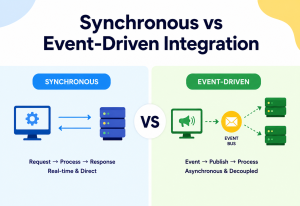
In synchronous communication, one service sends a request and waits for a reply before continuing — much like asking a question out loud and waiting for a spoken answer before moving on to the next sentence. This is commonly done over familiar web‑style protocols, and it fits situations where an immediate answer is genuinely needed, such as checking whether an item is in stock before confirming an order.
Asynchronous Communication
In asynchronous communication, a service sends a message and moves on immediately, without waiting for anyone to respond — closer to dropping a note in someone’s mailbox rather than demanding an answer on the spot. This is handled through message queues and event streams, and it fits situations where an immediate reply is not required, such as notifying other services that “an order was placed” and letting each interested service react whenever it is ready.
Most real systems use a thoughtful mix of both, choosing per situation rather than picking one style for everything. A checkout flow might synchronously check inventory (because the customer needs an immediate yes or no) while asynchronously notifying the shipping and analytics services afterward (because neither one needs to hold up the checkout to do its own job).
There is a useful pattern worth mentioning that leans heavily on the asynchronous style: event‑driven architecture, where services announce facts about what already happened — “an order was placed,” “a payment succeeded” — rather than directly instructing another service what to do next. Interested services simply listen for the events relevant to them and react on their own schedule. This keeps services genuinely independent of each other, since a new service can start reacting to an existing event stream without the original publishing service needing to know or change anything about who is listening.
A long chain of synchronous calls — Service A calls B, which calls C, which calls D — quietly recreates many of the monolith’s tight coupling problems, just spread across a network instead of within one process. If A now depends on B, C, and D all being healthy at once, a single slow or failing service anywhere in that chain can drag the whole chain down with it.
Managing Data Across Many Services
Once every service owns its own private data, a new question immediately appears: what happens when a single real‑world action needs to update several services at once?
Placing an order, for example, might need to reduce inventory, charge a payment, and schedule a shipment — three separate updates, in three separate services, each with its own database.
A monolith with one shared database could wrap all three updates inside a single database transaction, guaranteeing that either all three happen together or none of them happen at all. Microservices do not have that luxury, since a single transaction cannot easily span multiple independent databases owned by different services. This is one of the most genuinely difficult trade‑offs the whole architecture introduces, and it is solved with a small set of well‑established patterns rather than a single simple trick.
The Saga Pattern
Instead of one big transaction, a saga breaks the action into a sequence of smaller local transactions, each handled by a different service, with each step publishing an event that triggers the next. If a step partway through fails — say, the payment is declined — the saga runs a series of “compensating” steps to undo whatever already happened, like releasing the inventory that had already been reserved.

Eventual Consistency
Rather than guaranteeing every service reflects a change the instant it happens, many microservices systems accept that different services might be briefly, temporarily out of sync — updating a moment apart rather than simultaneously — as long as everything settles into agreement shortly afterward. This trade‑off, called eventual consistency, is often a very reasonable one in practice, since very few real business processes truly require every system to update in the exact same instant.
These patterns are not free — they trade the simplicity of a single database transaction for the flexibility of independent services, and that trade needs to be made deliberately, with a clear understanding of which parts of the business can tolerate a brief delay in consistency and which absolutely cannot.
The Supporting Cast: Tools That Make It All Work
A collection of independent services does not magically organise itself. A handful of supporting components consistently show up around real microservices systems, handling the traffic‑directing and coordination work that a monolith used to get for free simply by being one single program.
It is worth appreciating that none of this supporting infrastructure was strictly necessary in a monolith — a single running program did not need to “discover” its own internal functions, or route traffic between them, since everything already lived in the same process, reachable through an ordinary function call. Microservices reintroduce all of that coordination work deliberately, as a real, visible part of the system, rather than something the operating system handled invisibly.
One front door
A single, well‑guarded entry point that routes incoming requests to the right service, handles authentication, and hides the internal complexity from outside clients.
Finding a moving target
Since service instances are constantly starting, stopping, and moving between machines, a discovery mechanism keeps track of where each one currently lives.
A layer for internal traffic
Handles service‑to‑service communication concerns — encryption, retries, routing — consistently, without every team needing to reimplement the same logic themselves.
Following one request’s journey
Tracks a single request as it hops across multiple services, stitching together a full picture of where time was spent and where something went wrong.
A useful mental picture: the API gateway is like the food court’s information desk, directing hungry visitors to the right stall. Service discovery is like a live directory board, updated automatically whenever a stall opens, closes, or moves to a new spot. The service mesh is like the shared hallways and safety rules every stall follows, so deliveries and staff can move around consistently no matter which stall they are heading to. And distributed tracing is like a single receipt that shows every stall a customer’s order actually touched, in order, with a timestamp for each stop.
Containers and Orchestration
Most real‑world microservices deployments also lean heavily on containers — lightweight, self‑contained packages that bundle a service together with everything it needs to run, so it behaves consistently no matter which machine it lands on. An orchestration layer then automatically starts, stops, restarts, and spreads out large numbers of these containers across a cluster of machines, which becomes genuinely necessary once a system grows from a handful of services to dozens or hundreds of them.
Security Considerations
Spreading an application across many independent services does not just change how features are built — it meaningfully changes the security picture too, in ways worth understanding before committing to the approach.
A monolith typically has one clear perimeter: secure the outside edge of the application, and everything inside is implicitly trusted, since it is all one process. Microservices remove that comfortable assumption. Now there are many separate services, potentially running on many separate machines, all talking to each other over a network — and every one of those internal connections is a potential point where something could go wrong, whether through a misconfiguration, a compromised service, or an attacker who has found a way inside the perimeter.
Trust nothing by default
Rather than assuming internal traffic is automatically safe, each service verifies the identity and permissions of every request it receives, even from other internal services.
Services prove who they are
Services authenticate to each other using their own credentials, often through short‑lived tokens or mutual encryption, rather than relying on network location alone as proof of trust.
One place to manage access
A dedicated identity and access management layer keeps user permissions consistent across every service, instead of each service inventing its own separate login logic.
Protect data in motion
Traffic between services is typically encrypted, since data now travels across a real network between processes, rather than staying safely inside one program’s memory.
The expanded attack surface is real, but it is worth balancing against a genuine security upside: fault and blast‑radius isolation. If one service in a monolith is compromised, an attacker who breaks in often gains access to the entire application and its entire shared database in one move. In a well‑designed microservices system, compromising one narrowly scoped service — say, the recommendations engine — does not automatically hand an attacker access to payments or customer data, since those live in entirely separate services with their own credentials and their own data stores. Good microservices security turns that separation into a genuine defensive advantage, rather than just an added burden.
A Fully Worked Example: An Online Bookstore
Concepts land best with a concrete story, so imagine a small online bookstore deciding to break its single, growing application into microservices.
Identify the natural seams
The team looks at their monolith and spots four clear business capabilities already loosely tangled together inside it: browsing books, managing a shopping cart, processing payments, and handling shipping.
Extract one service at a time
Rather than rewriting everything at once, they start with the Payments capability, since it changes often and has the strictest security requirements — a natural first candidate.
Give it its own data
The new Payments service gets its own dedicated database, holding only payment‑related records, completely separate from the books catalog or shipping details.
Define a clear API
Other parts of the system, like the shopping cart, now talk to Payments only through a published API — “charge this amount to this customer” — never by directly touching its database.
Repeat, gradually
Over the following months, Browsing, Cart, and Shipping are each extracted the same way, one at a time, always keeping the overall system working throughout the transition.
A year later, during a huge holiday sale, the bookstore’s Browsing service — the part customers use to search and view books — experiences ten times its normal traffic, while Payments and Shipping stay roughly flat. Because Browsing is now its own independent service, the team can scale up just that one piece dramatically, adding extra copies of it running in parallel, without needing to also scale Payments or Shipping, and without redeploying anything else in the system at all.
Contrast that with how the same holiday spike would have played out under the old monolith. Since Browsing, Payments, and Shipping all lived inside one shared application, handling ten times the traffic on Browsing alone would have meant scaling up ten times as many copies of the entire application — Payments and Shipping code included, even though neither one needed the extra capacity at all. That is not just wasteful; it is also slower to respond to, since spinning up a full copy of a large, do‑everything application takes meaningfully longer than spinning up a lean, single‑purpose Browsing service built to do exactly one job.
Where This Shows Up in Real Life
Microservices are not just a whiteboard idea — they are quietly running behind a large share of the apps and platforms people use every day.
Hundreds of small services
Large video‑streaming platforms are famously built from hundreds of independent services, each responsible for one narrow job like recommendations, billing, or video encoding.
Separate concerns, separate services
Matching riders with drivers, calculating fares, and processing payments are commonly handled by entirely separate services, each scaling independently based on real demand.
Catalog, cart, and fulfilment apart
Large e‑commerce platforms typically separate product search, shopping cart management, and order fulfilment into distinct services with their own release schedules.
Isolating the sensitive parts
Some financial institutions isolate account management, fraud detection, and transaction processing into separate services, partly for scale and partly for tighter security boundaries.
It is worth noting that not every company that benefits from microservices is a household name running at global scale. Mid‑sized companies with a handful of engineering teams frequently adopt the same pattern for a much simpler reason: it lets a team of five focused engineers confidently own the billing system, while a completely separate team of five owns the customer support tooling, without either team needing to fully understand, or accidentally break, the other’s code. The scale of the traffic matters less here than the scale of the organisation trying to work together productively.
A useful thought experiment: imagine a food‑delivery app during a huge, unpredictable spike — a major sports final, say, when everyone orders food at the same halftime moment. If “search restaurants,” “place order,” and “track delivery” are all separate services, the platform can pour extra resources specifically into order placement and live tracking during that narrow window, while leaving less busy parts of the system, like account settings or restaurant reviews, running exactly as they normally do.

Testing a Distributed System
Testing changes shape considerably once an application is spread across many independent services, and it is worth understanding how before diving into the architecture headfirst.
Unit tests
Each service is tested on its own, checking that its internal logic behaves correctly in isolation — the same kind of testing a monolith would use, just scoped to one smaller piece.
Contract tests
Rather than spinning up every dependent service just to test one, a contract test checks that a service’s API still honours the agreed‑upon shape other services expect, without needing those other services running at all.
Integration tests
A smaller number of tests actually run two or more real services together, confirming they genuinely work correctly when talking to each other over the network, not just in theory.
End‑to‑end tests
A handful of tests simulate a full real user journey across the entire system — placing an order from start to finish, say — to catch problems that only show up when everything runs together.
The general wisdom that has emerged across the industry favours having many fast, cheap unit and contract tests, and comparatively few slow, expensive end‑to‑end tests — sometimes visualised as a pyramid, wide at the bottom and narrow at the top. End‑to‑end tests across many real, running services are valuable but slow and fragile at scale, since they depend on every single service in the chain being healthy and correctly configured at the exact moment the test runs; leaning too heavily on them tends to produce a test suite that is both painfully slow and frustratingly flaky.
Contract testing is often the most underused, most valuable tool in this list. It lets two teams confidently evolve their services independently, catching a broken agreement between them automatically, long before it ever reaches a shared staging environment.
Beyond these four familiar layers, many mature microservices teams also invest in chaos engineering — deliberately injecting failures, like shutting down a service instance or introducing artificial network delay, into a controlled environment to see how the rest of the system responds. This might sound counterintuitive, deliberately breaking things on purpose, but it reflects a healthy acceptance of one of this architecture’s core realities: in a system built from many independent, networked pieces, something will eventually fail, and it is far better to learn how the system behaves under that failure during a planned, low‑stakes exercise than to find out for the first time during a real, high‑stakes incident.
The Advantages
When applied to the right problem, at the right stage of a company’s growth, microservices deliver real, measurable benefits.
What You Gain
- Independent deployment — ship one service without waiting for every other team.
- Targeted scaling — grow only the parts of the system actually under pressure.
- Fault isolation — a failure in one service does not automatically take down the rest.
- Technology freedom — each team can choose the best tool for its specific job.
- Clearer team ownership — small teams can fully understand and own their service.
- Faster, safer releases — smaller, focused changes are easier to test and roll back.
What It Costs You
- Real operational complexity in running and coordinating many separate services.
- New failure modes that simply did not exist inside a single shared process.
- Harder cross‑service data consistency, since data now lives in separate places.
- More infrastructure and tooling investment needed to keep it all manageable.
The honest way to frame this trade‑off: microservices do not reduce the total complexity of a system — they redistribute it, moving complexity out of the codebase and into the operational space between services. That trade only pays off once a team is large enough, and a system busy enough, that the old bottleneck (everyone stuck waiting on one shared codebase) was genuinely worse than the new one (coordinating many independent moving parts).
There is also a less obvious, longer‑term benefit worth naming: resilience to organisational change. Teams reorganise, priorities shift, and products pivot far more often than any architecture diagram anticipates. A well‑bounded microservice tends to survive that kind of organisational churn more gracefully than a tangled monolith does, since ownership of one clearly scoped service can transfer between teams relatively cleanly, while untangling a shared responsibility buried deep inside a monolith often requires a much more painful, drawn‑out effort.
Challenges and Honest Trade‑Offs
Every one of the advantages above comes paired with a real, honest challenge. Understanding these clearly — before committing — is what turns microservices from a shiny idea into a survivable one.
Distributed Systems Are Genuinely Harder
The moment a request has to travel across a network to reach another service, an entire category of new problems appears that a single‑process monolith never had to deal with — network delays, partial failures, and messages arriving out of order all become everyday realities rather than rare edge cases. Engineers moving from monolith work to microservices work often describe this as the single biggest mental shift required: learning to treat every remote call as something that might fail halfway through, rather than something that either simply works or throws an immediate, clear error.
Data Consistency Gets Trickier
When each service owns its own database, a single business action — like placing an order — might need to update several separate databases across several separate services. Keeping all of that in sync, especially when one step succeeds and another fails, requires deliberate patterns that a monolith’s single shared database handled automatically. Teams new to this trade‑off sometimes underestimate just how much day‑to‑day design thinking gets absorbed by this one issue alone, since almost every meaningful business action in a real system tends to touch more than one service.
Observability Becomes Essential, Not Optional
Tracking down a bug that spans five different services, each with its own logs, is dramatically harder than debugging a single running program. Without solid monitoring, logging, and distributed tracing in place from early on, diagnosing production issues can become genuinely difficult.
The “Distributed Monolith” Trap
A particularly common failure pattern happens when teams split an application into many services on paper, but those services still call each other synchronously in long, tightly bound chains — recreating nearly all of a monolith’s tight coupling, while adding all of the network overhead and operational cost of a distributed system on top. This combination is often considered the worst of both worlds.
The Financial and Infrastructure Cost Is Real
Running dozens of independent services typically means dozens of independent deployments, dozens of sets of infrastructure, and a meaningfully larger cloud bill than a single, tightly packed monolith would have needed. This cost is often underestimated in early planning conversations, and it is worth budgeting for honestly rather than discovering it only after the migration is well underway.
Microservices trade one well‑understood set of problems (a large, tangled shared codebase) for a different, less familiar set of problems (network reliability, data consistency, and operational overhead). It is a genuine trade, not a strict improvement — and it is worth making with eyes open.
When It Makes Sense — and When It Does Not
Deciding whether microservices are the right fit is less about following a trend and more about honestly assessing a small handful of real signals.
| Signal | Leans Toward Microservices | Leans Toward a Monolith |
|---|---|---|
| Team size | Multiple teams, stepping on each other in one codebase | One small team that can hold the whole system in their heads |
| Release cadence | Need to ship different parts on different schedules | The whole application can reasonably ship together |
| Traffic patterns | Some features need far more scale than others | Traffic is fairly even across the whole application |
| Product maturity | The business domain is well understood and stable | The product is still young and the design is likely to change a lot |
| Operational maturity | Strong DevOps, monitoring, and automation already in place | Limited operational tooling or experience so far |
A genuinely important, often overlooked point: many successful companies deliberately start with a well‑organised monolith — sometimes called a “modular monolith,” where the internal code is already cleanly separated into distinct modules even though it all deploys together — and only split pieces out into true microservices once a specific, measured pain point justifies the extra operational cost of that one extraction. This gradual approach is often described as the “strangler fig” pattern, named after a vine that slowly grows around a host tree, eventually replacing it piece by piece rather than all at once.
Extract a service when it has clearly different scaling needs, a clearly different release schedule, or a clearly different team boundary than the rest of the system — not simply because “it feels like it should be separate.”
It is worth adding one more honest signal to this list: organisational appetite for operational work. Even a technically well‑justified split can go badly if the team taking it on does not yet have the monitoring, automation, and incident‑response habits needed to run a distributed system confidently. A team that struggles to keep one application healthy in production is unlikely to find managing ten smaller ones any easier — the operational maturity has to arrive alongside the architectural change, not after it.
Common Pitfalls
A handful of specific missteps come up again and again in microservices adoptions — worth naming plainly, so they can be spotted and avoided early.
Splitting Too Early
Adopting a full microservices setup before a product’s boundaries are even well understood often means splitting things along the wrong lines, then paying the ongoing cost of coordinating services that turn out to need constant, awkward communication with each other.
Services That Are Too Small
Chasing “smaller is always better” can lead to dozens of tiny services that each do almost nothing on their own, forcing nearly every business action to hop across many network calls just to get anything done — adding overhead without adding any real independence.
Sharing a Database “Just This Once”
Letting two services quietly share one database, even temporarily, tends to quietly recreate the tight coupling microservices were meant to eliminate — a change to one service’s data model can now unexpectedly break another service that was never supposed to know about it.
Underinvesting in Observability
Splitting an application into many services without also investing early in centralised logging, monitoring, and distributed tracing leaves a team essentially debugging blind the first time something goes seriously wrong in production.
Ignoring Organisational Alignment
Drawing service boundaries that do not match how teams are actually organised tends to create constant friction — a service split neatly on an architecture diagram but jointly owned by three different teams often ends up poorly maintained, since no single team feels fully responsible for it.
Before splitting anything further, it helps to ask plainly: “Does this specific split solve a real, measured problem we have today — or does it just feel architecturally tidy?” The second reason, on its own, rarely justifies the added operational cost.
Best Practices Worth Following
A handful of habits show up again and again in microservices teams that stay productive. None are magic on their own, but together they turn the architecture from a source of pain into a durable strength.
Design around business capabilities
Draw service boundaries around real business concepts — orders, payments, inventory — rather than around technical layers like “database access” or “validation logic.”
Give every service its own data
Resist any temptation to let two services share a database, even briefly, since that shortcut quietly undoes most of the independence the split was meant to provide.
Invest in observability from day one
Centralised logging, metrics, and distributed tracing are not optional extras — they are the tools that make a distributed system debuggable at all.
Automate deployment and testing heavily
With many services releasing independently, strong automated pipelines are what keep frequent, small deployments safe rather than risky.
Design for failure, not just for success
Assume any service, at any moment, might be slow or unavailable, and build in sensible retries, timeouts, and fallback behaviour wherever services depend on each other.
Grow into it gradually
Extract services one at a time from a well‑organised starting point, rather than attempting a single, risky, all‑at‑once rewrite of an entire system.
It is also worth remembering that organisational structure and system structure tend to mirror each other over time — a phenomenon well known in software circles, where the communication patterns between teams end up reflected in the architecture of the systems those teams build. Teams considering microservices are, in effect, also deciding how their organisation itself should be structured, since a service boundary that does not match a real team boundary tends to create constant, awkward coordination overhead regardless of how cleanly the code itself is separated.
Finally, it is worth resisting the temptation to treat any of these practices as a one‑time checklist. Service boundaries that made perfect sense a year ago sometimes stop making sense as a product evolves — a feature that used to be a small, quiet corner of the system might grow into something that genuinely deserves its own service, while two services that once seemed clearly distinct might turn out, in practice, to always change together and could reasonably be merged back into one. Healthy microservices architectures are revisited periodically, not designed once and left untouched forever.

Frequently Asked Questions
A handful of questions come up almost every time someone new is introduced to microservices — here are short, honest answers to the ones that surface most often.
Is microservices the same thing as “the cloud”?
No — they are related but separate ideas. Microservices is an architectural style for organising an application’s code and services. Cloud computing is about where and how that application’s infrastructure runs. Microservices can run in the cloud, on private servers, or in a mix of both.
How small should a microservice actually be?
There is no fixed size rule. A good gut check is whether a small team can fully own, understand, and confidently change the service without needing constant help from other teams. If a service has grown so large that no single team can hold its full picture in mind, it may be a sign to split it further.
Do microservices always use containers?
Not strictly, but the two go together extremely often in practice, since containers make it much easier to package, deploy, and scale many independent services consistently. It is entirely possible to run microservices without containers, but most modern deployments lean on them heavily.
What is the difference between microservices and service‑oriented architecture (SOA)?
They share the same underlying instinct — building systems from loosely connected services — but microservices are generally more strict about each service owning its own data completely and deploying entirely independently, while classic SOA implementations more often shared infrastructure and data stores across services.
Can a small startup use microservices from day one?
It is possible, but most experienced architects caution against it. A small team usually benefits far more from the simplicity of a single, well‑organised codebase early on, and can always split out services later, once real growth and real pain justify the extra operational investment.
How do microservices affect team structure?
Quite significantly, in practice. Many organisations organise small, cross‑functional teams around individual services or small groups of related services, giving each team full ownership from development through deployment and ongoing operation, rather than splitting work by technical layer across larger, more centralised teams.
Do all microservices need to use the same programming language?
No, and that is often cited as one of the architecture’s advantages — a team can pick the language and tools best suited to their specific service. In practice, though, many organisations still choose to standardise on one or two languages anyway, purely to make it easier for engineers to move between teams and services without a steep learning curve each time.
Key Takeaways
If you remember nothing else from this guide, remember the seven ideas below — and the quiet habit of drawing clean, deliberate lines that turns any of them into practice.
Remember This
- Many small services, not one giant app. A microservices architecture organises an application as many small, independently deployable services, each owning one clear business capability and its own data.
- The opposite of a monolith. It stands in contrast to a design where all features and data typically live together in one shared codebase and deployment.
- Two conversation styles. Services communicate over a network, using synchronous request‑reply calls for immediate needs and asynchronous messaging for everything that can happen later.
- The supporting cast matters. API gateways, service discovery, service meshes, and distributed tracing are what keep many independent services organised and debuggable.
- Genuine trade‑offs. The benefits — independent deployment, targeted scaling, fault isolation, team autonomy — come paired with new challenges around distributed systems, data consistency, and observability.
- Adopt for real pain, not fashion. The right moment to adopt microservices is when a real, measured pain point — not a trend — justifies the added operational cost of the split.
- Grow into it gradually. Moving from a well‑organised monolith into microservices, extracting one service at a time, tends to be safer and more successful than starting fully distributed from day one.
At the end of the day, a microservices architecture is a fairly humble idea dressed up in impressive‑sounding language: instead of one giant, tangled team‑of‑one doing every job at once, build many small, focused specialists who each do one thing well and know exactly how to ask each other for help. That instinct — small, focused ownership over sprawling, shared responsibility — turns out to be one of the more durable lessons software has borrowed from the way well‑run teams, kitchens, and organisations have quietly worked for a very long time.
Whether or not a particular team ever adopts microservices in full, the underlying discipline it demands — clear boundaries, honest ownership, and the willingness to say “this is exactly what I do, and no more” — tends to make software easier to reason about at almost any scale. That habit of drawing clean, deliberate lines is arguably the most valuable thing this architecture teaches, whether it is applied across a dozen independent services or simply used to keep the modules inside one well‑organised application honest with each other.