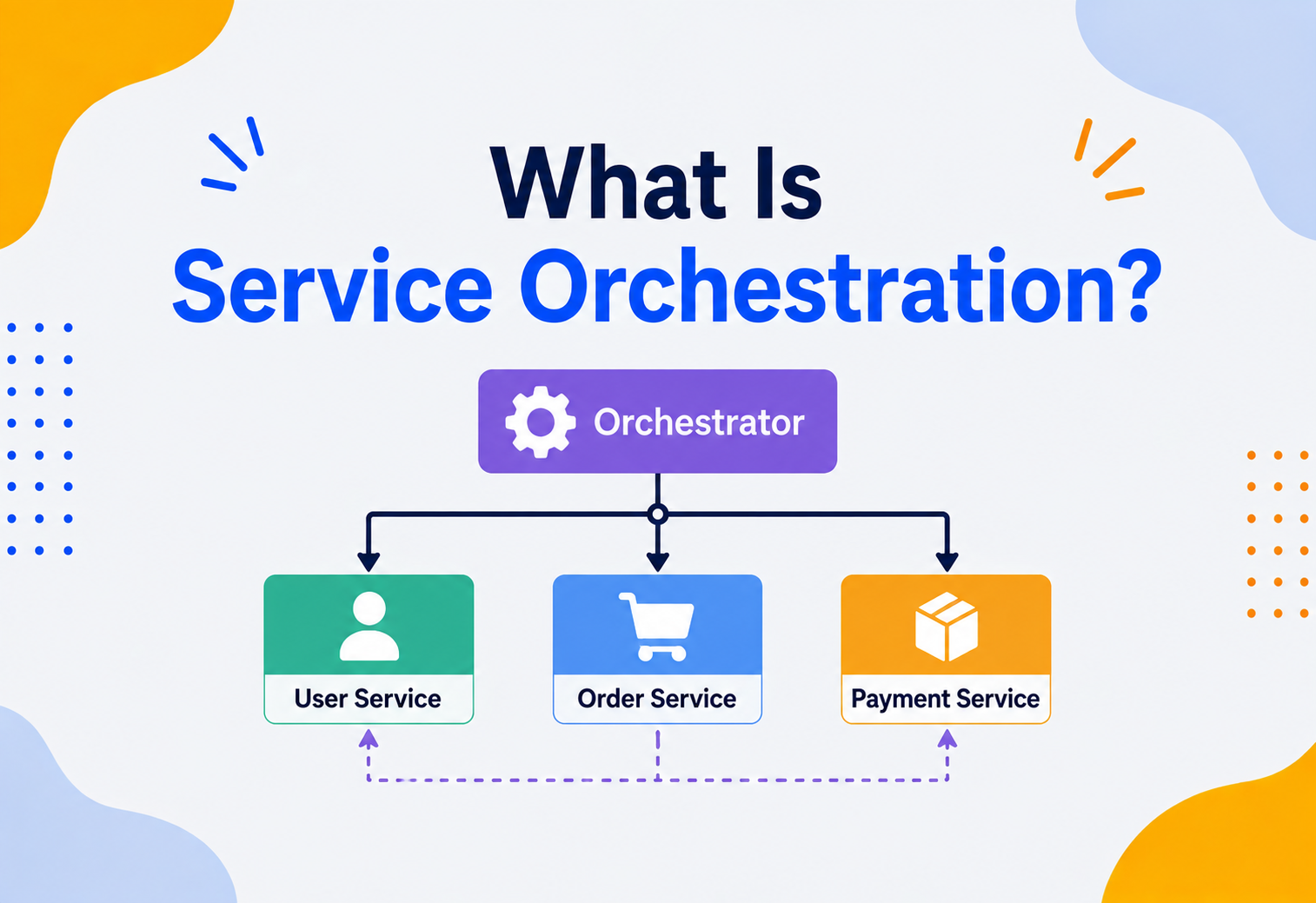
What Is Service Orchestration?
A complete, book‑quality walkthrough of how modern systems coordinate dozens of independent services into one reliable business process — built from the ground up, with diagrams, working code, and interview‑ready explanations, for readers who are starting from zero.
Introduction & History
Service orchestration is the software version of a wedding planner — a central controller that calls each service in the right order, waits for their answers, and decides what happens next, including what to do if something goes wrong.
Imagine you are planning a wedding. You do not personally cook the food, play the music, print the invitations, and drive the guests — you hire a caterer, a band, a printer, and a car service. But someone still has to decide the order things happen in: invitations go out first, catering is confirmed two weeks before, the band shows up an hour before guests arrive. That someone is the wedding planner — a single person who knows the whole plan, calls each vendor at the right time, and reacts if one of them cancels.
Service orchestration is the software version of that wedding planner. In modern applications, a single “task” — like placing an online order — is rarely done by one program. It is done by many small, independent programs called services, each responsible for one job: one checks payment, one checks inventory, one arranges shipping, one sends the confirmation email. Orchestration is the practice of having a central controller that calls each of these services in the right order, waits for their answers, and decides what happens next — including what to do if something goes wrong along the way.
Think of an orchestra (which is literally where the word comes from). A symphony has violinists, drummers, and trumpet players, each excellent at their own instrument — but without a conductor standing at the front, cueing each section on when to start, when to pause, and when to play loudly, the result would be noise, not music. The conductor does not play a single note. Their entire job is coordination. A service orchestrator plays the exact same role for software: it does not do the actual work itself, it simply makes sure every “instrument” — every service — plays its part at the right moment.
Where This Idea Came From
The term “orchestration” entered computing gradually, and its story tracks the evolution of how we build large systems:
1990s–2000s: Enterprise Application Integration (EAI)
Large companies had many separate systems (payroll, inventory, CRM) that did not talk to each other. Middleware tools were built specifically to connect and sequence calls between them — an early, clunky ancestor of orchestration.
Early 2000s: SOA and BPEL
Service‑Oriented Architecture (SOA) popularised the idea of reusable “services,” and a language called BPEL (Business Process Execution Language) let engineers formally describe multi‑step business processes that called those services in sequence — the first widely used “orchestration engines.”
2010s: Microservices Explosion
As companies like Netflix and Amazon broke enormous monolithic applications into hundreds of small, independently deployed microservices, the coordination problem grew far bigger — and orchestration (alongside its cousin, choreography) became a central architectural decision rather than a niche integration tool.
2015–2020: Container & Infrastructure Orchestration
Tools like Kubernetes popularised a different but related meaning of “orchestration” — automatically deciding where containers run, restarting failed ones, and scaling them. This is infrastructure orchestration, a close cousin of the business process / service orchestration this tutorial focuses on.
2020s–Today: Durable Workflow Engines
Modern tools such as Temporal, Camunda 8 (Zeebe), AWS Step Functions, and Netflix Conductor / Orkes turned orchestration into a first‑class, code‑friendly discipline — with built‑in retries, state persistence, and visual monitoring, so engineers rarely have to hand‑build these guarantees from scratch anymore.
If someone asks, “how is your system orchestrated?”, they are really asking: “Who is in charge of making sure all these separate services do their part, in the right order, and what happens when one of them fails?”
Problem & Motivation
To understand why orchestration exists, it helps to feel the pain of not having it — scattered failure handling, no single source of truth, and stuck orders that require grepping five codebases to explain.
To understand why orchestration exists, it helps to first feel the pain of not having it. Picture an e‑commerce checkout process. When a customer clicks “Place Order,” several things must happen, each handled by a different service:
- Reserve the items in the Inventory Service
- Charge the customer through the Payment Service
- Create a shipment with the Shipping Service
- Send a receipt via the Notification Service
Now ask the hard question: what happens if step 2 (charging the customer) fails after step 1 has already reserved the inventory? Someone — some piece of code, somewhere — needs to know that, and needs to release that reserved inventory back to the shelf. Without a clear coordinator, this logic tends to get scattered across every service that happens to call another one, and nobody has the full picture. Bugs like “items permanently stuck as reserved” or “customers charged twice” are the direct, painful result.
Life Without Orchestration
- No single place shows the full order of steps — you have to read five codebases to understand one business process
- Failure handling is duplicated (or missing) in every service that calls another
- Retrying a failed step safely is hard, because nobody “remembers” exactly where the process stopped
- Debugging a stuck order means grepping logs across many unrelated systems
Life With Orchestration
- One central definition of the process — readable top to bottom
- A single component owns retries, timeouts, and compensations
- The current state of every in‑flight process is visible at a glance
- Adding a new step means editing one workflow definition, not five services
Think about making a cup of tea. If you had to text five different housemates — “boil water,” “get a cup,” “add tea bag,” “pour water,” “add milk” — and hope they do it in the right order without talking to each other, you would end up with cold tea, or milk poured before water, or two people boiling water at once. It is far simpler for you to just do each step yourself, in order, and adjust if something runs out. Orchestration is choosing to have one clear “you” for the whole process, even when many different hands are actually doing the work.
Core Concepts
A short vocabulary before diving deeper. Every term below is one you will see repeatedly in real job interviews and real production systems.
Before going further, let’s build a solid vocabulary. Every term below is one you will see repeatedly in real job interviews and real production systems.
What Is a Service?
What it is: A small, independently deployable program that does one specific job and exposes that ability through a well‑defined interface (usually an API).
Why it exists: Breaking a huge application into small services lets different teams build, test, and deploy their piece without stepping on each other.
Where it is used: Nearly every modern application of meaningful size — banking apps, ride‑sharing apps, streaming platforms.
Analogy: A service is like one employee at a company who has one job title and does that job well, without needing to understand everyone else’s job.
Example: A PaymentService that only knows how to charge and refund cards.
What Is Orchestration?
What it is: A coordination style where one central component (the orchestrator) explicitly tells each service what to do and in what order, and tracks the overall progress of the process.
Why it exists: Complex, multi‑step business processes need a clear owner for sequencing, error handling, and state — otherwise that responsibility gets messily duplicated everywhere.
Where it is used: Order processing, loan approval, travel booking, CI/CD pipelines, data pipelines, ML training pipelines.
Analogy: The orchestra conductor, the wedding planner, the head chef in a kitchen.
Example: An OrderOrchestrator that calls Inventory, then Payment, then Shipping, then Notification, in that exact sequence.
What Is Choreography?
What it is: The opposite coordination style — there is no central controller. Each service listens for events and reacts on its own, publishing new events when it finishes.
Why it exists: It avoids a single point of control (and a single point of failure), and keeps services fully decoupled from each other.
Where it is used: High‑throughput event‑driven systems, real‑time analytics pipelines, systems built heavily around message brokers like Kafka.
Analogy: A colony of ants — no ant is “in charge,” yet a trail to food emerges from each ant reacting to simple local signals left by others.
Example: OrderPlaced event triggers Inventory to reserve stock and emit StockReserved, which triggers Payment to charge and emit PaymentCompleted, and so on — no service knows about the “whole” process.
| Aspect | Orchestration | Choreography |
|---|---|---|
| Control | Centralised (one brain) | Distributed (no single brain) |
| Visibility of full process | High — one place to look | Low — must trace events across services |
| Coupling | Services are coupled to the orchestrator, not each other | Services are decoupled but coupled to event contracts |
| Failure handling | Centralised retries and compensations | Each service must handle its own failure logic |
| Single point of failure risk | Yes, unless the orchestrator is made highly available | No single point, but debugging is harder |
| Best for | Complex, long‑running, auditable workflows | Simple, high‑throughput, loosely coupled event flows |
What Is a Workflow?
What it is: The formal definition of the steps, order, and rules of a business process — essentially the “recipe” the orchestrator follows.
Why it exists: Without a written‑down definition, the process only lives in scattered code and people’s memories.
Where it is used: Defined in BPMN diagrams, YAML/JSON state machine definitions, or plain code, depending on the tool.
Analogy: A recipe card that lists each cooking step in order.
Example: A JSON definition in AWS Step Functions listing states like ReserveInventory → ChargePayment → CreateShipment.
What Is a Saga?
What it is: A pattern for managing a long sequence of local transactions across multiple services, where each step has a matching “undo” step called a compensating transaction.
Why it exists: A single database transaction cannot span multiple independent services, so sagas provide a practical substitute for “all or nothing” behaviour across a distributed system.
Where it is used: Order processing, booking systems, banking transfers — any multi‑service process that must “undo itself” cleanly on failure.
Analogy: Planning a trip: if the hotel booking fails after you have already booked the flight, you cancel the flight rather than leaving it half‑arranged.
Example: If ChargePayment fails after ReserveInventory succeeded, the saga automatically runs ReleaseInventory as its compensating action.
Orchestration and sagas are not the same thing, but they pair naturally: a saga describes what the compensations are, and an orchestrator is often the component that executes them in the right order when something fails.
Architecture & Components
A production‑grade orchestration system is made of several distinct building blocks working together — the engine, the workflow definition, the workers, a state store, a task queue, and an event bus.
A production‑grade orchestration system is made of several distinct building blocks working together. Understanding each one individually makes the whole system far less mysterious.
The brain
Reads the workflow definition, tracks progress, decides the next step, and triggers it. This is the core component — sometimes a dedicated engine like Temporal or Zeebe, sometimes custom code.
The recipe
A declarative (BPMN, JSON, YAML) or code‑based description of the steps, their order, branching logic, and failure handling.
The hands
The actual pieces of code that do the real work of one step — calling a database, hitting an external API, sending an email.
The memory
Persists exactly where each running workflow currently is, so the orchestrator can resume correctly even after a crash or restart.
The inbox
Holds pending work items waiting to be picked up by available workers, decoupling “deciding what to do” from “actually doing it.”
The nervous system
Carries messages between the orchestrator and services (e.g., Kafka, RabbitMQ, SQS), especially in asynchronous designs.
Orchestrator Placement Patterns
Not every orchestrator looks the same. Three common placement styles show up in real systems:
| Pattern | Description | Example |
|---|---|---|
| Dedicated Orchestration Service | A standalone microservice whose only job is coordinating a specific business process. | A custom OrderOrchestrator microservice |
| Managed Orchestration Platform | A cloud‑hosted or self‑hosted engine that runs many different workflows for many teams. | AWS Step Functions, Temporal Cloud, Camunda 8 |
| Embedded / Library‑based | Orchestration logic runs as a library inside an existing service rather than a separate deployable component. | A workflow library called directly from application code |
Internal Working
Six sequential steps happen inside an orchestration engine when a workflow runs — and durable execution is what lets it survive a mid‑workflow crash without losing or duplicating work.
Let’s open the hood and see, step by step, what actually happens inside an orchestration engine when a workflow runs.
Workflow Starts
A trigger (an API call, a scheduled timer, an incoming event) tells the engine: “begin a new instance of this workflow.” The engine creates a unique workflow ID and writes an initial state record.
Engine Reads the Definition
The engine looks at the workflow definition to determine the very first step, and creates a task representing that step.
Task Is Queued
The task is placed on a queue (or dispatched directly), where an available worker picks it up.
Worker Executes and Reports Back
The worker performs the real work — calling a service, hitting a database — and reports success, failure, or “still in progress” back to the engine.
Engine Updates State & Decides Next Step
The engine records the result durably (so it survives a crash), evaluates any conditional logic, and either queues the next task, triggers a compensating action, or marks the workflow complete.
Repeat Until Terminal State
Steps 3–5 repeat until the workflow reaches a final state: completed, failed, or cancelled.
Why “Durable Execution” Matters
Modern orchestration engines like Temporal popularised a very important idea called durable execution. Here is the problem it solves: imagine a workflow has completed steps 1 and 2, and then the orchestrator process itself crashes (the machine loses power, or the container restarts). A naive implementation would lose track of where it was — and might restart the whole workflow from scratch, accidentally charging a customer twice.
A durable execution engine instead writes every completed step to persistent storage (an event history) before moving on. When the engine restarts, it replays that history to rebuild exactly where the workflow left off, then continues from the next incomplete step — without redoing work that already succeeded.
Data Flow & Lifecycle
Every workflow instance has a clear, finite set of states and clear, defined transitions between them. This state‑machine thinking is the backbone of virtually every orchestration engine.
Let’s trace one workflow instance from birth to death, using our e‑commerce order example, including the “sad path” where something fails.
Notice that every workflow instance has a clear, finite set of states, and clear, defined transitions between them. This state‑machine thinking is the backbone of virtually every orchestration engine, no matter which specific tool implements it.
Synchronous vs. Asynchronous Steps
Not every step behaves the same way. It is important to distinguish:
- Synchronous step: The orchestrator calls a service and waits (blocks) for an immediate response — good for fast operations like checking a database.
- Asynchronous step: The orchestrator fires off a task and continues elsewhere, resuming only when a separate “task completed” signal arrives later — necessary for slow operations, like waiting for a human to approve a loan, or waiting hours for a shipment to be picked up by a courier.
A loan‑approval workflow might synchronously call a credit‑check service (fast, seconds), but then asynchronously wait — potentially for days — for a human loan officer to click “approve” in a separate application. The orchestrator patiently keeps the workflow “paused” in that state, without wasting resources, until that outside signal finally arrives.
Advantages, Disadvantages & Trade‑offs
Most large real‑world systems do not pick orchestration or choreography exclusively — they mix both, using orchestration for complex, stateful business processes and choreography for simpler, high‑volume event flows.
Advantages
- Single, readable source of truth for a complex process
- Centralised, consistent error handling and retries
- Easier to test a whole business process end‑to‑end
- Clear audit trail and visibility into where any instance currently stands
- Simpler to onboard new engineers — one place explains the whole flow
Disadvantages
- The orchestrator can become a single point of failure if not made highly available
- Services become coupled to the orchestrator’s expectations, even if not to each other directly
- Adding a new orchestrated step requires updating the central definition
- Can encourage overly “chatty,” synchronous designs if used carelessly
- Introduces an extra moving part (the engine itself) that must be operated and maintained
When to Choose Orchestration vs. Choreography
| Choose Orchestration When | Choose Choreography When |
|---|---|
| The process has many steps with complex branching or compensation logic | The flow is simple and mostly linear |
| You need strong visibility into “where is this specific request right now?” | Throughput matters more than per‑request visibility |
| Human‑in‑the‑loop steps (approvals) are involved | Services should stay maximally decoupled from one another |
| Regulatory or audit requirements demand a clear process record | You already have a strong event‑streaming backbone (e.g., Kafka) in place |
Most large real‑world systems do not pick one exclusively — they mix both. Orchestration handles the complex, stateful, “must not get this wrong” business processes, while choreography handles the simpler, high‑volume, fire‑and‑forget event flows around the edges.
Performance & Scalability
Because the orchestrator sits in the middle of every workflow, its own performance directly affects the performance of everything it coordinates — and the state store is usually the true bottleneck.
Because the orchestrator sits in the middle of every workflow, its own performance directly affects the performance of everything it coordinates. A few key ideas matter here:
Throughput
How many workflow instances can the engine start and advance per second? This depends on how fast it can write to its state store, since every step transition typically requires a durable write before moving on.
Latency
How long does one workflow instance take from start to finish? This is the sum of every step’s execution time, plus any queueing delay while waiting for an available worker, plus the engine’s own bookkeeping overhead.
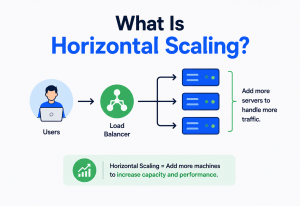
Horizontal Scaling
Production orchestration engines scale out by running many identical engine instances behind a shared, consistent state store (often a distributed database), and many independent workers pulling from a shared task queue. This lets both “deciding what happens next” and “actually doing the work” scale independently of each other.
Teams often assume the orchestration engine itself will be the performance bottleneck, but in practice it is usually the shared state store (the database recording every step) that hits its limits first, since every single step transition typically requires a durable write.
High Availability & Reliability
Because the orchestrator is so central, it must be built to survive failure — otherwise it becomes exactly the single point of failure critics warn about.
Because the orchestrator is so central, it must be built to survive failure — otherwise it becomes exactly the single point of failure critics warn about.
Techniques for High Availability
- Multiple engine replicas: Run several identical copies of the orchestration engine, so if one crashes, others keep processing.
- Replicated state store: Keep workflow history in a database that itself replicates across multiple nodes (and ideally multiple data centres), so a single storage node failure does not erase in‑flight progress.
- Idempotent task execution: Design each step so running it twice by accident (say, after a retry following a crash) has the same end result as running it once — critical because “at‑least‑once” delivery is the norm in distributed systems.
- Timeouts and automatic retries: Every step should have a maximum wait time, after which the engine assumes failure and retries or escalates, rather than waiting forever.
- Leader election: In many engines, only one replica actively “owns” a given workflow instance at a time, decided through a consensus mechanism, avoiding two replicas racing to process the same step.
Disaster Recovery
Because the state store holds the entire memory of every running process, its backup and recovery plan is arguably the most important disaster‑recovery concern in the whole system. Regular, tested backups, combined with point‑in‑time recovery capability, ensure that even a catastrophic data‑centre failure does not leave thousands of in‑flight orders permanently lost or stuck in limbo.
Imagine the “Charge Payment” step succeeds, but the network drops before the engine receives that success confirmation. Not knowing this, the engine retries the step. If the Payment Service is not idempotent, the customer gets charged twice. A well‑designed Payment Service instead accepts an idempotency‑key with every request and simply returns the original result if it sees the same key again, safely absorbing the duplicate retry.
Security
An orchestrator often has broad reach — it can trigger payments, access customer data, and call many internal services — which makes it an important security surface to protect carefully.
An orchestrator often has broad reach — it can trigger payments, access customer data, and call many internal services — which makes it an important security surface to protect carefully.
Verify who is calling
Every worker and every client triggering a workflow should prove its identity, typically via mutual TLS or signed tokens (e.g., OAuth2 / JWT).
Least privilege
Each workflow and worker should only be able to trigger the specific tasks it truly needs — a shipping worker should not be able to issue refunds.
Encrypt what is stored
Workflow state often contains sensitive data (payment details, personal information) and should be encrypted both at rest and in transit.
Who did what, when
Because the orchestrator sees the entire business process, its logs are a goldmine for compliance and audit requirements — but must themselves be protected from tampering.
A particularly important and often overlooked concern is secrets management: workflow definitions and task inputs frequently need credentials (API keys, database passwords) to call other services. These should never be hardcoded into a workflow definition; instead, they should be fetched at runtime from a dedicated secrets manager, so that even someone who can read the workflow definition itself cannot see the underlying credentials.
Monitoring, Logging & Metrics
Because orchestration engines coordinate business‑critical processes, strong observability is not optional — it is how teams know the system is actually working, and how they diagnose it when it is not.
Because orchestration engines coordinate business‑critical processes, strong observability is not optional — it is how teams know the system is actually working, and how they diagnose it when it is not.
Metrics Worth Tracking
- Workflow completion rate: what percentage of started workflows reach a successful “Completed” state.
- Average and p99 latency: typical and worst‑case time from workflow start to finish.
- Task failure rate per step: which specific step is failing most often, pinpointing the weakest link.
- Queue depth: how many tasks are waiting for an available worker, an early warning sign of capacity problems.
- Compensation rate: how often workflows have to roll back, which can reveal upstream data quality or reliability issues.
Distributed Tracing
Because a single workflow touches many services, a trace ID generated at the very start of the workflow should be passed along to every single step and every downstream service call. Tools like OpenTelemetry then stitch together a single visual timeline showing exactly how long each hop took — turning what would otherwise be an impossible‑to‑follow scavenger hunt through five separate log files into one clear picture.
Alerting only on “the engine is down” misses the more common real‑world problem: the engine is perfectly healthy, but one specific downstream service is slow or failing, causing workflows to quietly pile up in a stuck or retrying state. Alert on business‑level metrics (like “workflows stuck for over 10 minutes”), not just infrastructure uptime.
Deployment & Cloud
Teams generally choose between three broad deployment approaches: fully managed cloud services, self‑hosted open‑source engines, or custom‑built coordination logic inside their own services.
Teams generally choose between three broad deployment approaches for orchestration:
| Approach | Description | Trade‑off |
|---|---|---|
| Fully Managed Cloud Service | AWS Step Functions, Azure Logic Apps, Google Cloud Workflows | Fastest to start, least operational burden, but tighter coupling to one cloud provider |
| Self‑Hosted Open‑Source Engine | Temporal, Camunda Zeebe, Netflix Conductor (via Orkes) | More control and portability, but your team operates and scales it |
| Custom‑Built Orchestrator | Hand‑rolled coordination logic inside your own services | Maximum flexibility, but you must build durability, retries, and visibility yourself |
Most orchestration engines deploy naturally onto container platforms like Kubernetes, which handles restarting crashed engine or worker pods, scaling worker pool size based on queue depth, and rolling out new versions of workflow code without downtime. It is worth remembering that Kubernetes itself is a form of infrastructure orchestration — a good example of how the same word “orchestration” gets reused at a different layer of the stack.
Long‑running, mostly‑waiting workflows (like a 30‑day trial subscription reminder) should ideally sit in cheap, durable storage rather than occupying active compute resources while they wait. Well‑designed engines suspend a waiting workflow entirely, consuming no CPU, and simply “wake up” it when the timer fires or the event arrives — a major cost saver at scale.
APIs & Microservices
Orchestration and microservices are natural partners — in fact, orchestration is one of the main patterns that makes microservices practical at scale, rather than a scattered mess of point‑to‑point calls.
Orchestration and microservices are natural partners — in fact, orchestration is one of the main patterns that makes microservices practical at scale, rather than a scattered mess of point‑to‑point calls.
How the Orchestrator Talks to Services
Two common integration styles exist, and real systems often mix both:
- Direct API calls (synchronous): The orchestrator calls a service’s REST or gRPC API directly and waits for the response. Simple to reason about, but creates temporal coupling — the orchestrator is stuck waiting if the service is slow.
- Task queues (asynchronous): The orchestrator places a task message on a queue; a worker owned by the relevant team picks it up whenever it is ready, and reports back later. More resilient to slow or temporarily unavailable services.
API Design Considerations for Orchestrated Services
A service that is meant to be called by an orchestrator should be designed with a few extra considerations beyond a normal API: it should be idempotent (safe to call twice), should return clear, structured error codes the orchestrator can branch on, and should support a reasonable timeout so the orchestrator never waits indefinitely.
Design Patterns & Anti‑patterns
A short catalogue of what genuinely helps around an orchestrator — sagas, retry with backoff, circuit breaker, human‑in‑the‑loop — and the anti‑patterns that quietly turn it into a disguised monolith.
Useful Patterns
Coordinated rollback
The orchestrator explicitly runs compensating actions in reverse order when a later step fails.
Patient retries
Failed steps are retried with increasing delay between attempts, avoiding hammering a struggling service.
Stop hitting a dead service
The orchestrator temporarily stops calling a repeatedly failing service, giving it room to recover instead of piling on more load.
Pause for approval
The workflow pauses indefinitely at a defined step until a person takes an action, then resumes automatically.
Anti‑patterns to Avoid
The “God Orchestrator”
Cramming business logic that belongs inside individual services into the orchestrator itself, turning it into a disguised monolith that knows too much.
Chatty Synchronous Chains
Making every single step a blocking synchronous call, so one slow service stalls the entire workflow and ties up engine resources unnecessarily.
Missing Compensations
Defining the “happy path” carefully while leaving failure and rollback logic as an afterthought — the single most common source of data inconsistency bugs.
Non‑Idempotent Steps
Building a step that produces a different (or duplicated) result if accidentally executed twice, which turns routine retries into a source of real bugs.
The orchestrator should coordinate the story, not write it.
That pull‑quote captures the single most important design discipline in this whole field: the orchestrator’s job is sequencing and coordination, not business logic. Business rules — how to calculate a discount, how to validate an address — belong inside the individual services, not inside the workflow definition itself. Keeping this boundary clean is what keeps an orchestrated system maintainable as it grows.
Advanced Topics
Five deeper topics that come up naturally once an orchestration engine meets real production traffic: the CAP theorem, Raft leader election, replication and sharding, optimistic concurrency, and failure recovery by failure type.
CAP Theorem and Orchestration
The CAP theorem states that a distributed data store can only guarantee two out of three properties at once during a network failure: Consistency (everyone sees the same data), Availability (every request gets a response), and Partition tolerance (the system keeps working despite network splits). Because network partitions are unavoidable in real distributed systems, the real‑world choice is almost always between consistency and availability during a partition.
For an orchestration engine’s state store, most teams lean toward consistency over raw availability — it is far more dangerous to let two engine replicas both believe they “own” and are actively advancing the same workflow instance (a consistency violation that can cause a customer to be charged twice) than it is to briefly reject a new workflow start request during a network hiccup.
Consensus & Leader Election
To guarantee only one engine replica is actively driving a given workflow instance at a time, orchestration engines commonly rely on a consensus algorithm such as Raft to elect a leader among a cluster of replicas. The leader is responsible for making state‑changing decisions; if it crashes, the remaining replicas quickly elect a new leader and continue from the last durably recorded state — no work is lost, though there may be a brief pause during the handoff.
Replication & Partitioning
At large scale, a single state‑store node cannot hold every workflow instance. Two techniques address this:
- Replication: Copying the same data across multiple nodes for fault tolerance — if one node dies, another has an up‑to‑date copy.
- Partitioning (sharding): Splitting workflow instances across many nodes (often by workflow ID) so no single node has to hold everything, allowing the system to scale horizontally.
Concurrency Control
What happens if two events for the same workflow instance arrive at nearly the same moment — say, a timeout fires at the exact instant a worker reports success? Engines typically use optimistic concurrency control: each workflow instance carries a version number, and any update must match the expected version or be rejected and retried, preventing two conflicting updates from silently overwriting each other.
Failure Recovery Strategies
| Failure Type | Recovery Strategy |
|---|---|
| Worker crashes mid‑task | Task visibility timeout expires; task returns to the queue for another worker to pick up |
| Engine replica crashes | Leader election promotes a healthy replica; workflow resumes from last persisted state |
| Downstream service is down | Retry with exponential backoff; circuit breaker opens after repeated failures |
| Entire data centre outage | Failover to a replicated state store in a second region |
Code Walkthrough
A simplified but structurally accurate orchestrator for the order‑processing example, in three languages. Each version implements the same core idea: run steps in sequence, and roll back with compensations if any step fails.
To make all of this concrete, here is a simplified — but structurally accurate — orchestrator for our order‑processing example, in three languages. Each version implements the same core idea: run steps in sequence, and roll back with compensations if any step fails.

Python Example
class Step:
    def __init__(self, name, action, compensation):
        self.name = name
        self.action = action            # function to run
        self.compensation = compensation  # function to undo it

class OrderOrchestrator:
    def __init__(self, steps):
        self.steps = steps

    def run(self, order):
        completed = []
        try:
            for step in self.steps:
                print(f"Running step: {step.name}")
                step.action(order)          # execute the step
                completed.append(step)      # remember for rollback
            return "COMPLETED"
        except Exception as err:
            print(f"Step failed: {err}. Rolling back...")
            for step in reversed(completed):
                step.compensation(order)    # undo in reverse order
            return "FAILED_AND_COMPENSATED"


# --- Example usage ---
def reserve_inventory(order): order["inventory_reserved"] = True
def release_inventory(order): order["inventory_reserved"] = False

def charge_payment(order):
    if order["amount"] > 1000:
        raise Exception("Card declined")
    order["payment_charged"] = True

def refund_payment(order): order["payment_charged"] = False

steps = [
    Step("ReserveInventory", reserve_inventory, release_inventory),
    Step("ChargePayment", charge_payment, refund_payment),
]

orchestrator = OrderOrchestrator(steps)
result = orchestrator.run({"amount": 1500})
print(result)  # FAILED_AND_COMPENSATED
Here, n is the number of steps in the workflow. In the worst case (the very last step fails), every step runs forward once and every prior step runs its compensation once, giving roughly 2n operations — still linear, not exponential, which is why sagas remain practical even for workflows with many steps.
Java Example
import java.util.*;
import java.util.function.Consumer;

class Step {
    String name;
    Consumer<Order> action;
    Consumer<Order> compensation;

    Step(String name, Consumer<Order> action, Consumer<Order> compensation) {
        this.name = name;
        this.action = action;
        this.compensation = compensation;
    }
}

class Order {
    double amount;
    boolean inventoryReserved;
    boolean paymentCharged;
    Order(double amount) { this.amount = amount; }
}

class OrderOrchestrator {
    private final List<Step> steps;

    OrderOrchestrator(List<Step> steps) { this.steps = steps; }

    String run(Order order) {
        Deque<Step> completed = new ArrayDeque<>();
        try {
            for (Step step : steps) {
                System.out.println("Running step: " + step.name);
                step.action.accept(order);
                completed.push(step);
            }
            return "COMPLETED";
        } catch (RuntimeException ex) {
            System.out.println("Step failed: " + ex.getMessage() + ". Rolling back...");
            while (!completed.isEmpty()) {
                completed.pop().compensation.accept(order);
            }
            return "FAILED_AND_COMPENSATED";
        }
    }
}

// --- Example usage ---
public class Main {
    public static void main(String[] args) {
        List<Step> steps = List.of(
            new Step("ReserveInventory",
                o -> o.inventoryReserved = true,
                o -> o.inventoryReserved = false),
            new Step("ChargePayment",
                o -> {
                    if (o.amount > 1000) throw new RuntimeException("Card declined");
                    o.paymentCharged = true;
                },
                o -> o.paymentCharged = false)
        );

        OrderOrchestrator orchestrator = new OrderOrchestrator(steps);
        String result = orchestrator.run(new Order(1500));
        System.out.println(result); // FAILED_AND_COMPENSATED
    }
}
JavaScript (Node.js) Example
class Step {
  constructor(name, action, compensation) {
    this.name = name;
    this.action = action;           // async function
    this.compensation = compensation; // async function
  }
}

class OrderOrchestrator {
  constructor(steps) {
    this.steps = steps;
  }

  async run(order) {
    const completed = [];
    try {
      for (const step of this.steps) {
        console.log(`Running step: ${step.name}`);
        await step.action(order);
        completed.push(step);
      }
      return "COMPLETED";
    } catch (err) {
      console.log(`Step failed: ${err.message}. Rolling back...`);
      for (const step of completed.reverse()) {
        await step.compensation(order);
      }
      return "FAILED_AND_COMPENSATED";
    }
  }
}

// --- Example usage ---
const steps = [
  new Step(
    "ReserveInventory",
    async (order) => { order.inventoryReserved = true; },
    async (order) => { order.inventoryReserved = false; }
  ),
  new Step(
    "ChargePayment",
    async (order) => {
      if (order.amount > 1000) throw new Error("Card declined");
      order.paymentCharged = true;
    },
    async (order) => { order.paymentCharged = false; }
  ),
];

const orchestrator = new OrderOrchestrator(steps);
orchestrator.run({ amount: 1500 }).then(console.log); // FAILED_AND_COMPENSATED
These three examples are simplified to teach the core saga‑orchestration idea clearly. They intentionally leave out durable persistence (surviving a crash mid‑workflow), distributed task queues, and retries — the exact features that dedicated engines like Temporal, Camunda, or Step Functions provide out of the box. In production, most teams use one of those engines rather than hand‑rolling this logic, precisely because getting durability and crash‑recovery right from scratch is genuinely hard.
Best Practices & Common Mistakes
Six habits that separate an orchestration‑based system that genuinely helps from one that quietly turns into a disguised monolith.
Best Practices
- Keep the orchestrator focused purely on sequencing and coordination
- Design every step to be idempotent from day one
- Always pair a forward step with a compensating step at design time, not as an afterthought
- Use distributed tracing so any single workflow instance can be followed end‑to‑end
- Version your workflow definitions so in‑flight instances are not broken by a new deployment
- Set sensible timeouts on every single step
Common Mistakes
- Embedding business rules directly inside the orchestrator (“God Orchestrator”)
- Forgetting that “at‑least‑once” delivery means duplicate task execution will happen eventually
- Running the orchestrator as a single, non‑replicated instance in production
- Ignoring queue depth and worker scaling until a backlog is already causing customer complaints
- Treating the workflow definition as “set once and forget,” instead of reviewing it as the business evolves
Real‑World Examples
As a company’s number of independent services grows into the hundreds, hand‑coding coordination logic inside each service becomes unsustainable — and a dedicated orchestration layer becomes the more maintainable, more visible, and more reliable path forward.
Conductor
Netflix built and open‑sourced Conductor, an orchestration engine originally created to manage complex media‑processing pipelines — encoding, packaging, and distributing video across a huge global catalog. It is now commercially maintained as Orkes.
AWS Step Functions
Amazon offers a fully managed orchestration service used widely across AWS customers to coordinate serverless Lambda functions, data pipelines, and order‑processing flows without operating any orchestration infrastructure directly.
Cadence & Temporal
Uber originally built Cadence to reliably orchestrate long‑running processes like a multi‑day trip lifecycle or driver onboarding; several of its original creators later founded Temporal, now widely adopted across the industry.
Camunda at Scale
The European e‑commerce company Zalando runs synchronous order processing through Camunda’s orchestration engine, sharded across multiple structurally identical databases to keep response times low even at high order volume.
Across every one of these examples, the underlying motivation is identical: as a company’s number of independent services grows into the hundreds, hand‑coding coordination logic inside each service becomes unsustainable, and a dedicated orchestration layer becomes the more maintainable, more visible, and more reliable path forward.
Interview Questions
Ten questions across beginner, intermediate, and advanced difficulty — the kind of orchestration questions that come up in nearly every system‑design interview.
What is service orchestration? Beginner
It is a coordination style where a central component (the orchestrator) explicitly directs multiple independent services through a multi‑step business process, tracking progress and handling failures along the way.
What’s the difference between orchestration and choreography? Beginner
Orchestration uses a central controller that tells each service what to do; choreography has no central controller, with each service reacting independently to events from others.
What is a saga, and how does it relate to orchestration? Intermediate
A saga is a pattern for managing a sequence of local transactions across services, where each step has a compensating action to undo it if a later step fails. An orchestrator is often the component that executes those compensations in the correct reverse order.
Why must workflow steps be idempotent? Intermediate
Because distributed systems typically guarantee “at‑least‑once” delivery, a step can be executed more than once due to retries after a crash or timeout. If the step is not idempotent, that duplicate execution can cause real bugs, like charging a customer twice.
How does an orchestration engine survive a crash without losing progress? Advanced
Through durable execution: every completed step is persisted to a durable history store before the engine proceeds. On restart, the engine replays that history to reconstruct exactly where the workflow left off, then resumes from the next incomplete step.
How would you design an orchestrator to avoid being a single point of failure? Advanced
Run multiple engine replicas behind a consensus protocol (like Raft) for leader election, back the state store with a replicated, consistent database, and make every task idempotent so retries after a failover are safe.
When would you deliberately choose choreography over orchestration? Intermediate
When the flow is simple and mostly linear, when maximum service decoupling matters more than centralised visibility, or when the system is already built around a strong event‑streaming backbone like Kafka.
Explain how CAP theorem applies to an orchestration engine’s state store. Advanced
During a network partition, the state store must choose between consistency and availability. Most orchestration engines favour consistency, since allowing two replicas to both believe they own the same workflow instance risks duplicate or conflicting actions, which is more dangerous than briefly rejecting new requests.
What’s the “God Orchestrator” anti‑pattern? Intermediate
It is when business logic that should live inside individual services gets embedded directly into the orchestrator, turning it into a disguised monolith that is hard to change safely and defeats the purpose of having independent services in the first place.
How do you handle a step that depends on a slow, asynchronous external process, like a human approval? Advanced
The workflow is designed to pause at that step without consuming active compute resources, waiting for an external signal (an API callback or event) to resume — durable execution engines support this “wait indefinitely” state natively.
Frequently Asked Questions
A handful of questions about service orchestration come up in nearly every conversation on the topic. Here are short, honest answers to the ones that surface most often.
Is service orchestration the same as Kubernetes orchestration?
No, though they share the same word. Kubernetes performs infrastructure orchestration — deciding where containers run and keeping them alive. Service orchestration coordinates business processes across application‑level services. They often work together in the same system.
Do small applications need an orchestrator?
Usually not. A small application with only two or three services and simple flows can often coordinate calls directly in code. Orchestration earns its complexity once a process spans many services with real failure and rollback needs.
Can I build my own orchestrator instead of using an existing tool?
You can, and many teams do for simple cases — but replicating durability, retries, and crash recovery correctly is genuinely difficult. Most production teams adopt an existing engine (Temporal, Camunda, Step Functions) rather than reinventing that groundwork.
Does orchestration only apply to microservices?
No. The same coordination ideas apply to data pipelines, machine learning training pipelines, CI/CD pipelines, and IoT device coordination — anywhere multiple independent steps must run in a defined, fault‑tolerant sequence.
Is orchestration slower than choreography?
Not inherently — it depends on implementation. Orchestration adds a small coordination overhead per step, but this is usually negligible compared to the actual work each service performs, and the visibility and reliability gained are often well worth it.
Summary & Key Takeaways
Service orchestration concentrates the sequencing, failure handling, and overall status of a multi‑step business process in one clear, observable place — much like a conductor leading an orchestra, or a wedding planner coordinating vendors who have never met each other.
Service orchestration solves a problem that becomes unavoidable the moment an application grows beyond a handful of services: someone, or something, has to own the sequence, the failure handling, and the overall status of a multi‑step business process. Rather than scattering that responsibility across every service involved, orchestration concentrates it in one clear, observable place — much like a conductor leading an orchestra, or a wedding planner coordinating vendors who have never met each other.
Remember This
- Orchestration centralises control through one coordinator; choreography distributes it through independent, event‑reacting services — most real systems use a thoughtful mix of both.
- A saga, paired with compensating transactions, is how orchestrated systems achieve “all or nothing” behaviour without a traditional distributed database transaction.
- Durable execution — persisting every completed step before moving on — is what lets an orchestrator survive crashes without losing or duplicating work.
- Idempotency is not optional; distributed systems guarantee at‑least‑once delivery, so every step must safely handle being run more than once.
- High availability comes from replicated engines, consensus‑based leader election, and a consistency‑favouring state store — not from hoping nothing ever crashes.
- Keep business logic out of the orchestrator itself; its only job is sequencing, timing, and failure handling, not deciding business rules.
At its heart, service orchestration is one of those quietly disciplined ideas that shows up wherever software has to survive real‑world complexity. From the enterprise middleware of the 1990s and the BPEL engines of the early 2000s, through the microservices explosion of the 2010s, to the modern durable‑workflow engines like Temporal, Camunda 8, and AWS Step Functions in use today, the underlying insight never really changes: someone has to own the story of a business process from start to finish, patiently sequencing every step and gracefully recovering when something goes wrong. Systems built with that discipline tend to be the ones that stay calm under stress, recover cleanly from setbacks, and quietly earn the trust of the people relying on them every single day.