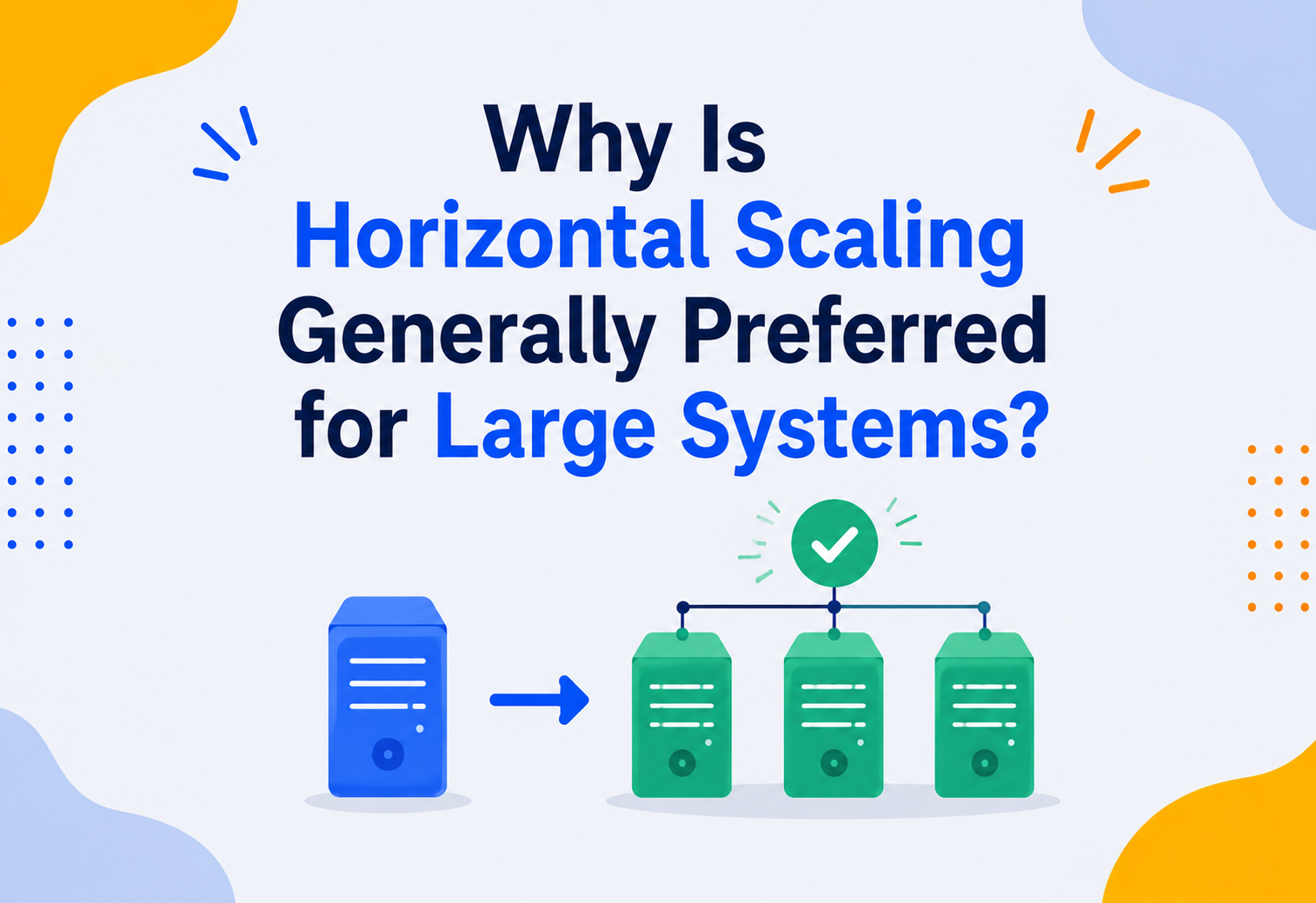
Why Is Horizontal Scaling Generally Preferred for Large Systems?
Small apps can get away with one strong computer. But once millions of people show up, that single computer starts to creak, then crack. This complete guide walks through exactly why the biggest, busiest systems in the world almost always choose to grow sideways — adding more machines — rather than upward, and what that choice actually buys them.
The Big Idea, in One Breath
Large systems face a fork in the road: try to build one impossibly powerful machine, or coordinate many ordinary machines. Time and time again, the biggest, busiest systems in the world choose the second path.
Think about a small neighbourhood bakery. One oven, one baker, a handful of loyal customers each morning — everything runs smoothly with just that. Now imagine that same bakery suddenly becomes famous overnight, and a line forms around the block every single day, with people flying in from other cities just to try the bread.
The bakery has a choice to make. It could try to build one absolutely enormous oven, big enough to bake a thousand loaves at once. That sounds impressive, but it is expensive, it takes a long time to build, and if that one giant oven ever breaks down, there is no bread for anyone, anywhere, until it is fixed. Or, the bakery could open several smaller branches around the city, each with its own oven and staff, all baking the same recipe at the same time. If one branch has a problem, the others keep serving customers without missing a beat.
Large computer systems face this exact fork in the road, multiplied by a factor of millions. And time and time again, the biggest, busiest, most important systems in the world — the ones running search engines, banks, hospitals, and social networks — choose the second path. They choose horizontal scaling: many ordinary machines working together, rather than one extraordinary machine working alone. This guide is entirely about understanding why that choice keeps winning, again and again, once a system gets truly large.
Imagine trying to move a mountain of sand with just one very strong person and one giant shovel, versus handing out a hundred ordinary shovels to a hundred ordinary people. The crowd of regular helpers will almost always win, and if one of them needs a break, ninety‑nine others are still digging. Large systems are built the exact same way.
It is worth being precise about the word “generally” in the title of this guide, because it is doing real work. Nobody is claiming horizontal scaling is the right answer in every single situation, for every single system, no matter what. What is true is something slightly narrower and far more useful: once a system crosses a certain size — once it starts serving huge numbers of people, storing enormous amounts of information, or promising to never go down — the reasons to spread the work across many machines start piling up so heavily that they become very hard to ignore. This guide walks through each of those reasons in turn, one at a time, so that by the end, the preference for horizontal scaling at scale feels less like a rule to memorise and more like plain common sense.
A Quick Recap First: The Two Ways to Grow
Every computer system that needs to handle more visitors, more data, or more work has exactly two directions it can grow in: upward, by making one machine stronger, or sideways, by adding more machines that share the work.
Before diving into the “why,” it helps to be crystal clear on the “what.” Every computer system that needs to handle more visitors, more data, or more work has exactly two directions it can grow in.
Vertical scaling means upgrading a single machine — more memory, a faster processor, more storage — the same way you might trade a small car in for one with a much bigger engine. Horizontal scaling means adding more machines that share the work between them, the same way a delivery company adds more vans instead of building one van the size of a warehouse. Both are valid tools. But as you will see throughout this guide, once a system gets genuinely large, one of these two options consistently becomes the safer, more sustainable choice.
| Trait | Vertical Scaling | Horizontal Scaling |
|---|---|---|
| Growth style | One machine gets stronger | More machines join the group |
| Upper limit | Bound by hardware physics | Practically open‑ended |
| Risk if it fails | Everything stops at once | The rest of the group keeps going |
| Best suited to | Smaller, simpler, predictable workloads | Large, unpredictable, mission‑critical workloads |
Keep this table in mind as you read on — nearly every reason explored in the rest of this guide traces back to one row or another in it. Large systems tend to care enormously about the upper limit, the failure risk, and the ability to handle unpredictability, and those three concerns are exactly where horizontal scaling pulls ahead.
A Short History: How We Got Here
The preference for horizontal scaling developed over time. In the earliest days of computing it was not so clear‑cut — but the internet giants of the 1990s and 2000s effectively wrote the playbook the rest of us now inherit for free.
It is worth understanding how this preference developed over time, because it was not always so clear‑cut. In the earliest days of computing, systems were mostly small, and vertical scaling was often the only realistic option anyway — the very idea of coordinating many separate machines to act as one was still new and difficult.
As the internet grew through the 1990s and early 2000s, a handful of pioneering companies — building search engines, online retailers, and early social networks — ran headfirst into problems nobody had really solved before. Their audiences were growing faster than any single machine could keep up with, and buying an ever‑bigger machine every few months was both painfully expensive and, eventually, simply impossible, since there is only so powerful one machine can be built. These companies had to invent new ways of splitting work across large groups of ordinary machines, effectively writing the early playbook for horizontal scaling as they went.
What started as a specialised, in‑house solution built by a handful of large technology companies gradually became publicly available knowledge, then publicly available tools, and eventually an entire industry of cloud providers offering these same capabilities to anyone willing to pay for them. Today, a small team building a brand‑new app can use, within minutes, the very same fundamental scaling techniques that were once the closely guarded secret of a handful of internet giants. That democratisation is a huge part of why horizontal scaling has become the default assumption for large systems, rather than a rare, expert‑only trick.
Reason One: Every Single Machine Has a Ceiling
No matter how much money you are willing to spend, one single computer has a hard physical ceiling. Horizontal scaling sidesteps that ceiling entirely by simply adding another machine, and another, and another.
No matter how much money you are willing to spend, there is a limit to how powerful one single computer can become. There is only so much memory that can physically fit inside one machine, only so many processing cores that can be packed onto one chip, only so much data one hard drive can hold. Even the most expensive, most cutting‑edge server available today still has a hard ceiling, built into the very laws of physics and engineering.
A large system — one serving tens of millions of people, storing enormous amounts of information, answering huge numbers of requests every second — will eventually smash straight into that ceiling if it only ever relies on vertical scaling. It is a bit like trying to fit an entire city’s population into one single house, no matter how many extra rooms you add on. At some point, there simply is not a house big enough, and you need an entirely different approach: many houses, spread across many streets.
To make this concrete: a single, extremely powerful server today might comfortably handle thousands of requests every second. That sounds like a lot, until you consider that some of the world’s largest services handle millions of requests every single second, spread across an enormous number of machines working in parallel. No amount of vertical upgrading closes a gap that wide — the only realistic path forward is adding more machines, and continuing to add them as the audience keeps growing.
Horizontal scaling sidesteps this ceiling entirely. Instead of trying to make one machine impossibly powerful, you simply add another ordinary machine next to it, and another, and another. There is no theoretical limit to how many machines can work together — large systems today can be built from thousands, or even hundreds of thousands, of individual machines, all quietly cooperating. That is a scale of growth vertical scaling could never dream of reaching on its own.
You can only make one shovel so big before it becomes too heavy to lift. But you can always hand out one more shovel to one more helper.
Why the Ceiling Keeps Getting Lower, Relatively Speaking
For decades, computer chips got faster and faster at a fairly predictable pace, a trend engineers nicknamed “Moore’s Law.” For a long time, that steady improvement meant a company could often just wait a year or two, buy the newest available machine, and get a meaningful boost in power without changing anything about how their system was built. That easy path has slowed down considerably in recent years, as chipmakers bump up against the physical limits of how small and fast a single processor can realistically get.
At the same time, the amount of data and traffic that large systems need to handle has kept climbing sharply, with no sign of slowing down. So the gap between “how much power one machine can offer” and “how much power a large system actually needs” has been widening, not narrowing. Horizontal scaling is, in a very real sense, the industry’s answer to that widening gap — instead of waiting for one machine to somehow become powerful enough, simply add as many machines as the job requires, today, without waiting for the next generation of hardware to arrive.
Reason Two: Nobody Wants One Single Point of Failure
A single giant machine means everything stops the moment that one machine breaks. Horizontal scaling turns that all‑or‑nothing risk into something far gentler — and dramatically shrinks the blast radius of everyday failures.
Here is a question worth sitting with: what happens to a system relying on a single, giant machine, the moment that machine breaks? The honest answer is simple and a little frightening — everything stops. Every user, every order, every login attempt, all of it grinds to a halt at the exact same moment, because there was never a backup plan built in.
Engineers have a name for this danger: a single point of failure. It describes any one part of a system that, if it fails, takes the entire system down with it. For a small hobby project, that risk might be perfectly acceptable. For a bank, a hospital records system, or a service used by millions of people every single day, it is a risk that simply cannot be tolerated.
What makes this risk especially uncomfortable at large scale is simple math: the more people who depend on a system, the more expensive and more damaging any single failure becomes. A five‑minute outage on a hobby project affects a handful of people and is quickly forgotten. A five‑minute outage on a service used by tens of millions of people can mean an enormous number of frustrated users all at once, real financial losses, and a dent in trust that can take much longer than five minutes to repair. Large systems, precisely because they matter to so many people, simply cannot afford to gamble everything on one single machine never failing.
Horizontal scaling turns this frightening all‑or‑nothing risk into something far gentler. When the work is spread across many machines, losing one of them is a minor, almost boring event. A load balancer notices the failed machine, quietly stops sending it visitors, and the rest of the group keeps everything running as if nothing happened. Multiply this across a system with hundreds or thousands of machines, and individual failures — which are inevitable at that scale — stop being emergencies and simply become routine background noise that the system absorbs on its own.
Picture a football team with only one player on the field. If that player twists an ankle, the game is over. A full team of eleven players can lose one player to injury and — while not ideal — keep playing, keep defending, and keep scoring. Large systems are built like full teams, not lone players.
This is not just a theoretical worry — outages caused by a single failed component have knocked major, well‑known online services offline for hours at a time, generating real headlines and real financial losses. The lesson large engineering teams take from these moments is almost always the same: find whatever single piece the whole system was quietly depending on, and redesign it so that no single piece ever holds that much power again. Horizontal scaling, applied thoroughly, is essentially that lesson turned into a permanent architectural habit — never let any one machine become too important to fail.
Engineers sometimes talk about this using the idea of a blast radius — how much damage is done when one particular thing goes wrong. On a single giant machine, the blast radius of a failure is the entire system, every single time. On a well‑designed horizontally scaled system, the blast radius of losing one ordinary machine out of a hundred is small and contained, often invisible to anyone outside the engineering team. Shrinking the blast radius of everyday failures, rather than trying to prevent every possible failure from ever happening (which is impossible), is one of the quiet, unglamorous superpowers that horizontal scaling brings to large systems.
Reason Three: Real Crowds Are Wildly Unpredictable
Large systems do not experience calm, steady traffic. They experience waves — and horizontal scaling was practically built to breathe with those waves, using a trick called elasticity.
Large systems do not experience calm, steady traffic. They experience waves — a normal Tuesday afternoon, followed by an enormous, sudden spike the moment a big sale starts, a celebrity mentions the app, or a major sporting event kicks off. A system built on one giant machine, sized for the average day, gets flattened the moment an unusual day arrives. A system built on one giant machine, sized for the busiest possible day just in case, sits mostly idle and wastes money the other 360 days of the year.
Horizontal scaling solves this with a trick called elasticity — the ability to add extra machines automatically the instant traffic rises, and remove them again automatically once things calm down. It is a moving target that horizontal scaling was practically built to chase, because adding one more ordinary machine to a group takes minutes, while building one bigger super‑machine to handle a single unusually busy afternoon simply is not realistic.
Normal, steady traffic
A small, comfortable group of machines easily handles the usual, predictable flow of visitors.
A surprise rush
Extra machines join the group within minutes, absorbing the surge before anyone waiting notices a slowdown.
Late‑night lull
Unneeded machines are switched off automatically, so nobody pays for capacity that is not being used.
A big sale or launch
Engineers can prepare extra capacity ahead of time, then let it shrink back down once the excitement passes.
This kind of breathing — expanding and shrinking with real demand — simply is not something a single, fixed machine can do. A giant machine is what it is; you cannot temporarily double its power for one busy afternoon and then temporarily shrink it back down an hour later. A group of many smaller machines can do exactly that, which is precisely why almost every large, modern system leans so heavily on horizontal scaling to survive its own popularity.
A Familiar Example: The Big Sale Day
Think about the busiest online shopping day of the year, when a huge retailer expects far more visitors than usual, all squeezed into just a few hours. In the weeks before, engineers can prepare the system to automatically bring on extra machines the moment traffic starts climbing. During the sale itself, the system might be running many times its normal number of machines, smoothly handling checkouts, searches, and payments for a flood of shoppers. A day later, once the rush has passed, those extra machines quietly switch off again, and the system settles back down to its usual, smaller size — all without anyone needing to buy a single new piece of permanent hardware that would then sit unused for the other 364 days of the year.
Compare that with what a single, fixed machine would have to do on that same busy day: it would need to already be built powerful enough to survive the absolute worst‑case rush, every single day of the year, whether that rush actually happens or not. Horizontal scaling lets a system be “just big enough” almost all the time, and “big enough for the rush” only when the rush genuinely arrives.
Reason Four: The Economics Change at Scale
Extremely powerful individual machines get disproportionately expensive. At a small scale that barely matters, but at large scale, spreading the same amount of capability across many ordinary machines is often dramatically cheaper.
It might seem like buying one enormous machine should be the cheaper option — after all, it is “just one thing” to manage. But the economics quietly flip once a system grows large enough, for a very simple reason: extremely powerful individual machines get disproportionately expensive.
Doubling the strength of a single top‑tier machine often costs far more than double the price, the same way a car with twice the horsepower rarely costs exactly double. Meanwhile, buying ten ordinary, everyday machines tends to cost close to ten times the price of one — a far more predictable, straight‑line relationship between how much you pay and how much power you get. At a small scale, this difference barely matters. At a large scale — where a company might need the equivalent of hundreds of powerful machines — that difference adds up to enormous sums of money.
This pattern shows up again and again across engineering, not just in computing: pushing any single component to its absolute limit tends to cost far more than the same amount of capability spread across several ordinary components. Large systems are, in many ways, simply applying that everyday economic lesson to the world of servers and data centres.
| Situation | Vertical Scaling | Horizontal Scaling |
|---|---|---|
| Doubling capacity | Often costs more than double | Costs close to double, predictably |
| Buying used or older hardware | Rarely an option at the high end | Ordinary machines are widely available and cheap |
| Paying only for what you use | Difficult — the machine is what it is | Easy — add or remove machines as demand shifts |
| Best fit | Small to medium workloads | Large or fast‑growing workloads |
There is also a hidden cost to consider: idle capacity. A single giant machine bought to comfortably handle a system’s busiest day of the year sits largely underused every other day of the year, quietly burning money the whole time. A horizontally scaled system, thanks to its elasticity, largely avoids this waste — you mostly pay for what you are actually using, expanding for the busy moments and shrinking back down the rest of the time.
Large organisations often think about this using a wider measure called the total cost of ownership — not just the price tag of the hardware itself, but everything around it too: electricity, cooling, physical space, the engineers needed to maintain it, and the cost of an outage if that one expensive machine ever fails. When all of those extra costs are added up, a group of many ordinary, cloud‑based machines very often comes out ahead of one enormous, specially built machine, especially once a system is large enough that both approaches are being considered seriously in the first place.
There is one more subtle cost advantage worth mentioning: buying power. Cloud providers purchase and run enormous numbers of ordinary machines, which lets them offer those machines to customers at a lower price than most individual companies could ever achieve building and running similar hardware themselves. A large system built from many rented, ordinary machines is quietly benefiting from that bulk buying power every single month, an advantage that simply is not available to a company trying to buy or build one uniquely powerful machine of its own.

Reason Five: Growing Without Ever Switching Off
Upgrading a single machine often means pausing everything for maintenance. Horizontal scaling avoids that problem almost entirely — new machines simply join the team, and rolling updates keep the whole group running while the software changes underneath.
Upgrading a single machine often is not as simple as flipping a switch. Adding more memory or a faster processor to an existing server can require shutting it down, physically opening it up, or migrating everything it was doing onto a temporary replacement while the upgrade happens. For a small personal project, a short pause might not matter much. For a large system serving people around the clock, even a few minutes of downtime can mean lost business, frustrated users, and, in serious cases, real financial damage.
There is also a psychological cost to consider, one that is easy to overlook. Every planned maintenance window on a single critical machine is, in a sense, a small scheduled risk — a moment engineers hold their breath and hope everything comes back online exactly as expected. Doing that regularly, for years, on a system millions of people depend on, takes a real toll on a team, and it is one more quiet reason large organisations prefer an approach where growth and maintenance rarely require holding your breath at all.
Horizontal scaling avoids this problem almost entirely. Adding a new machine to an existing group does not require switching anything off — the new machine simply joins the team, quietly starts taking on visitors once it is ready, and the rest of the system carries on exactly as before. It is the difference between renovating a house while a family is still living inside it versus needing everyone to move out for six months while the walls come down.
Large systems that promise to be available “24 hours a day, every day of the year” almost always need horizontal scaling, simply because it is one of the few realistic ways to grow capacity without ever needing to pause the whole system to do it.
This same benefit extends beyond just growing bigger — it also applies to everyday software updates. When engineers want to release an improved version of their software, a horizontally scaled system can update its machines one small group at a time, a practice often called a rolling update. A handful of machines are updated and checked while the rest keep serving visitors as normal, then the next handful is updated, and so on, until the whole group is running the new version — all without a single moment where the entire system was unavailable. A single giant machine offers no such gentle option; updating it usually means some kind of pause, however brief, for absolutely everyone at once.
Reason Six: Serving People All Over the Planet
One machine can only exist in one place at a time. Horizontal scaling lets a large system exist in many places at once — a shopper in Singapore served from Asia, a shopper in Germany served from Europe, nobody waiting for their request to cross an ocean.
Here is a challenge vertical scaling can never solve, no matter how powerful the single machine becomes: distance. If a company’s one giant server sits in a data centre in, say, the eastern United States, a visitor browsing from Tokyo or Mumbai will always experience some delay, simply because information has to physically travel a long way there and back, even at the speed of light.
Horizontal scaling offers a second, often underappreciated superpower here: it lets a large system place groups of machines in many different locations around the world, each one serving the visitors nearest to it. A shopper in Singapore gets served by machines running in Asia; a shopper in Germany gets served by machines running in Europe. Nobody has to wait for their request to cross an ocean and back.
This is something a single machine, however powerful, physically cannot do — it can only exist in one place at a time. Horizontal scaling, by contrast, lets a large system exist in many places at once, and that is a huge part of why global services feel fast no matter where in the world you happen to be sitting.
A related idea worth mentioning is the content delivery network, often shortened to CDN — a huge, worldwide group of machines whose entire job is storing copies of commonly requested content, like images or videos, at locations close to everyday visitors. When you watch a video and it starts playing almost instantly, there is a very good chance a CDN quietly served it to you from a nearby location, rather than sending the request all the way back to wherever the video was originally uploaded. CDNs are, at their heart, simply horizontal scaling applied specifically to the problem of distance.

The Trade‑Off Nobody Mentions at First
Spreading machines across the world does come with a genuine puzzle attached: keeping information in sync everywhere at once. If a shopper in Paris updates their profile picture, how quickly does a machine in Sydney learn about that change? Large systems generally choose one of two honest answers. Some insist that every location must agree before anyone anywhere is shown the update, which is perfectly safe but can add a noticeable delay. Others allow a brief, tiny window where different locations might show a slightly older version of the same information, in exchange for everything staying fast everywhere. Most large, everyday systems — social feeds, product listings, video platforms — happily choose the second option, because a shopper seeing a half‑second‑old version of a page is a far smaller problem than a slow, frustrating wait every time they open the app.
Reason Seven: The Cloud Made It Easy
Renting an extra machine used to take weeks. Today it takes seconds. That single shift removed most of the old friction around horizontal scaling and turned it from a rare, expert‑only technique into the default for large systems.
It is worth pausing to appreciate why horizontal scaling has become so overwhelmingly popular in just the last couple of decades. In the past, adding another machine meant physically buying a server, having it delivered, and someone plugging it into a rack in a data centre — a process that could take weeks. That slow, expensive process made vertical scaling the more practical choice for a very long time, even for large companies.
Cloud computing changed the entire equation. Renting an extra virtual machine from a cloud provider today can take seconds, not weeks, and can be automated so completely that no human needs to be involved at all. This shift is a massive part of why horizontal scaling is now the default choice for large systems — the old cost of “many machines are a hassle to set up” has largely disappeared, while the old benefits of horizontal scaling — resilience, elasticity, unlimited growth — remain exactly as valuable as ever.
It is genuinely hard to overstate how big a shift this was. A decision that once required months of planning, real money spent on physical hardware, and a genuine risk of guessing wrong about how much capacity would actually be needed, became something a single engineer could reverse with a few clicks if it turned out to be unnecessary. That freedom to experiment, to scale up cautiously and scale back down just as easily, removed much of the fear that used to surround the idea of building a large, multi‑machine system in the first place.
It is a bit like the difference between building your own furniture from raw wood versus ordering ready‑made furniture online for next‑day delivery. The end result was always achievable either way, but one path used to be so slow and difficult that most people avoided it. The cloud did for computers what online furniture shopping did for a new sofa — it removed the friction, not the underlying idea.
Alongside the cloud, two other ideas made horizontal scaling dramatically easier to manage in practice. The first is containers — a way of packaging an application so it runs identically no matter which machine it is copied onto, removing the old headache of “it worked on my machine but not on the new one.” The second is orchestration software, which watches an entire group of machines automatically, restarting ones that fail, adding new ones under pressure, and removing them again once things quiet down. Together, the cloud, containers, and orchestration form the modern toolkit that turned horizontal scaling from a rare, expert‑only skill into something teams of almost any size can set up and rely on.
What Large Systems Actually Do
These reasons are not just theory — they show up constantly in the systems people use every single day, from search engines to streaming platforms to banks to social networks.
These reasons are not just theory — they show up constantly in the systems people use every single day. Nearly every service built to handle a truly massive audience leans on horizontal scaling as its foundation.
Billions of questions daily
No single machine could ever answer that volume of searches; the work is spread across enormous groups of machines working together.
Millions watching at once
Video traffic is spread across many servers placed close to viewers, so a show loads instantly whether you are in one city or another.
Always available, never down
Financial systems cannot afford a single point of failure, so transactions are handled by groups of machines built to keep running even if one fails.
A post that goes viral overnight
Sudden, unpredictable surges in attention are absorbed by automatically adding more machines the moment they are needed.
It is genuinely difficult to find a large, globally used service that does not rely heavily on horizontal scaling somewhere in its foundation. That is not a coincidence — it is the natural result of the reasons covered so far all pointing in the same direction once a system reaches real scale.
Interestingly, this pattern holds true even in industries that people do not automatically associate with “big tech.” Large airlines processing bookings, large hospital networks managing patient records across many locations, and large logistics companies tracking packages worldwide all lean on the same fundamental idea, even though their day‑to‑day business looks nothing alike. Whenever the shared ingredients of scale, unpredictability, and the need for constant availability show up together, horizontal scaling tends to show up right alongside them.
A Closer Look: A Major Live Event
Consider what happens behind the scenes during a hugely anticipated live event streamed online — a championship final, say, watched by tens of millions of people who all press play within the same few minutes. In the hour beforehand, engineers watch viewer numbers climbing and let the system automatically bring on wave after wave of extra machines to keep pace. During the event itself, the traffic is spread across an enormous group of servers positioned around the world, each one handling only its own small slice of the overall audience. If a handful of machines happen to stumble under the pressure, viewers connected to them are quietly and instantly redirected to healthy machines nearby, often without ever noticing a flicker. None of that graceful handling would be realistic with a single machine, no matter how expensive or well built.
How Large Teams Know It Is Actually Working
Adding more machines is only half the story. Large engineering teams also keep a close eye on a handful of numbers to make sure their horizontal scaling strategy is genuinely paying off.
Adding more machines is only half the story — large engineering teams also keep a close eye on a handful of numbers to make sure their horizontal scaling strategy is genuinely paying off, rather than just adding cost and complexity for no real benefit.
Speed under pressure
If pages and requests stay fast even as visitor numbers climb, the extra machines are genuinely sharing the load the way they should.
How often something breaks
A rising number of failures during busy periods suggests scaling has not kept pace with real demand, or something else is quietly struggling.
Staying available
Large systems often measure how many minutes of downtime they had over a whole year — the fewer, the better the resilience strategy is working.
Efficient growth
Healthy scaling keeps the cost of serving each visitor roughly steady, rather than climbing faster as the audience grows larger.
Watching these numbers together, especially during real spikes in traffic, tells a much clearer story than watching any single one alone. A system that stays fast, keeps failures rare, remains available almost all the time, and does not get proportionally more expensive as it grows is a strong sign that horizontal scaling is doing exactly what it was brought in to do.

When Vertical Scaling Still Makes Sense
Vertical scaling still has a genuine comfort zone. Being fair about where it still shines matters — a good architect never reaches for the same tool for every job, and reflexively over‑engineering a small system is its own kind of mistake.
None of this means vertical scaling is a bad idea — it simply means vertical scaling has a smaller comfort zone. It is worth being fair about where it still shines, because a good architect never reaches for the same tool for every job, and reflexively over‑engineering a small system is its own kind of mistake.
- Small or brand‑new projects rarely need the added complexity of managing a whole group of machines just yet, and the time saved can be spent improving the actual product instead.
- Certain heavy calculations — like some scientific simulations — genuinely benefit from one extremely powerful machine rather than splitting the work up, since some problems do not divide neatly into smaller pieces.
- Simplicity has real value. A single machine is far easier for a small team to understand, monitor, and fix at 2am than a large distributed group, and that peace of mind is worth something too.
- Some older software was never designed to be split across multiple machines, and rebuilding it can be a bigger project than it is worth for a smaller audience, at least for now.
The honest, balanced view is this: vertical scaling is often the right first step, and horizontal scaling is usually the right long‑term destination once real scale, real risk, or real unpredictability enters the picture. Very few systems start out horizontally scaled from day one — but very few systems that become genuinely large stay purely vertical forever, either.
A useful way to think about it: ask whether the pain of staying on one machine is currently bigger than the pain of managing several. Early on, managing several machines is usually the bigger pain, so vertical scaling wins. As the audience grows, the risk of one machine failing, the cost of over‑provisioning for peak demand, and the physical ceiling of hardware all start to weigh more heavily — until, for most large systems, the balance tips decisively the other way.
Signs a System Has Outgrown Vertical Scaling
A handful of warning signs tend to show up together when a system is quietly running out of room on a single machine. Noticing them early makes the eventual move to horizontal scaling far less stressful.
A few warning signs tend to show up together when a system is quietly running out of room on a single machine, and noticing them early makes the eventual move to horizontal scaling far less stressful than waiting for a crisis to force the decision.
- The machine is already the biggest one money can buy, and it is still struggling to keep up during busy periods.
- Every upgrade requires a scary maintenance window, with real users affected each time the machine needs a change.
- One outage recently took the entire system down, revealing just how much was quietly resting on a single point of failure.
- Traffic is becoming less predictable, with sharp, sudden spikes that a fixed‑size machine cannot stretch to absorb.
- Users in other parts of the world are complaining about slow load times, hinting that physical distance has become a real problem.
Seeing just one of these signs is not necessarily a five‑alarm fire. But when several of them start appearing together, it is usually a strong, reliable signal that a system has genuinely outgrown what a single machine can comfortably offer, and that the investment of moving toward horizontal scaling is about to start paying for itself.
The Honest Challenges of Going Horizontal
Horizontal scaling solves the big problems covered so far, but it introduces its own set of challenges that a team has to be ready for. Vertical scaling trades away future growth for present simplicity; horizontal scaling makes the opposite trade.
It would be misleading to make horizontal scaling sound like a problem‑free upgrade. It solves the big problems covered so far, but it introduces its own set of challenges that a team has to be ready for.
What Horizontal Scaling Buys You
- No hard ceiling on how far the system can grow
- One failed machine barely affects anyone
- Can expand and shrink automatically with real demand
- Can be placed close to users anywhere in the world
What It Asks of You
- Applications often need redesigning to work well across many machines
- Keeping data consistent across machines takes real planning
- More moving parts to monitor, secure, and maintain
- Needs a team with the right skills and tools to run it properly
- Coordinating updates and changes across a large group takes real discipline
None of these challenges are reasons to avoid horizontal scaling altogether at large scale — they are simply the honest price of admission. A useful way to frame it: vertical scaling trades away future growth in exchange for present‑day simplicity, while horizontal scaling trades away some present‑day simplicity in exchange for future growth and resilience. For a large system, that second trade is almost always the one worth making, but pretending the trade does not exist at all would do readers a disservice.
This is exactly why the word “generally” matters so much in the question this guide set out to answer. Horizontal scaling is not preferred because it is effortless — it is preferred because, for large systems, its benefits reliably outweigh its costs, even though those costs are real and worth respecting.
It is also worth noting that these challenges rarely appear all at once, right at the start. A team usually meets them gradually, one at a time, as their system grows — first learning to design without relying on local memory, then learning to monitor many machines instead of one, then learning to plan for data spread across several places. Large, experienced engineering teams treat this as a normal, expected part of growing up, not a sign that something has gone wrong.
Best Practices for Scaling Out at Scale
Teams that successfully run large, horizontally scaled systems tend to follow a similar playbook, refined over years of hard‑earned lessons.
Teams that successfully run large, horizontally scaled systems tend to follow a similar playbook, refined over years of hard‑earned lessons — often the hard way, after a difficult night dealing with an outage that a little more preparation could have prevented.
- Design for statelessness early. Machines that do not rely on remembering things locally are far easier to add, remove, and replace.
- Automate scaling decisions. Let the system add and remove machines based on real, measured demand rather than manual guesswork.
- Spread machines across locations. Placing groups of machines in different regions protects against both traffic spikes and entire data centre outages.
- Test failure on purpose. Deliberately switching off a machine in a safe environment confirms the rest of the system truly can carry on without it.
- Watch the whole group, not just the average. A few struggling machines can hide behind a healthy‑looking overall number if nobody checks individually.
- Plan the database story just as carefully as the servers. A brilliantly scaled group of servers is only as strong as the database sitting behind them.
- Set clear limits on growth. Auto‑scaling should always have a sensible upper boundary, so a bug or false alarm cannot silently spin up an unlimited, costly number of machines.
- Give clear ownership to real people. Even in a large, automated group of machines, someone should always know exactly who is responsible for noticing and responding when something does go wrong.
None of these practices are exotic secrets — they are mostly common sense, applied consistently and taken seriously. What separates large systems that handle scale gracefully from those that struggle is not usually a clever trick nobody else knows about; it is the discipline to actually follow through on practices like these, day after day, long after the initial excitement of building the system has worn off.
Scaling out the easy parts of a system while leaving one old, unscaled piece — often a database or a legacy service — quietly acting as a hidden single point of failure underneath everything else.
Questions People Often Ask
A handful of questions come up in nearly every conversation about horizontal vs. vertical scaling. Here are short, honest answers to the ones that surface most often.
Does “large system” just mean a lot of users?
Usually, but not only that. A system can also be considered large because of how much data it stores, how many requests it handles every second, or how critical it is that it never goes down — even with a modest number of users, like a hospital’s patient records system.
Is horizontal scaling always cheaper than vertical scaling?
Not at every size. At a small scale, one reasonably sized machine can be the cheaper, simpler option. The cost advantage of horizontal scaling tends to grow clearer as the system grows larger and traffic becomes less predictable.
Can a system switch from vertical to horizontal scaling later?
Yes, and many systems do exactly this. They often start on a single, simple machine while small, and gradually redesign themselves to run across multiple machines as real growth and real risk make that redesign worthwhile.
Do large systems ever use vertical scaling at all?
Very often, yes — just not as their only strategy. A large horizontally scaled system is usually still made up of individually decent, reasonably powerful machines; the “horizontal” part is about how many of them there are, not about making each one as weak as possible.
Why don’t all companies just start with horizontal scaling from day one?
Because it adds real complexity that is not worth carrying for a small audience. Building a distributed, multi‑machine system before you have the users to justify it is a bit like hiring a large delivery fleet before you have sold your first product — better to grow into it.
Is horizontal scaling the same thing as cloud computing?
No, though the two are closely linked. Cloud computing is a way of renting computing power on demand; horizontal scaling is the strategy of spreading work across many machines. The cloud simply makes horizontal scaling far easier and faster to set up than it used to be.
What is the biggest single reason large systems prefer horizontal scaling?
If forced to pick just one, most experienced engineers would point to resilience — the fact that a group of machines can absorb the failure of any one of them, while a single machine cannot. Everything else covered in this guide builds on top of that same core idea.
How many machines does a “large” horizontally scaled system actually use?
It varies enormously depending on the service, but it is common for sizeable systems to run anywhere from dozens to many thousands of machines at once, automatically adjusting that number up and down as real traffic rises and falls throughout the day.
Does horizontal scaling make a system completely unbreakable?
No system is ever completely unbreakable, and it is important not to oversell horizontal scaling as some kind of guarantee. What it does is dramatically reduce how often ordinary, everyday failures turn into full outages, turning most individual failures into quiet, routine, barely noticed events instead.
Words Worth Knowing
A short glossary gathering the key terms from this guide in one place, worth bookmarking for a quick refresher any time one of these words comes up again.
One weak link
Any single part of a system that, if it breaks, takes the whole system down with it.
Growing and shrinking
The ability of a system to automatically add or remove machines as real demand rises and falls.
The traffic director
The component that spreads visitors evenly across a group of machines.
One machine in the group
A single server, physical or virtual, that is part of a larger team sharing the workload.
How long the wait feels
The delay between asking a system for something and getting an answer back, often affected by physical distance.
Shrugging off failure
A system’s ability to keep working properly even when one or more of its parts have failed.
The full price tag
Every cost tied to running a system, not just the hardware — including power, space, staff, and the cost of downtime.
Updating without stopping
Upgrading software on a group of machines a few at a time, so the whole system never has to pause at once.
Key Takeaways
Every reason covered in this guide points in the same direction: one machine, no matter how powerful, eventually hits a wall. A group of many ordinary machines, working together, sidesteps every one of those problems at once.
Every reason covered in this guide points in the same direction. One machine, no matter how powerful, eventually hits a wall — a physical ceiling, a frightening single point of failure, an inability to bend and stretch with unpredictable crowds, and a cost curve that gets steeper the bigger it gets. A group of many ordinary machines, working together, sidesteps every one of those problems at once, which is exactly why the world’s largest, busiest, most important systems consistently choose to grow sideways rather than upward.
None of this makes vertical scaling wrong, and none of it means horizontal scaling is free of trade‑offs. What it does mean is that, as a system’s size, importance, and unpredictability all grow together, the scales — quite literally — tip further and further toward spreading the work across many machines rather than piling it all onto one. That gradual, well‑earned shift, repeated across countless real systems over the past two decades, is the entire story behind why horizontal scaling has become the generally preferred approach for large systems everywhere.
Remember This
- Every single machine has a hard ceiling on how powerful it can become; a group of machines does not.
- Relying on one giant machine creates a single point of failure that can take an entire system down at once.
- Horizontal scaling handles unpredictable spikes far more gracefully than a fixed, single machine ever could.
- At large scale, adding many ordinary machines is usually more cost‑effective than endlessly upgrading one extreme machine.
- New machines can join a horizontally scaled system without ever needing to switch anything off.
- Spreading machines across the world lets large systems serve everyone quickly, no matter where they are.
- Vertical scaling still has its place, especially early on — but it rarely stays the whole story once a system becomes genuinely large.