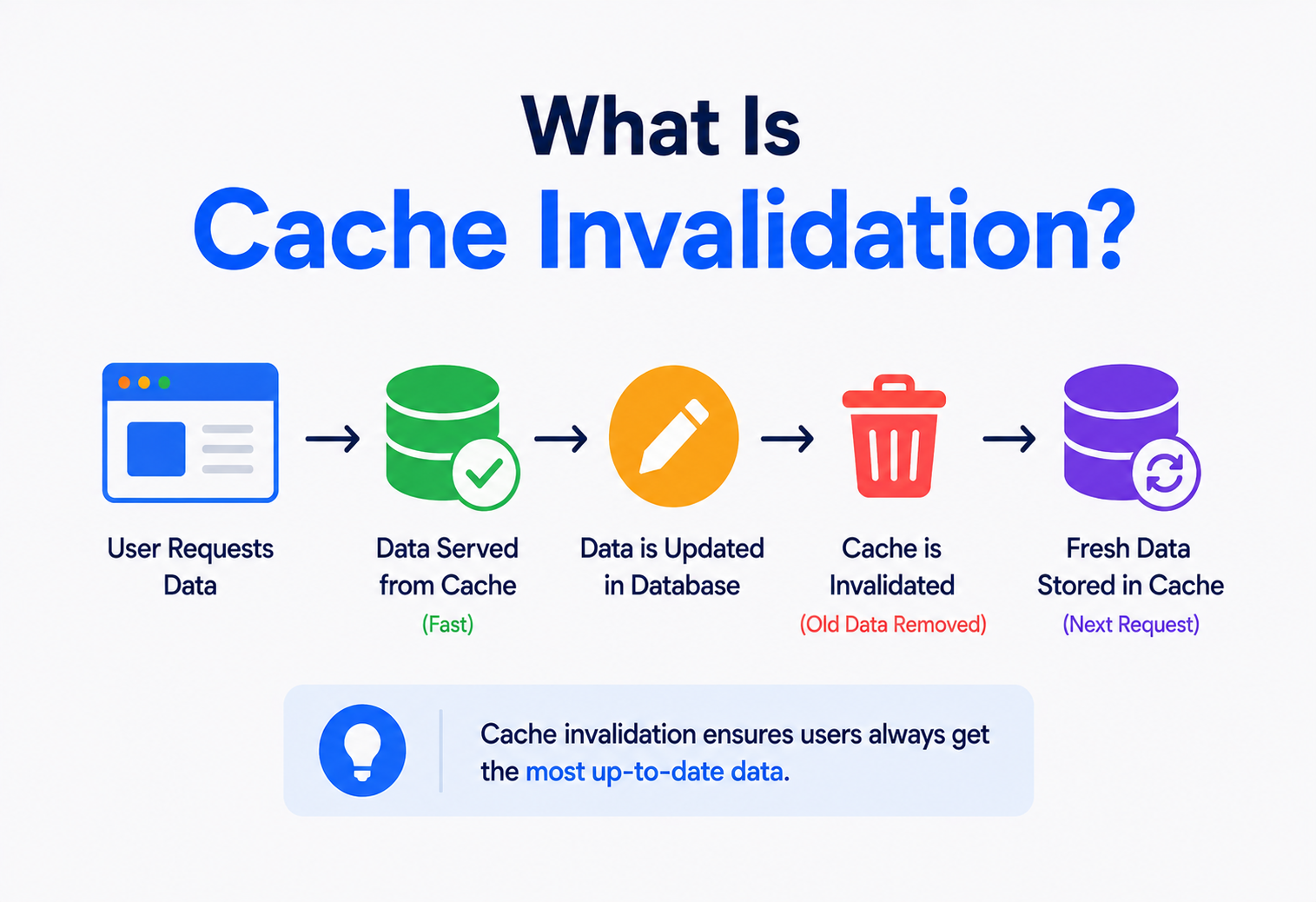
What Is Cache Invalidation?
Saving a fast copy of something is the easy part. Knowing exactly the right moment to throw that copy away, once it is no longer true, turns out to be one of the trickiest little puzzles in all of software — famous enough that engineers joke about it. This complete guide unpacks why, and how to get it right.
The Big Idea, in One Breath
A cache is a fast, easy‑to‑check copy of an answer. Cache invalidation is the deliberate act of deciding when to erase or refresh that copy, so it never quietly starts lying to anyone who trusts it.
Picture a family kitchen with a whiteboard on the fridge, listing tonight’s dinner plan: “Tacos.” Everyone in the house glances at that whiteboard all afternoon instead of texting Mom directly to ask what is for dinner — it is faster, and it is usually right. But then, at four o’clock, Mom decides to make pasta instead. If nobody erases “Tacos” and writes “Pasta,” every single person checking that whiteboard for the rest of the day gets a confidently wrong answer.
That whiteboard is a cache — a fast, easy‑to‑check copy of an answer, so nobody has to ask the slower, original source every single time. The moment the real plan changes, the whiteboard needs to be updated or wiped clean, or it starts confidently lying to anyone who trusts it. That single act — deciding when and how to erase or refresh a cached answer once it is no longer true — is exactly what cache invalidation means.
It sounds simple in a kitchen. In real software systems, the same basic problem — knowing precisely when a cached copy has gone stale, and making sure it gets fixed before anyone relies on it — turns out to be surprisingly difficult, especially once many different computers are all keeping their own separate whiteboards, updated at slightly different times, possibly disagreeing with each other.
Think about a carton of milk in the fridge with a printed expiration date. That date is the fridge’s way of saying “trust this until here, then don’t.” Cache invalidation is software’s version of that expiration stamp — a deliberate plan for deciding exactly how long a saved answer stays trustworthy, and what happens the moment it does not anymore.
Keep that whiteboard and that milk carton in mind as you read on, because nearly every idea in this guide — the strategies, the famous difficulty, the real‑world mishaps — comes back to that same core tension: a cache is only useful for as long as it is telling the truth, and knowing exactly when it stops telling the truth is a genuinely hard problem to solve well.
What makes this particular problem so interesting is how quietly it hides in plain sight. Caching itself gets plenty of attention because its benefits are so visible — pages load faster, apps feel snappier, servers breathe easier under heavy traffic. Invalidation, by contrast, only becomes visible when it fails, showing up as a confusing bug report rather than a celebrated feature. That asymmetry — caching gets the praise, invalidation gets blamed when things go wrong — is part of why this topic deserves its own careful, dedicated attention.

A Short History of a Famous Problem
Cache invalidation is not new. It has shown up at every scale computing has ever operated at, from inside a single processor chip to across entire global networks.
Long before the modern internet, computer engineers building the earliest processors ran into a version of this exact puzzle. In the 1960s and 1970s, as computers gained small, extremely fast memory caches sitting right next to the processor, engineers quickly realised that a value sitting in that fast cache could become outdated the instant the “real” copy, somewhere in main memory, changed. Solving that mismatch reliably, at the speed a processor operates, became a serious engineering challenge in its own right, eventually giving rise to specialised hardware called cache controllers, built purely to police the freshness of cached data.
As software moved from single machines to networks and eventually the web, the same underlying puzzle resurfaced at every new scale. Web browsers began caching pages in the 1990s, and site owners quickly discovered that visitors sometimes saw outdated versions of a page long after it had been updated. Databases added their own caching layers, and engineers found that a cached query result could quietly drift out of sync with the actual rows in a table. The specific technology kept changing, but the underlying dilemma — how do you know exactly when a cached copy stops being true? — stayed remarkably consistent.
The phrase most people associate with this topic today traces back to a well‑known, half‑joking line among software engineers: that there are only two genuinely hard problems in computer science — cache invalidation, and naming things. It is a joke with real teeth, because it captures something true: despite decades of tools and techniques, keeping a cache honestly in sync with reality remains one of those problems that resists easy, permanent solutions, no matter how much technology improves around it.
Cache invalidation is not a new problem invented by websites — it is a decades‑old challenge that shows up at every scale computing has ever operated at, from inside a single processor chip to across entire global networks.
It is worth noting how the tools built to fight this problem have evolved without ever fully conquering it. Early systems relied almost entirely on simple timers, since there was no practical way for one part of a system to reliably notify another the instant something changed. Modern systems have far more sophisticated options — event streams, webhooks, pub‑sub messaging systems built specifically to broadcast changes instantly — yet even with all that machinery, engineers still reach for a humble expiry timer as a trustworthy fallback, because no notification system is ever perfectly guaranteed to reach every single listener, every single time.
What Cache Invalidation Really Is
Cache invalidation is the deliberate housekeeping step that keeps a fast, convenient shortcut from quietly turning into a source of wrong answers.
Cache invalidation is the process of removing, updating, or marking cached data as no longer trustworthy, once the original data it was copied from has changed. It is the deliberate housekeeping step that keeps a fast, convenient shortcut from quietly turning into a source of wrong answers.
It helps to separate two words that sound similar but mean different things: a cache holds data because it was requested recently, and that data stays useful only as long as it still matches the truth. Invalidation is specifically about that second part — truthfulness — not about how much room the cache has left. A cache can have plenty of free space and still be full of dangerously outdated information if nobody is watching for changes.
It is worth being precise about what invalidation is not. It is not the same thing as simply making a cache bigger, and it is not the same thing as choosing which items to remove when a cache runs out of room — that is a related but distinct idea called eviction, covered properly a little later in this guide. Invalidation is purely about correctness: does this cached copy still match reality, and if not, what happens next?
If someone says “we need better cache invalidation,” they mean this: their system is at real risk of confidently showing people an answer that used to be true, but is not anymore.
Two ideas are worth carrying with you through the rest of this guide, because they explain almost every decision an engineering team makes about invalidation:
- Freshness is a promise, not a guarantee. Every cache makes an implicit bet about how long a copy stays trustworthy — invalidation is how that promise gets honoured.
- There is always a trade‑off between freshness and speed. Checking for changes constantly keeps data honest but slows things down; checking rarely keeps things fast but risks staleness.
There is a helpful way to think about a cache entry’s life story: it is born the moment it is first fetched and saved, it lives happily and usefully for a while, and it eventually needs to die — either because it has been explicitly invalidated, or because its time simply ran out. A cache without a clear plan for that ending is a cache that is quietly accumulating risk, one uninvalidated entry at a time.
How It Actually Works
At its simplest, cache invalidation compares what is sitting in the cache against what is true at the original source, and reacts the moment the two disagree. There are two broad ways that comparison can happen.
At its simplest, cache invalidation compares what is sitting in the cache against what is true at the original source, and reacts the moment the two disagree. There are two broad ways that comparison can happen.
The first way is passive: the cache does not actively watch for changes at all — it simply assumes any entry older than a set amount of time might be stale, and automatically discards or refreshes it once that time is up, regardless of whether the underlying data actually changed. The second way is active: the moment the original data genuinely changes, something explicitly tells the cache to update or remove the affected entry right away, rather than waiting for a timer to run out.
Passive approaches are simpler to build but can leave a window where stale data is served, however briefly, before the timer expires. Active approaches close that window much faster but require real engineering effort to make sure every single place data can change is properly wired up to notify the cache — miss even one, and a quiet gap in the system’s freshness guarantee opens up.
Most real systems do not pick purely one approach — they combine a short passive expiry as a safety net with active invalidation for the changes that matter most, catching anything the active path might have missed.
There is a subtle but important detail worth adding here: invalidation does not always mean deleting a cached entry outright. In some systems, an “invalidated” entry is simply marked as stale rather than removed, and can still be served temporarily — usually alongside a background effort to fetch a fresh replacement. This softer approach, sometimes paired with the stale‑while‑revalidate technique covered a little later, trades a small window of imperfect freshness for consistently fast response times, which is often exactly the right call for data where a few seconds of staleness genuinely does not matter.

Why It Is Considered So Hard
A problem that sounds simple — “throw away the old copy when the real thing changes” — earns its fearsome reputation for a few genuinely real reasons.
It is fair to ask why a problem that sounds this simple — “throw away the old copy when the real thing changes” — earns a reputation as one of the trickiest challenges in software. A few genuine reasons explain it.
More than one whiteboard
In a large system, the same data might be cached in dozens of places at once — a browser, a CDN, an app server, a database — each needing to hear about a change.
The update takes time to spread
Even with a perfect notification system, there is always a brief window between “the change happened” and “every cache heard about it.”
Data touches other data
Updating one thing can quietly affect the correctness of several other cached items nobody thought to connect it to.
Nothing crashes, just lies
Unlike a bug that causes an obvious error, stale data usually looks completely normal — it is just wrong, which makes it hard to notice.
That last point is perhaps the most important. A program serving stale cached data typically keeps running perfectly smoothly from a technical standpoint — no crash, no error message, nothing that automatically raises an alarm. It simply, quietly, hands out an answer that used to be correct. That combination of “looks fine” and “is actually wrong” is exactly what makes cache invalidation bugs so frustrating to track down, and why engineers only half‑jokingly call it one of the hardest problems around.
A cache invalidation bug rarely announces itself. It shows up as confused users, quietly wrong numbers, or a support ticket asking “why does this page show old information” — long after the actual mistake happened.
There is a compounding effect worth naming too: as a system grows, the number of places data can be cached tends to grow faster than the number of places that data can change. A single database update might ripple outward to a query cache, an API response cache, a CDN edge cache, and a browser cache, all at once — four separate places that each need their own invalidation logic, any one of which can quietly fail without the others noticing. The bigger and more successful a system becomes, the more this problem tends to compound rather than shrink.
Invalidation vs. Eviction: Not the Same Thing
Eviction is about capacity. Invalidation is about truth. Both matter, both work side by side in a well‑designed cache, but they answer completely different questions.
These two words get mixed up constantly, so it is worth drawing a clean, permanent line between them.
| Question | Invalidation | Eviction |
|---|---|---|
| Why does it happen? | The underlying data changed | The cache ran out of room |
| What triggers it? | A change, or the passage of time | New data needing space |
| Is the removed data wrong? | Yes — it no longer matches reality | Not necessarily — it might still be correct |
| Goal | Correctness and freshness | Efficient use of limited space |
Eviction is about capacity: a cache is full, and something has to go to make room for something new, using rules like LRU or LFU to decide what is least likely to be missed. Invalidation is about truth: a specific piece of cached data is now known, or suspected, to be wrong, and needs to be dealt with regardless of how much free space the cache currently has.
Eviction is like clearing out your fridge because it is too full to fit the groceries you just bought — you remove the items you are least likely to eat soon. Invalidation is throwing out the milk specifically because it has gone sour, whether or not the fridge has room for anything else.
A well‑designed cache almost always needs both mechanisms working side by side: eviction to stay within its size limits, and invalidation to stay honest about what it is actually holding.
It is worth noting that these two mechanisms can occasionally interact in surprising ways. An eviction policy like LRU might accidentally remove a perfectly fresh, still‑correct entry simply because it had not been accessed in a while, while a stubbornly popular but genuinely stale entry sticks around precisely because it keeps getting requested, refreshing its “recently used” status even though its content is wrong. This is exactly why invalidation cannot be left purely to an eviction policy — the two need to be designed and reasoned about separately, even though they often work together in the same system.
Types of Cache Invalidation
Engineers generally sort invalidation approaches into a handful of recognisable categories, each suited to a different kind of situation.
Engineers generally sort invalidation approaches into a handful of recognisable categories, each suited to a different kind of situation.
Expire after a while
The simplest approach — a cached entry automatically becomes invalid once a set duration has passed, whether the data actually changed or not.
React to a specific change
Invalidation fires the moment a relevant event happens, such as a blog post being edited or a price being updated.
Triggered by an action
A specific action, like deleting a file, directly triggers the removal of the matching cached entry.
Clear a whole category at once
An entire related group of cached entries — like every article in a news section — gets invalidated together in one sweep.
Time‑based invalidation is the easiest to set up and works well for data that changes at a predictable pace, like an hourly weather forecast. Event‑based invalidation reacts immediately and precisely, which matters for data where staleness is genuinely costly, like a product’s price. Command‑based invalidation ties cleanup directly to a specific user action, ensuring things like deleted content disappear from the cache right away. Group‑based invalidation avoids the inefficiency of clearing hundreds of related entries one at a time, sweeping a whole related batch out together instead.
Most real systems do not rely on just one of these types — a news website, for instance, might use time‑based invalidation for its homepage, event‑based invalidation for individual articles, and group‑based invalidation whenever an entire section gets reorganised.
It is worth introducing one more useful concept here: the dependency ID, a label attached to related cache entries so they can all be invalidated together as a single group, rather than one at a time. If a store reorganises its entire “Electronics” category, tagging every product in that category with a shared dependency ID means a single invalidation command can clear the whole group in one clean sweep, instead of an engineer having to hunt down and clear each individual product page separately.
Common Invalidation Techniques
Beyond the broad categories, a handful of specific, well‑known techniques show up constantly in real systems, each with its own particular flavour of trade‑off.
Beyond the broad categories, a handful of specific, well‑known techniques show up constantly in real systems, each with its own particular flavour of trade‑off.
A built‑in countdown
Every cached entry is given a “time to live,” after which it is automatically treated as expired and refreshed on the next request.
A direct command to remove
An engineer or automated tool explicitly tells the cache to drop a specific entry immediately, often after a known important change.
Change the name, not the file
Updated content gets a brand‑new identifier — like a version number in a filename — so old cached copies simply become irrelevant rather than needing to be found.
Serve now, check quietly
A slightly old cached answer is served immediately for speed, while a background check quietly fetches a fresh copy for next time.
Cache busting deserves special mention because it is such an elegant workaround: rather than trying to notify every single cache in the world that a file changed, a website simply renames the file — adding something like a version number or a hash of its contents to the filename — so that the old cached version and the new version have entirely different names, and never get confused with each other again.
Stale‑while‑revalidate is a clever middle ground increasingly used across the web: it accepts that a visitor might see an answer that is a few seconds out of date, in exchange for genuinely instant response times, while quietly fixing that staleness in the background before the next request arrives.
Cache busting is why you rarely need to manually clear your browser cache after a website updates its styling — the website itself changed the filename, so your browser naturally fetches the new version without any special instruction.
These techniques are not mutually exclusive, and combining them thoughtfully is often the mark of a mature caching strategy. A large website might use cache busting for its images and scripts, since those rarely change unpredictably, while relying on stale‑while‑revalidate for its constantly shifting homepage content, and reserving manual purges for the rare, urgent correction that simply cannot wait for any automated process to catch up.

Distributed Caches and Coherency
Everything gets noticeably harder once a system has more than one cache running at the same time — the normal situation for any application running across several servers, or any chip running across several cores.
Everything gets noticeably harder once a system has more than one cache running at the same time — which is the normal situation for any application running across several servers, or any hardware system running across several processor cores.
Inside a single computer chip, this exact problem shows up at a hardware level. Modern processors have several cores, and each core keeps its own small, extremely fast local cache of recently used data. If one core changes a piece of data, and another core is still holding an old copy of that same data in its own local cache, the two cores now disagree about reality — a problem engineers call cache coherency. Specialised hardware called a cache controller exists purely to catch this and invalidate the outdated copy the instant it is detected, before it can cause incorrect behaviour.
At the much larger scale of a distributed web application, the same idea applies, just with software instead of specialised hardware doing the coordinating. If three separate caches around the world each hold a copy of the same piece of data, and that data changes, all three need to hear about it — otherwise, two‑thirds of visitors might keep seeing an outdated version, depending purely on which cache happens to answer their request.
The more copies of the same data exist across a system, the more places invalidation has to reach — and the easier it becomes for just one forgotten copy to quietly keep serving the wrong answer.
Systems that genuinely cannot tolerate any disagreement between caches often reach for stronger coordination guarantees, accepting extra complexity and a small performance cost in exchange for certainty. Others deliberately accept a brief, bounded window of possible disagreement, betting that the cost of occasional short‑lived staleness is smaller than the cost of coordinating perfectly every single time. Neither choice is universally correct — it depends entirely on how much a brief disagreement would actually matter for the specific data involved.
A Real Hardware Mystery: When Invalidation Goes Too Far
A genuinely fascinating real‑world story shows how subtle cache invalidation problems can get, even at the hardware level. Two identical servers running the same software behaved wildly differently — and the answer turned out to be false sharing.
A genuinely fascinating real‑world story shows just how subtle cache invalidation problems can get, even for extremely experienced engineering teams working at the hardware level. A large streaming company once noticed something strange: identical servers, running the exact same software and handling the exact same kind of traffic, were splitting into two distinct groups — some running comfortably around 20% processor usage, others straining anywhere from 25% up to 90%, for no apparent reason.
After a long investigation, engineers traced the mystery back to a subtle hardware‑level invalidation problem called false sharing. Inside a processor, memory is not fetched one tiny piece at a time — it is pulled into the cache in small, fixed‑size chunks, so that grabbing one small piece of data quietly brings its close neighbours along for the ride, all packed into the same chunk. If two completely unrelated pieces of data happen to land in that same chunk, and two different processor cores are working with those two unrelated pieces at the same time, something odd happens.
When Core 1 updates its value, the whole shared chunk gets invalidated in Core 2’s cache — including Core 2’s completely unrelated value that happened to live right next door in memory. Core 2 then has to pay the slow cost of fetching that chunk all over again from main memory, even though the value it actually cared about never changed at all. This phenomenon, appropriately named false sharing, was quietly slowing down roughly one in eight of the affected servers, purely due to how two unrelated pieces of data happened to be arranged next to each other in memory.
The story is a wonderful, humbling illustration of just how many layers cache invalidation touches. It is not only a concern for web developers managing a CDN or a database — it reaches all the way down into how processors themselves are designed, where invalidating too eagerly, based purely on physical neighbourliness in memory rather than any real relationship between the data, can quietly cost real performance without a single line of buggy application code being involved.
Not every invalidation problem comes from a mistake in application logic. Sometimes it is baked into how computer hardware itself organises memory — a reminder that this challenge runs deeper than any one layer of a system.
Where Cache Invalidation Actually Shows Up
This is not an abstract, academic concern — it is quietly at work behind nearly every fast, reliable digital experience.
This is not an abstract, academic concern — it is quietly at work behind nearly every fast, reliable digital experience.
Purging content worldwide
When a website updates an image or page, a purge request tells every edge server around the globe to drop its outdated copy.
Keeping query results honest
A cached query result gets cleared the moment the underlying rows it depended on are updated, inserted, or deleted.
Fresh pages after updates
Cache‑control headers and versioned filenames tell your browser exactly how long to trust a cached page, script, or image.
Syncing local data
Apps that cache data locally for offline use need a plan for refreshing that data the moment a connection is available again.
E‑commerce platforms depend heavily on precise invalidation, especially around pricing and inventory. A cached “in stock” message that has not been invalidated after the last item sold out can lead a shopper to attempt a purchase that is destined to fail — a small technical gap with a real, frustrating human consequence.
Financial applications lean on invalidation even more strictly. A cached account balance that does not immediately reflect a just‑completed transaction is not just an inconvenience — it can lead to genuinely serious confusion or mistakes, which is exactly why sensitive financial data is often deliberately kept out of long‑lived caches altogether, or invalidated the instant anything relevant changes.
Even something as ordinary as a weather app depends on invalidation working correctly, even if the stakes are much lower. A forecast cached for too long during a fast‑moving storm could show sunny skies to someone about to walk outside into heavy rain — a small, low‑stakes example, but a genuinely real one, showing how invalidation timing decisions ripple out into everyday moments most people never think twice about.
Real Systems, Real Choices
It helps to see invalidation playing out in systems people actually use, rather than staying purely theoretical.
It helps to see this playing out in systems people actually use, rather than staying purely theoretical.
Large news organisations invest heavily in fast, reliable invalidation for a very practical reason: breaking news changes by the minute, and a homepage still showing an hour‑old headline during a major event can feel embarrassingly out of touch. Many newsrooms use event‑based invalidation tied directly to their publishing systems, so the moment an editor hits “publish,” caches around the world are told to refresh almost immediately.
Streaming platforms rely on careful invalidation around content availability. If a show’s licensing changes, or an episode is pulled for any reason, cached listings referencing that content need to be updated quickly and consistently across every region — otherwise, some viewers might see content that is technically no longer available to them, creating both a poor experience and a potential legal headache.
Large‑scale search engines apply invalidation to keep their cached results honest as the web itself changes underneath them. A cached search result pointing to a page that has since been deleted or significantly changed needs to be refreshed reasonably promptly, or users start receiving links and summaries that no longer reflect what is actually there.
The more time‑sensitive or high‑stakes a piece of information is, the more an organisation tends to invest in fast, precise invalidation, even if it costs a little extra engineering effort and infrastructure.
Ride‑sharing and delivery platforms offer another instructive example, since their entire business depends on location and availability data that changes by the second. A cached “driver available nearby” status that lags even briefly behind reality can lead to a frustrating mismatch between what an app promises and what actually happens, which is why these platforms typically favour extremely short‑lived caches, or skip caching entirely for their most time‑critical data, accepting the extra database load as the cost of staying accurate.

Getting It Right: The Payoff
Good invalidation does not just prevent problems — it actually unlocks more aggressive, longer‑lived caching elsewhere, precisely because staleness will be caught and corrected reliably.
Investing real thought into cache invalidation pays off in ways that go well beyond simply avoiding embarrassing mistakes.
What It Protects
- Users consistently see accurate, trustworthy information
- Sensitive or outdated data does not linger longer than it should
- Systems stay compliant with data‑freshness and privacy regulations
- Support teams field fewer confusing “why is this wrong” tickets
- Engineers can trust their own systems while debugging other issues
What It Enables
- Frees a cache to actually be aggressive and long‑lived where it is safe to be
- Reduces unnecessary load on databases from overly cautious short expiry times
- Builds genuine user trust in a system’s reliability over time
- Makes large‑scale caching, like CDNs, genuinely safe to rely on
That second point is worth sitting with. Good invalidation does not just prevent problems — it actually unlocks more aggressive caching elsewhere. A team that trusts its invalidation logic can confidently cache data for much longer stretches, squeezing far more performance benefit out of the very same cache, precisely because they know staleness will be caught and corrected reliably.
There is a team‑morale benefit worth naming too, one that rarely gets discussed openly. Engineers who trust their caching layer spend far less time second‑guessing themselves during debugging, wondering “is this actually broken, or am I just looking at stale data?” That confidence compounds over time into a healthier, faster‑moving engineering culture, where people can reason clearly about a system instead of constantly working around a nagging uncertainty about whether what they are looking at is even true.
The Trade‑offs and Risks
Cache invalidation is not free of downsides of its own, and being honest about them leads to far better decisions than pretending the problem is simple.
Cache invalidation is not free of downsides of its own, and being honest about them leads to far better decisions than pretending the problem is simple.
The Honest Downsides
- Event‑based invalidation adds real engineering complexity to wire up correctly
- Overly aggressive invalidation can undercut most of caching’s speed benefit
- Distributed invalidation across many caches is genuinely hard to get perfectly right
- Missed or forgotten invalidation paths quietly reintroduce staleness
Risks to Watch For
- A “thundering herd,” where many invalidated entries are refetched all at once
- Race conditions, where an update and an invalidation happen in the wrong order
- Partial invalidation, where some but not all copies of data get updated
- Over‑invalidating, which quietly turns a fast cache into a slow one
More invalidation is not automatically safer. Invalidating too aggressively defeats much of the point of caching in the first place, trading away real performance for a level of freshness the data might not have actually needed.
Race conditions deserve special attention, since they are among the sneakiest bugs in this space. Imagine an update writing new data to a database, and an invalidation message racing to clear the cache at nearly the same moment — if the invalidation arrives just before the update finishes, rather than after, the cache might refill itself with the old, soon‑to‑be‑outdated value moments later, undoing the invalidation entirely without anyone noticing.
The thundering herd problem deserves its own moment of attention too. When an extremely popular cache entry expires or gets invalidated, and hundreds or thousands of requests arrive for that same data within the same instant, every single one of them can see a cache miss simultaneously, sending a sudden flood of identical requests crashing into the database all at once — the very overload caching was supposed to prevent in the first place. Thoughtful techniques, like letting only the very first request rebuild the cache while others briefly wait for it, exist specifically to soften this particular risk.
Cache Invalidation in the Cloud
Modern cloud platforms and content delivery networks have built dedicated tools specifically for the invalidation problem, recognising just how central it is to running caching infrastructure reliably at scale.
Modern cloud platforms and content delivery networks have built dedicated tools specifically for the invalidation problem, recognising just how central it is to running caching infrastructure reliably at scale.
Most major CDN providers offer a “purge” capability, letting a website explicitly tell every edge location around the world to drop a specific piece of cached content immediately, rather than waiting for a normal expiry timer to run its course. This is typically used right after a significant update — a corrected price, a fixed typo in an important page, a newly published article — where waiting even a few minutes for natural expiry would be unacceptable.
A change is made
Someone updates a product price, corrects an article, or removes a piece of content.
A purge request fires
The system sends an invalidation instruction to the CDN or caching layer, naming the exact content that changed.
Edge caches drop the old copy
Servers around the world remove or mark the affected entry as invalid, ready to fetch a fresh copy on the next request.
The next visitor gets the update
Whoever requests that content next receives the corrected version, and a fresh copy is cached again for others.
Managed database and caching services increasingly offer built‑in support for event‑based invalidation too, letting a change in the underlying data automatically trigger a notification to connected caches, without an engineering team needing to hand‑build that plumbing themselves from scratch.
A CDN purge is a bit like sending the exact same corrected memo to every branch office at once, rather than waiting for each office to eventually notice the old memo on their own and replace it whenever they happen to get around to it.
It is worth knowing that purges are not always instantaneous across every provider and configuration — some networks confirm a purge within seconds, while others may take a short while longer to fully propagate to every edge location worldwide. Teams working with time‑critical content often test and measure this propagation delay directly, rather than simply assuming “purge” means “instant everywhere,” so they know exactly how long a correction genuinely takes to reach every visitor.

The Cost of Getting It Wrong
Poor cache invalidation rarely announces itself with an obvious crash. Its costs tend to show up quietly, spread across performance, trust, and sometimes even compliance.
Poor cache invalidation rarely announces itself with an obvious crash — instead, its costs tend to show up quietly, spread across performance, trust, and sometimes even compliance.
| Cost Area | What Goes Wrong |
|---|---|
| User trust | People notice outdated prices, statuses, or content and lose confidence in the system |
| Support burden | Confused users file tickets about “wrong” information that was actually just stale |
| Privacy and security | Sensitive data can remain visible in a cache longer than it should, risking exposure |
| Compliance | Regulations governing data accuracy or retention may be quietly violated |
| Engineering time | Staleness bugs are notoriously slow and frustrating to track down after the fact |
The user‑experience cost deserves particular attention, since speed and accuracy are often treated as though they trade off against each other, when really both matter enormously. Research into web performance has consistently found that slow‑loading pages drive people away — but a fast page showing the wrong information can be just as damaging to trust, simply in a quieter, less immediately visible way.
A slow system frustrates people in the moment. A system that is fast but occasionally wrong erodes trust more slowly, but often more permanently, since people start double‑checking everything it tells them.
It is worth noting that the cost of stale data is not evenly distributed either. A blog showing yesterday’s view count is a nearly invisible cost. A medical portal showing an outdated test result, or a logistics platform showing an incorrect delivery status, carries a cost that is measured not just in engineering time but in genuine human consequences. Part of designing a thoughtful invalidation strategy is being honest about which category a given piece of data actually falls into, rather than treating every cache the same way by default.
Choosing the Right Strategy
Deciding exactly how to invalidate a particular piece of cached data comes down to being honest about how it behaves and how costly a brief mistake would actually be.
Deciding exactly how to invalidate a particular piece of cached data comes down to being honest about how it behaves and how costly a brief mistake would actually be.
Favour time‑based
Data that changes on a known, regular schedule — like an hourly forecast — suits simple expiry timers well.
Favour event‑based
Data where a delay in freshness genuinely matters, like account balances, deserves immediate, precise invalidation.
Favour long TTLs plus versioning
Content that changes infrequently, like a logo or a static page, can safely use cache busting and long expiry together.
Favour stale‑while‑revalidate
Data read constantly, where a few extra seconds of staleness is harmless, benefits from serving fast and refreshing quietly behind the scenes.
Most real systems end up blending several of these approaches, matched carefully to each specific kind of data rather than applying one universal rule everywhere.
That guiding sentence captures a genuinely useful discipline: it is tempting to invalidate everything constantly out of caution, but doing so quietly erodes the performance benefits caching was supposed to deliver in the first place. The goal is matching the level of caution to the actual cost of being wrong, not applying maximum caution everywhere by default.
A practical way to apply this thinking is to sort every major kind of cached data in a system into a simple table: how often it is read, how often it truly changes, and how bad it would be if someone briefly saw an old version. Data landing in the “read constantly, changes rarely, low harm if stale” corner deserves generous, simple caching. Data landing in the opposite corner deserves careful, precise, possibly expensive invalidation — or in some cases, no caching at all.
A Worked Example, Start to Finish
Ideas like this are easiest to remember through a story, so imagine a small app called Ticketly, which shows how many seats remain for local concerts.
Ideas like this are easiest to remember through a story, so imagine a small app called Ticketly, which shows how many seats remain for local concerts. Here is how thoughtful invalidation might come together for it.
A concert page loads
Ticketly checks the cache first, finds no entry yet, fetches “42 seats left” from the database, and caches it for thirty seconds.
Many fans check the same page
For the next thirty seconds, every visitor sees the cached “42 seats left” instantly, sparing the database from repeated identical queries.
Someone buys four tickets
The purchase updates the database to “38 seats left,” and immediately fires an event‑based invalidation for that concert’s cached entry.
The next visitor gets fresh data
Rather than waiting out the remaining seconds on the thirty‑second timer, the very next request refetches and re‑caches the correct “38 seats left.”
The short TTL remains as a safety net
Even if an invalidation event were somehow missed, the thirty‑second expiry guarantees the cache can never drift more than half a minute from the truth.
Notice how this design leans on two techniques at once: a fast, precise event‑based invalidation for the common case, backed up by a short, patient time‑based expiry in case anything slips through. That combination is exactly the kind of layered thinking that separates a fragile caching setup from a genuinely trustworthy one.
The best invalidation story is usually a boring one — purchases update instantly, seat counts stay accurate, and nobody using Ticketly ever notices any of this happening behind the scenes.
It is worth imagining what could have gone wrong with a less careful design. If Ticketly had relied purely on the thirty‑second timer, without event‑based invalidation, a burst of ticket sales in the final seconds before a popular show sold out could have shown “seats available” to dozens of hopeful fans, right up until the stale cache finally expired — leading to a wave of failed purchase attempts and understandably frustrated customers. The small extra effort of wiring up event‑based invalidation directly prevents exactly that kind of avoidable disappointment.
Common Pitfalls
A handful of specific mistakes come up again and again in cache invalidation work. Each one is worth naming plainly, so it can be spotted early — ideally before a confused user has to notice it first.
Forgetting a Dependent Cache Entry
Updating one piece of data without realising several other cached entries depended on it is one of the most common ways staleness quietly slips through.
Racing the Update Itself
Firing an invalidation before a database write has actually finished can let the cache refill itself with the old value moments later, silently undoing the invalidation.
Invalidating Everything, Constantly
Overcorrecting out of caution and clearing far more of the cache than necessary quietly erodes most of the performance benefit caching was meant to provide.

No Fallback for Missed Events
Relying purely on event‑based invalidation, with no backup expiry timer, means a single missed notification can leave stale data sitting indefinitely.
Ignoring the Thundering Herd
Invalidating a hugely popular entry all at once can cause a sudden flood of simultaneous requests to hit the database as everyone tries to refill the cache at the same moment.
Assuming Invalidation Is “Set and Forget”
Treating an invalidation strategy as finished the day it is written, rather than revisiting it as data patterns and system scale evolve, lets small gaps quietly widen into real problems over time.
A system where nobody can confidently explain exactly how a piece of cached data gets invalidated. If the answer is a shrug, staleness bugs are likely already happening quietly, waiting to be noticed.
Best Practices for Cache Invalidation
Good invalidation design tends to follow a consistent handful of habits, regardless of the specific technology involved.
Good invalidation design tends to follow a consistent handful of habits, regardless of the specific technology involved.
- Match the strategy to the data’s real behaviour. Predictable, low‑stakes data can use simple timers; sensitive, fast‑changing data deserves precise, event‑based triggers.
- Always keep a backup expiry. Even reliable event‑based systems benefit from a time‑based safety net in case a notification is ever missed.
- Map out data dependencies. Know exactly which cached entries are affected when a particular piece of underlying data changes.
- Guard against races. Make sure invalidation happens strictly after an update completes, never before or during.
- Stagger invalidation for hot items. Avoid clearing a hugely popular cache entry all at once in a way that triggers a sudden flood of refetch requests.
- Test invalidation like a real feature. Deliberately verify that changes actually propagate correctly, rather than assuming the logic works because it compiled.
- Log invalidation events. Keeping a record of when and why a cache entry was invalidated makes future debugging dramatically easier.
- Document the plan in plain language. Make sure any engineer touching the system can quickly answer “what invalidates this, and when?”
None of these habits require exotic tools or a large team — they mostly come down to treating invalidation as a genuine, first‑class part of a system’s design, deserving the same careful thought as the caching itself, rather than an afterthought bolted on once something has already gone visibly wrong.
For any new cached data, write down in plain language exactly what event should invalidate it, and who or what is responsible for triggering that event. If nobody can answer clearly, the invalidation plan probably is not finished yet.
Questions People Often Ask
A few questions about cache invalidation come up again and again, in conversations ranging from casual curiosity to serious architecture reviews. Here are short, honest answers to the ones that surface most often.
Is cache invalidation the same as clearing a cache?
Not exactly. Clearing wipes everything out indiscriminately, while invalidation is more targeted — removing or refreshing only the specific entries that are actually known or suspected to be outdated.
Why do people call it “one of the hardest problems in computer science”?
It is a well‑known, half‑joking phrase, but it points at something real: coordinating freshness across many copies of data, with no obvious errors when it goes wrong, is genuinely difficult to get perfectly right.
Can a system avoid cache invalidation entirely by just not caching anything?
Technically yes, but that usually is not practical — it sacrifices most of the speed and efficiency benefits caching provides in the first place, especially for high‑traffic systems.
What is the safest default if I am not sure which strategy to use?
A short time‑based expiry is usually a safe, simple starting point — it caps how stale data can ever become, even without any active invalidation logic in place yet.
Does every cached item need its own invalidation plan?
In spirit, yes — even if many items end up sharing the same simple rule, like a default expiry time, it is worth being deliberate about that choice rather than leaving it as an afterthought.
Do small personal projects need to worry about this?
Usually not deeply. A small project with light, infrequently changing data can often get by with a simple, generous expiry time until real growth or more sensitive data types show up.
What is the very first thing to check if data seems mysteriously outdated?
Confirm whether the affected data is cached anywhere, and if so, trace exactly what is supposed to trigger its invalidation — the gap between “supposed to” and “actually does” is where most staleness bugs hide.
Is there a way to guarantee zero staleness anywhere in a system?
In practice, no — there is always at least a tiny window between a change happening and every cache learning about it. The realistic goal is making that window small enough that it never meaningfully matters.
Key Takeaways
If you remember nothing else from this guide, remember the six ideas below — and the honest habit of pairing every cache with a clear, written plan for exactly how and when it gets invalidated.
Remember This
- Cache invalidation means removing or refreshing cached data once the original it was copied from has changed.
- It is distinct from eviction — invalidation is about correctness, eviction is about making room.
- Time‑based, event‑based, command‑based, and group‑based invalidation each suit different kinds of data.
- The problem gets genuinely harder once many caches exist across a distributed system, all needing to agree.
- Good invalidation does not mean invalidating everything constantly — it means matching the strategy to how much staleness a given piece of data can actually tolerate.
- Most healthy systems combine an active, precise invalidation path with a passive, time‑based safety net underneath it.
At its heart, cache invalidation is the quiet discipline of keeping fast answers honest. Everything else in this guide — the strategies, the diagrams, the false‑sharing story, the Ticketly worked example — is really just different ways of practising that one skill: noticing exactly when a saved copy has stopped telling the truth, and dealing with it before anyone downstream is meaningfully misled. Systems that respect that discipline tend to feel not just fast, but trustworthy — which is, in the end, the whole point of building them in the first place.