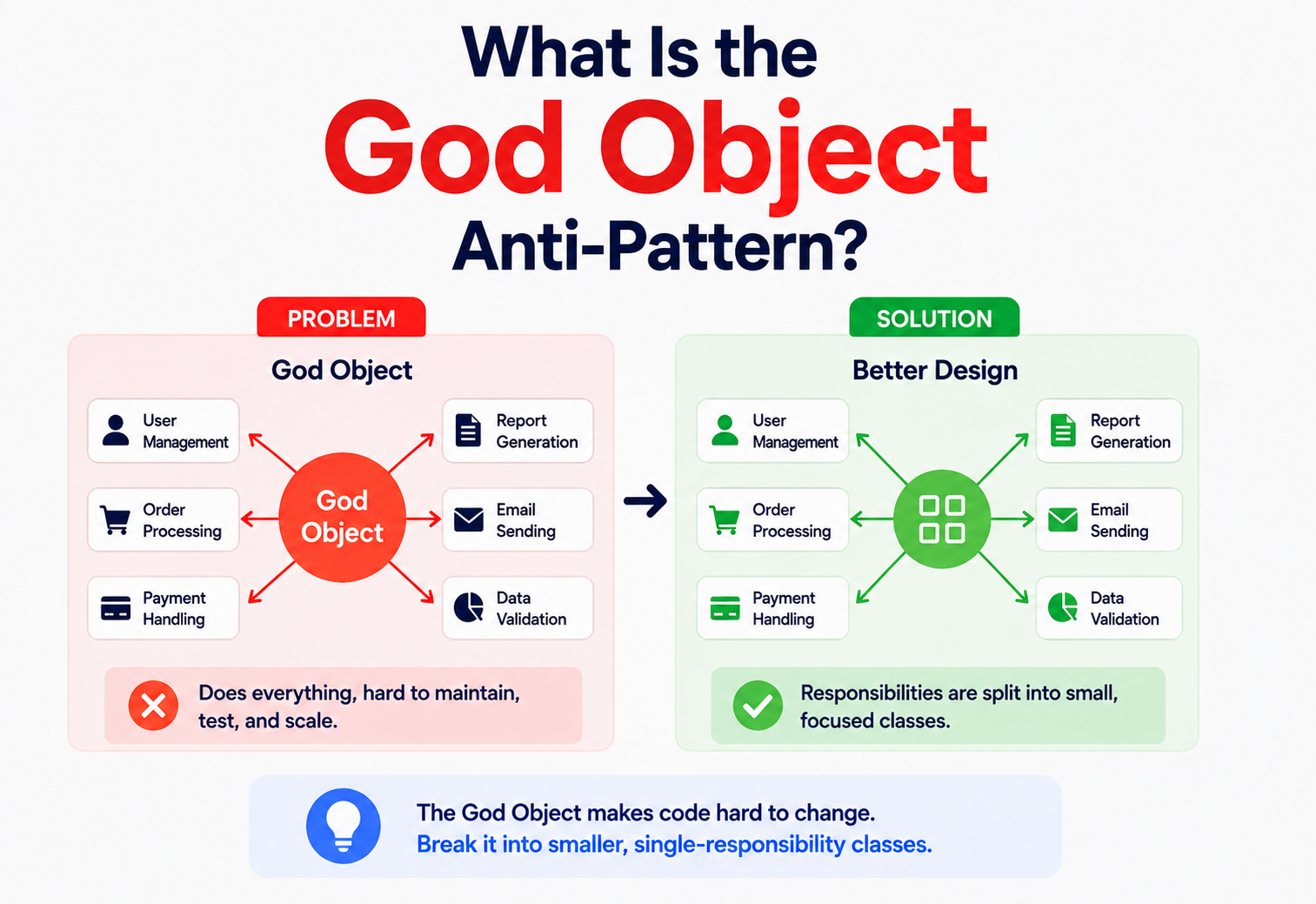
What Is the God Object Anti-Pattern?
Every office has that one person who somehow ends up holding the keys to everything — the passwords, the client relationships, the one spreadsheet nobody else understands. It’s convenient, right up until that person goes on vacation and the whole office quietly grinds to a halt. Software has the exact same character, and it’s called the God Object.
The Big Idea, in One Breath
Picture a kitchen drawer — the one every household has, tucked somewhere near the door. It started out holding spare keys. Then a few rubber bands moved in. Then a phone charger, a tape measure, some birthday candles, a half-used tube of glue, and a single chopstick nobody remembers keeping. Nothing about any individual item was a bad choice to put there — each one felt like a perfectly reasonable, temporary home at the time. But now, finding anything in that drawer means digging through everything else in it first, and every new thing that gets tossed in makes the next search a little bit worse.
A God Object — sometimes called a God Class, or a Blob — is that kitchen drawer, except it’s a single class in a piece of software that has quietly accumulated far too many responsibilities over time. It knows too much, does too much, and ends up tangled into nearly every other part of the system, until touching almost anything in the codebase means touching it too.
Think about a company where one manager insists on personally approving every expense report, reviewing every hire, writing every press release, and signing off on every product decision, no matter how small. At first, it feels efficient — one clear point of authority, nothing slips through the cracks. But as the company grows, that manager becomes the bottleneck for absolutely everything. Every decision, however tiny, has to wait in line behind every other decision. One overloaded person is now quietly limiting the speed of an entire organization. A God Object does exactly this to a codebase — one class becomes the bottleneck that everything else has to wait behind.
The term borrows its dramatic name from exactly the idea it suggests: a class that behaves like an all-knowing, all-powerful deity within the system, aware of everything, controlling everything, and depended upon by everything — which sounds impressive until you remember that even a genuinely all-powerful being would still be a single point of failure if it ever had a bad day.
It’s also sometimes called a “Blob,” a nickname borrowed from the classic 1950s horror movie about a shapeless creature that keeps absorbing everything it touches and growing larger with each meal. The comparison is more apt than it might first appear — a Blob class doesn’t set out to consume the codebase around it, but each small thing it absorbs makes it slightly larger, slightly hungrier, and very slightly more likely to absorb the next tempting, nearby piece of logic too.
What the God Object Really Is
Formally speaking, a God Object is a class that has accumulated far too many responsibilities, too much knowledge of the rest of the system, and too many dependencies on or from other parts of the codebase, violating the basic idea that a class should have one clear, focused job. It’s one of the most widely recognized code-level anti-patterns in all of software development, precisely because nearly every codebase, given enough time and enough well-meaning shortcuts, seems to grow one eventually.
Two ideas anchor this concept, and they’re worth holding onto through the rest of this guide:
- It’s about responsibility, not just size. A long class isn’t automatically a God Object if everything in it genuinely belongs together. A God Object is defined by doing many unrelated jobs, not merely by having many lines of code.
- It becomes a central hub. Other classes increasingly depend on it, and it increasingly depends on them, until it sits at the tangled center of the entire system’s web of connections.
If someone asks “what’s a God Object?”, the honest short answer is: it’s the one class in the codebase that ends up knowing and doing almost everything, making it the single most dangerous, most overworked, and most feared file for any engineer to touch.
The concept directly violates one of the oldest and most widely respected ideas in object-oriented design — the Single Responsibility Principle, which simply states that a class should have exactly one reason to change. A God Object typically has dozens of reasons to change, all tangled together in the same file, which means a huge share of the entire codebase’s activity ends up funneling through this one increasingly fragile place.
It’s worth noting there’s no single, universally agreed-upon number — no exact line count or method count — that officially crosses the line into “God Object” territory. This is a genuinely fair point some engineers raise, and it’s one of the reasons the term occasionally sparks debate rather than instant agreement. What experienced architects generally look for instead is a pattern of unrelated concerns living together, growing dependency from unrelated parts of the system, and a class that keeps absorbing new, unrelated features simply because it’s convenient to do so — the combination matters far more than any single measurement on its own.

How a God Object Actually Forms
Nobody sits down on day one and deliberately designs a God Object. It’s almost always the slow, gradual result of dozens of individually reasonable decisions, made over months or years, each one feeling perfectly harmless at the time.
A useful, focused class is born
A class like
GameManagerorAppControllerstarts out doing one genuinely central job well.“It’s already here, let’s just add it”
A new, loosely related feature gets bolted on, since the class already has access to everything it would need.
Other classes start depending on it
Because it now knows so much, other parts of the system find it convenient to just ask this class for things directly.
It becomes too risky to touch
The class is now so large and so central that refactoring it feels dangerous, so new additions keep landing there instead, out of fear.
That last step is the cruelest part of the whole cycle. Once a class becomes big and tangled enough, splitting it apart safely starts to feel genuinely risky — which paradoxically makes engineers more likely to keep adding new things to it, rather than less, since adding “just one more small thing” to an already-massive class feels safer in the moment than attempting a large, uncertain refactor. The God Object’s own size becomes the very reason it keeps growing.
This cycle also tends to accelerate rather than stay steady, which surprises many teams the first time they watch it happen closely. A class with ten unrelated responsibilities doesn’t just attract an eleventh at the same rate it attracted the second — it attracts new responsibilities faster, because it’s now the obvious, well-known, battle-tested place “where things like this go” in the team’s shared mental map of the codebase. The very familiarity that made it convenient in the first place becomes the gravity pulling in everything nearby.
Warning Signs to Watch For
A God Object rarely announces itself with a dramatic single moment — it’s usually recognized through a collection of smaller warning signs that add up over time.
An unusually long class
Hundreds or thousands of lines, far beyond what any single, focused responsibility would reasonably require.
Vague, catch-all names
Names like Manager, Handler, Utility, or AppController often signal a class that’s become a dumping ground for unrelated logic.
Everyone imports it
An unusually large number of other files across the codebase reference this one class directly.
An enormous, unrelated method list
Dozens of methods with no obvious shared theme, covering everything from user login to report generation to email formatting.
Every change feels scary
Engineers hesitate before touching this file, since even a small edit risks breaking something completely unrelated elsewhere.
Nearly impossible to test in isolation
Testing one small piece of its behavior requires setting up a huge amount of unrelated context first.
No single symptom on its own proves a class has become a God Object — a long class that’s genuinely doing one cohesive job isn’t automatically a problem. It’s the combination of several of these signs together, especially unrelated responsibilities plus widespread dependency from the rest of the codebase, that reliably points to a genuine God Object rather than just a naturally large, well-organized class.

Step by Step: Watching One Grow
Let’s trace a God Object forming inside a small online store’s codebase, using simple pseudocode, to see exactly how innocent each individual step feels along the way.
Step 1 — A focused, reasonable beginning
v1.tsclass StoreManager {
    addToCart(item) { /* ... */ }
    removeFromCart(item) { /* ... */ }
}
Nothing alarming here — a class managing a shopping cart is a perfectly sensible, focused responsibility.
Step 2 — A year of well-intentioned additions
v2.tsclass StoreManager {
    addToCart(item) { /* ... */ }
    removeFromCart(item) { /* ... */ }
    calculateShipping(address) { /* ... */ }
    applyDiscountCode(code) { /* ... */ }
    chargeCreditCard(card) { /* ... */ }
    sendOrderConfirmationEmail(order) { /* ... */ }
    updateInventoryCount(item) { /* ... */ }
    generateInvoicePdf(order) { /* ... */ }
    logAdminAction(action) { /* ... */ }
    syncWithWarehouseSystem() { /* ... */ }
}
Each addition made sense in isolation — “the cart already has the order details, so it’s the easiest place to trigger the confirmation email” was a genuinely reasonable thought, repeated ten different times for ten different features, by possibly several different engineers who never sat down together and noticed the pattern forming.
Step 3 — The consequences arrive
- A small fix to the PDF invoice formatting accidentally breaks the warehouse sync, because both share internal helper methods inside the same enormous class.
- Testing “does the discount code apply correctly” requires loading credit card charging logic, email sending logic, and warehouse syncing logic, none of which are actually relevant to the test.
- A new engineer joining the team has to read through unrelated shipping, billing, and inventory code just to understand how the shopping cart itself works.
Step 4 — A healthier, refactored structure
v3.tsclass Cart { addToCart(item) {} removeFromCart(item) {} }
class ShippingCalculator { calculateShipping(address) {} }
class DiscountService { applyDiscountCode(code) {} }
class PaymentProcessor { chargeCreditCard(card) {} }
class OrderEmailService { sendOrderConfirmationEmail(order) {} }
class InventoryService { updateInventoryCount(item) {} }
Each class now has exactly one job, one clear name, and one clear reason to ever change. Fixing the invoice PDF formatting can no longer accidentally break the warehouse sync, since they no longer share a file, or even necessarily know about each other at all.

Notice that this refactor didn’t remove any functionality — every original capability still exists. It simply gave each responsibility its own clearly labeled home, instead of piling everything into one increasingly overworked class.
God Object vs. Related Anti-Patterns
The God Object shares a neighborhood with a few other well-known anti-patterns, and it’s worth knowing what sets each one apart.
| Anti-Pattern | What Makes It Different |
|---|---|
| God Object | One class accumulates too many unrelated responsibilities and becomes a tangled central hub. |
| Spaghetti Code | Logic jumps unpredictably between many places with no clear structure — the problem is disorganization, not necessarily one overloaded class. |
| Singleton Abuse | A class designed to have only one instance gets used as a convenient global dumping ground, often becoming a God Object as a side effect. |
| Lava Flow | Old, unused, or poorly understood code is left in place out of fear of removing it — often found lurking inside an aging God Object. |
| Shotgun Surgery | A single small change requires editing many different files — almost the opposite symptom, though sometimes caused by splitting a God Object carelessly. |
It’s worth noticing how often these anti-patterns show up together rather than in isolation. A convenient Singleton is a very common gateway into a God Object, since a globally accessible class is an easy, tempting place to keep adding “just one more thing.” And a God Object, once it finally does get broken apart hastily under pressure, can sometimes overcorrect straight into Shotgun Surgery, if the new boundaries between classes aren’t drawn thoughtfully.
Most God Objects didn’t arrive all at once — they arrived one convenient, reasonable-sounding addition at a time.
Real-World Examples
The God Object shows up across nearly every kind of software, often under its own local nickname within a particular community.
The “God Component”
A single React or Vue component that handles data fetching, form logic, styling decisions, and business rules all at once, instead of being broken into smaller pieces.
The “God Activity”
A single Activity or Fragment class in an Android app that ends up controlling UI, networking, database access, and navigation logic all together.
The central “Manager” class
Long-running enterprise systems often develop one infamous class — sometimes literally named Manager or Utils — that everyone knows is overloaded but nobody wants to be the one to refactor.
The all-powerful GameManager
A common pattern in game projects where one class ends up controlling player state, scoring, audio, save data, and level transitions simultaneously.
It’s worth noting that some of these — particularly the game development GameManager — sometimes get a partial pass in casual conversation, since games often genuinely do need one central coordinator. Even there, though, experienced architects usually recommend that the “central coordinator” delegate real work out to smaller, focused classes rather than doing everything itself, which is really just the same underlying fix applied a little more gently.
Open-source projects offer a particularly visible real-world example, since their entire history is often publicly viewable. It’s not uncommon to find a well-known open-source library with one famously oversized core file, openly acknowledged in the project’s own issue tracker or contributor documentation as “the class everyone knows needs to be split up eventually.” Seeing this play out publicly, in projects maintained by genuinely skilled engineers, is a useful reminder that God Objects aren’t a sign of incompetence — they’re simply an extremely common, extremely human outcome of software growing and changing over a long period of time.
Why Capable Teams Build Them Anyway
It would be comforting to believe God Objects are only created by inexperienced engineers, but the honest truth is that skilled, experienced teams build them constantly, usually for a small set of very human, very understandable reasons.
Everything’s already accessible
Adding a new feature to an existing, widely-used class is genuinely faster in the short term than designing a brand-new one.
Refactoring feels risky
Once a class is large and depended upon everywhere, splitting it apart feels dangerous, so teams route around the problem instead of through it.
No time for “proper” design
Under real time pressure, bolting a feature onto an existing class is faster than the “correct” architecture, at least for today.
No one person feels responsible
When many different engineers each add one small thing over time, no single person ever feels like they caused the overall problem.
That last point deserves particular attention, because it explains why God Objects are so much more common on teams with high turnover, or teams where ownership of a given part of the codebase isn’t clearly assigned to anyone in particular. A class that “belongs to everyone” often ends up, in practice, belonging to no one — and a class nobody feels personally responsible for is exactly the kind of place unrelated features tend to quietly accumulate.
There’s a related organizational pressure worth naming too: performance incentives that reward shipping features quickly rarely reward the quieter, harder-to-measure work of keeping a codebase well organized. An engineer who bolts a new feature onto an existing God Object in an afternoon looks, on paper, just as productive as one who spends two extra days designing a cleaner, more maintainable structure — and often looks more productive, since the visible output arrives faster. Until a team explicitly values and rewards the second kind of work, the first kind will keep winning by default, one convenient shortcut at a time.
Is There Any Upside at All?
In the interest of fairness, it’s worth being honest that a God Object does offer a few genuine, short-term conveniences — which is precisely why it remains so tempting, even though those conveniences are almost always outweighed by the long-term cost.
Short-Term “Convenience”
- Everything needed for a quick feature is already in one accessible place.
- No time spent designing new classes or interfaces before shipping.
- Fewer files to navigate when a project is still genuinely small.
The Real, Long-Term Cost
- Every change carries a growing risk of breaking something unrelated.
- Automated testing becomes slow, difficult, or effectively impossible.
- New engineers take far longer to understand any single piece of behavior.
- The class becomes a single point of failure and a team-wide bottleneck.
The short-term convenience of a God Object is real, not imagined — that’s exactly why it’s such a persistent trap. The mistake isn’t feeling the temptation; it’s never pausing to weigh that convenience against its very real, very predictable long-term cost.
How to Detect a God Object
Beyond the warning signs covered earlier, a few more concrete techniques help teams catch a forming God Object before it becomes unmanageable.
- Static analysis tools. Many code quality tools can automatically flag classes with unusually high line counts, method counts, or “coupling” scores — a numeric measure of how many other classes depend on this one.
- Dependency graphs. Visualizing which classes depend on which others often makes a God Object immediately, visually obvious — it’s the one node in the middle of the diagram with far more connecting lines than anything else.
- Git history review. A class that shows up in an unusually large share of a project’s commit history, across many unrelated features, is very often a God Object in disguise.
- The “one sentence” test. Try describing what a class does in a single, honest sentence without using the word “and.” If that’s impossible, the class is very likely carrying more than one true responsibility.
How to Refactor One
Fixing an existing God Object is genuinely harder than avoiding one in the first place, but it’s rarely impossible — it just needs to be done carefully, in small, safe steps, rather than as one giant, risky rewrite.
- List every responsibility. Go through the class method by method, and honestly group them by real, distinct purpose — billing, email, inventory, and so on.
- Extract one responsibility at a time. Pull the most self-contained, least risky group of methods out into its own new class first, to build confidence before tackling the trickier parts.
- Keep the old class as a thin coordinator, temporarily. Let the original class simply delegate to the new, smaller classes at first — a gentler middle step before removing it entirely.
- Add tests as you go. Each newly extracted class becomes far easier to test in isolation than it ever was tangled inside the original God Object — take advantage of that immediately.
- Repeat, and resist adding new things to the old class in the meantime. The refactor only sticks if the team also agrees to stop feeding the old habit while the fix is in progress.
Resist the urge to fix everything in one enormous pull request. Extracting one clear responsibility at a time, verified with tests along the way, is far safer than a single sweeping rewrite — and far easier for a teammate to review.
Key Takeaways
Remember This
- A God Object is a class that has accumulated far too many unrelated responsibilities, becoming a tangled, overworked hub the rest of the system depends on.
- It almost always forms gradually, through many individually reasonable “just add it here” decisions, not through one obviously bad choice.
- Warning signs include unusual size, vague catch-all names, widespread dependencies, and a general fear among engineers of touching the file.
- It shares a neighborhood with related anti-patterns like Singleton Abuse, Spaghetti Code, and Lava Flow, and often overlaps with them in practice.
- Its short-term convenience is genuinely real — that honesty is exactly why the trap remains so persistent even among experienced teams.
- Fixing one works best through small, careful, test-covered extractions, one clear responsibility at a time, rather than one large and risky rewrite.