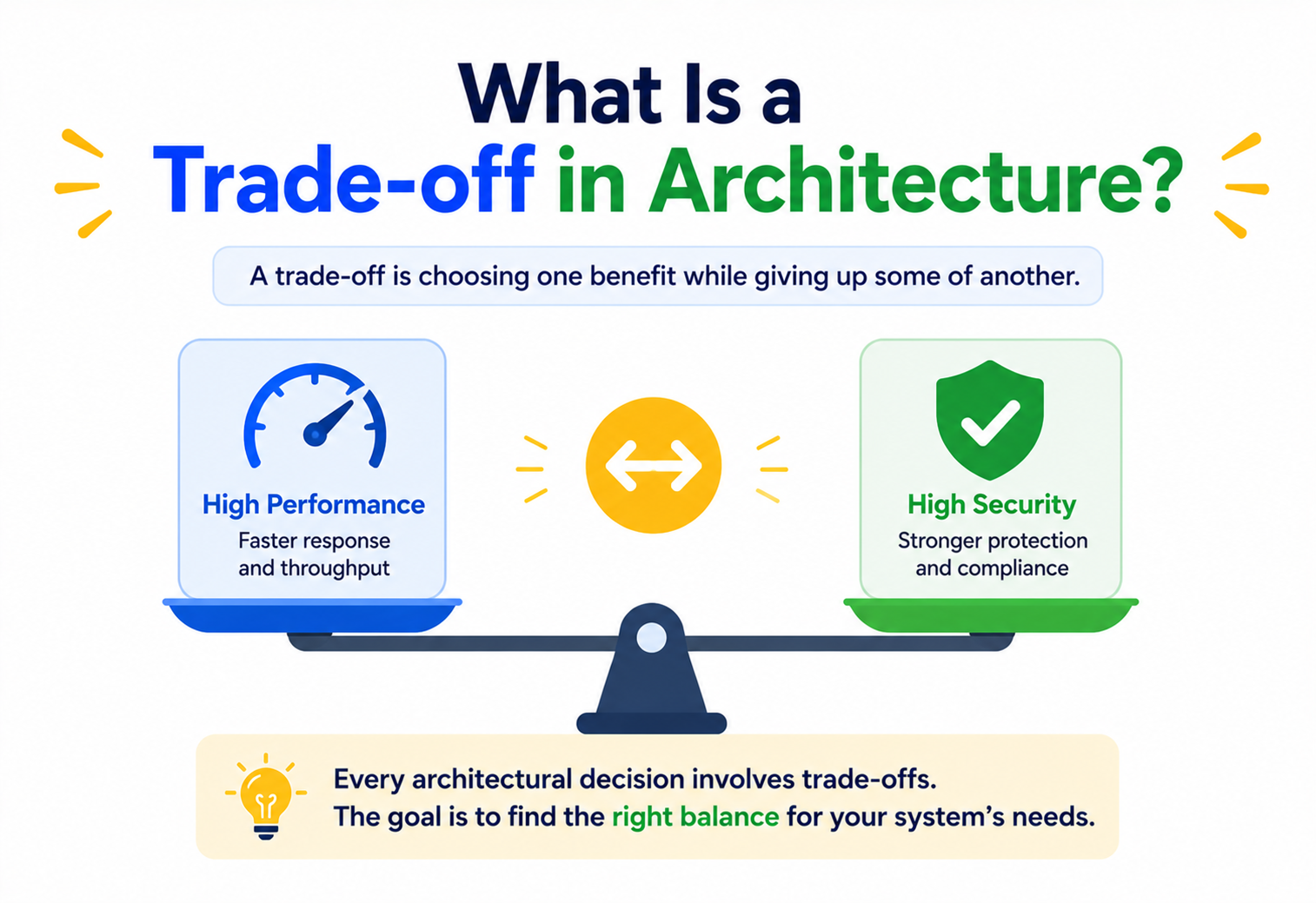
What Is a Trade-off in Architecture?
You can’t have everything at once — not in a treehouse, not in a school timetable, and not in the software running your favourite apps. Here is what a “trade-off” really means, why every good architect has to make them, and how to make them wisely.
The Big Idea, in One Breath
One hour of screen time. Cartoons or games? Whatever you pick, you’re giving up something to gain something else. That tiny everyday choice is the whole heart of architectural trade-offs.
Imagine your parents give you one hour of screen time and ask you to split it between watching cartoons and playing a video game. If you spend the whole hour on cartoons, you get zero minutes of gaming. If you spend it all gaming, you get zero minutes of cartoons. Whatever you pick, you are giving up something to gain something else. That is exactly what a trade-off is — and it happens everywhere, including deep inside the software that runs banks, games, and school apps.
Software architects — the people who plan how big computer systems are built — run into this exact situation every single day, except instead of cartoons and games, they are usually choosing between things like “make it fast” and “make it cheap,” or “make it simple” and “make it able to handle a million users.” They can rarely have every good thing at maximum strength at the same time. So they learn to choose carefully, on purpose, with open eyes — and that skill of choosing wisely is what this entire guide is about.
Think of packing a school bag. You want it light so your back doesn’t hurt, but you also want to carry every book, your lunch, a water bottle, and your art supplies. You cannot make the bag both feather-light and fully packed — you have to decide what matters more today. A software system is the same: you cannot make it maximally fast, maximally cheap, maximally secure, and maximally simple all at once. Something always has to give a little so something else can shine.
The word “trade-off” itself is a lovely little clue if you look closely at it. It is made of “trade” — exchanging one thing for another — and “off,” meaning something is taken away in the process. That’s the whole idea in two syllables: you trade a little bit of one good thing to gain a little bit of another good thing. Nobody loses everything, and nobody gets everything either. The skill of architecture is choosing which trade is worth making, for this particular system, for these particular people, at this particular moment in time.
What a Trade-off Really Is
A precise definition, plus the small but crucial distinction between a trade-off and a plain mistake.
In plain words, a trade-off is a decision where improving one quality of a system means slightly weakening another quality. It is not a mistake, and it is not a sign that the architect did a bad job. It is simply what happens any time two good things pull in different directions and you only have limited time, money, and effort to spend.
Architects have a special name for the qualities that get traded against each other: Quality Attribute Requirements, often shortened to QARs, or sometimes just called “the -ilities” because so many of them end that way — scalability, reliability, maintainability, usability, and so on. A trade-off shows up whenever pushing one of these qualities higher quietly pulls another one lower.
Here’s a very human way to say it: to be an architect is to be someone who wants to build something perfect, and who has to make peace with the fact that perfect is not actually available. The real job is not finding the flawless answer — because it doesn’t exist — but finding the answer that is “good enough,” where the downsides are ones the team and the users can comfortably live with.
If someone asks “what were the trade-offs in this design?”, they are really asking: “What did you give up, and why did you think that was worth it?”
It also helps to notice that a trade-off is different from a plain mistake. A mistake is something nobody wanted and nobody chose on purpose — like forgetting to test a feature before shipping it. A trade-off is something the team saw clearly and chose on purpose, fully aware of the cost, because the benefit was judged to be worth it. That single difference — seeing the cost clearly versus not seeing it at all — is really what separates thoughtful architecture from accidental architecture.
Why Trade-offs Are Unavoidable
Three honest reasons perfection isn’t on the menu: the future is a guess, good qualities can clash, and time and money are never unlimited.
You might wonder — why can’t a really smart team just design a system that is fast, cheap, secure, simple, and scalable, all at the very top level, all at once? There are three honest reasons this almost never happens, and none of them are about the team not trying hard enough.
1. Some Requirements Are Simply Unknown at the Start
When a new app is being built, nobody actually knows how popular it will become. Will ten people use it, or ten million? The team has to guess, and guesses are not the same as facts. Building for ten million users when only ten show up wastes enormous time and money. Building only for ten users, and then suddenly getting ten million, can make the whole system collapse. Since nobody can see the future perfectly, some trade-offs are really just educated bets.
2. Good Qualities Often Pull Against Each Other
Some qualities are simply opposites in disguise. Making a system extremely secure (lots of checks, passwords, and locks) usually makes it a little slower and a little harder to use. Making a system extremely fast often means storing shortcuts (called caches) that can occasionally show slightly outdated information. These are not accidents — they are built into the very nature of what each quality demands.
3. Time, Money, and People Are Always Limited
Even if a team could theoretically solve every quality perfectly, they usually don’t have unlimited time or an unlimited budget to do it. A small start-up building its very first version of an app cannot spend eight months preparing for ten million users who may never arrive. So the team consciously decides where to spend their limited effort, and where to accept a smaller compromise.
The future is a guess
Nobody can be certain how many people will use a system, so some early requirements are simply educated guesses.
Good things can clash
Being extremely secure and being extremely fast often pull the design in opposite directions.
Nothing is unlimited
Time, money, and skilled people always run out before every quality can be maximised.
Needs shift over time
A choice that fit perfectly last year might not fit the business at all this year.
There’s also a very human side to this. Making a trade-off can genuinely feel disappointing to a team, especially one that holds itself to high standards. Choosing a compromise can feel like admitting defeat, even though it is actually the mature, professional thing to do. The healthiest engineering teams learn to see trade-offs not as failures, but as the normal cost of shipping something real into the real world.
It also helps to remember that trade-offs are not unique to computers at all — they show up in almost every grown-up decision too. A family choosing a home has to weigh a shorter commute against a bigger garden. A school choosing a timetable has to weigh more break time against more class time. Architecture simply borrows this very human pattern and applies it to code, servers, and databases instead of houses and timetables. Once you start noticing the pattern, you begin seeing it absolutely everywhere, not just in software.
The Building Blocks of a Trade-off
Five vocabulary words that unlock almost every architecture conversation about trade-offs, even the very technical ones.
To talk about trade-offs clearly, architects use a small set of building-block words. Once you know these five words, you can follow almost any conversation about architecture trade-offs, even a very technical one.
- Quality attribute — a property of the system such as speed, safety, or ease of use.
- Scenario — a short, concrete sentence describing how a quality attribute will be tested, such as “the page must load in under two seconds when 500 people are using it at once.”
- Sensitivity point — a single design decision that has a big effect on one particular quality attribute, for better or worse.
- Trade-off point — a design decision that affects two or more quality attributes at the same time, often pushing one up while pushing another down.
- Risk — a decision that could cause real trouble later if the assumptions behind it turn out to be wrong.
Notice how the middle box — “Add a Cache” — is the actual trade-off point. It is not good or bad by itself. It becomes good or bad depending on what the system needs most: an online game leaderboard might be totally fine with slightly old data if it means everything feels instant, while a hospital’s patient records system would never accept old data, no matter how much speed it bought.
Trade-off vs. Requirement vs. Risk
Three words that regularly get tangled together. A tiny table — using the same school-bag example — sorts them out for good.
These three words often get mixed together, so here is a simple way to keep them apart, using our school-bag idea again.
| Question | Who Answers It | School Bag Example |
|---|---|---|
| What do we actually need? | Requirement | “I need my books, lunch, and water bottle every day.” |
| What am I giving up to get something else? | Trade-off | “I’ll leave the heavy art kit at home so the bag isn’t too heavy.” |
| What could go wrong because of that choice? | Risk | “If there’s an art class today, I won’t have my supplies.” |
A requirement tells you what the system must do. A trade-off is the decision you make when two requirements pull against each other and you cannot fully satisfy both. A risk is what might happen later if that trade-off turns out to be the wrong bet — for example, if the “unlikely” busy day turns out to happen every single day.

Not every trade-off is risky, and not every risk comes from a trade-off. A trade-off becomes risky mainly when the team isn’t fully sure how things will play out in the real world — which, in software, is most of the time.
Common Types of Trade-offs
Seven classic tug-of-wars that show up in almost every codebase. Learning to name them makes any architecture conversation instantly clearer.
Over many years of building software, engineers keep bumping into the same handful of tug-of-wars, again and again. Knowing these by name makes it much easier to spot them in real projects.
Performance vs. Scalability
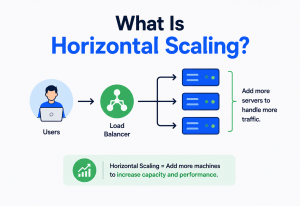
Performance is how fast the system answers one single request. Scalability is how well it keeps working as thousands more people show up at once. A trick that makes one single answer super fast, like storing everything on one powerful computer, can actually make it harder to add more computers later to handle more people.
Choosing Performance
- Feels instant for today’s users
- Simpler to build right now
- Great for smaller, steady audiences
Trade-off Paid
- May struggle if traffic suddenly grows
- Could need a costly rebuild later
- Harder to add more machines quickly
Consistency vs. Availability
Consistency means everyone sees the exact same, most up-to-date information at the exact same moment. Availability means the system always answers, even if one part of it is having trouble. When the network connecting different parts of a system breaks (which does happen), you cannot have both perfectly — you must decide whether to pause and wait for consistency, or answer anyway and risk showing slightly different information in different places.
Security vs. Usability
More locks, more passwords, and more checks make a system safer, but each one adds a small amount of friction for a real person trying to use it. A banking app that asks for five passwords is very secure but very annoying. A banking app with no password at all is effortless but unsafe. The right balance depends entirely on what is being protected.
Cost vs. Speed to Market
Building the sturdiest, most future-proof version of a system usually takes longer and costs more. Building a quick, “good enough” first version gets it in front of real users sooner, so the team can learn whether anyone even wants it — but it may need rework later.
Flexibility vs. Simplicity
A very flexible system can be reshaped for many future needs, but that flexibility usually adds extra layers and extra complexity today. A very simple system is easy to understand and fix, but may need to be redesigned if requirements change a lot.
Build vs. Buy
Teams can build a piece of the system themselves, keeping full control but spending lots of time, or they can buy or reuse something that already exists, saving time but depending on someone else’s tool and its limitations.
Latency vs. Throughput
Latency is how long a single task takes from start to finish, like how long one delivery van takes to reach one house. Throughput is how many tasks the whole system can finish in a given stretch of time, like how many houses all the delivery vans together can reach in a day. Sometimes the fastest way to boost throughput is to group many small tasks into a bigger batch before processing them, which makes each individual task wait a little longer — a direct trade between the two.
Coupling vs. Independent Teams
When parts of a system share a lot of code and data directly, changes can be made quickly because everything is right there together — but it also means one team’s mistake can easily break another team’s part. Keeping parts loosely connected lets teams work independently and safely, but usually adds extra communication steps between the parts, which can slow things down slightly.
Performance ↔ Scalability
Fast for one user today, versus fast for a million users tomorrow.
Consistency ↔ Availability
Always accurate, versus always answering, when a network hiccup hits.
Cost ↔ Speed to Market
A sturdier build takes longer and costs more upfront.
Latency ↔ Throughput
One task done quickly, versus many tasks done efficiently together.
A Deep-Dive Example: The CAP Idea
Two computers, two cities, one broken cable for a few seconds. Watch a famous trade-off play out in slow motion.
Let’s slow down and walk through one famous trade-off in detail, because it shows exactly how these decisions play out in the real world. Imagine a system is split across two different computers, sitting in two different cities, and the network cable connecting them suddenly goes down for a few seconds — this really does happen, even to the biggest companies in the world.
When that network gap happens, the system has exactly two choices, and it must pick one:
Picture two classmates keeping score of a game on two separate notebooks in two separate rooms, with no way to talk to each other for a minute. If someone asks each of them “what’s the score right now?”, they can either refuse to answer until they’ve compared notebooks (accurate, but slow), or answer immediately from their own notebook, risking a slightly different number than the other room (fast, but possibly mismatched for a moment). Big distributed computer systems face this exact dilemma constantly.
This is not a flaw in anyone’s programming — it is a basic limit of physics and networks. A shopping website often chooses to “answer anyway,” because showing a product page that’s a second out of date is far less harmful than showing no page at all. A banking system handling a money transfer often chooses to “wait,” because showing the wrong account balance, even briefly, could cause real harm. Neither choice is universally right — the correct one depends entirely on what the system is for.
How Architects Actually Handle Trade-offs
Not genius. Not luck. Five repeatable habits any careful engineer can practise, turning a scary judgement call into a calm, defensible decision.
Making a good trade-off is not about being a genius who magically knows the right answer. It is a repeatable skill, built from a handful of honest habits that any careful architect can practise.
List the Real Alternatives
Write down two or more genuinely different ways to solve the problem, not just one idea dressed up in different words.
Name What Each Option Costs
For every alternative, spell out plainly which quality gets better and which quality gets a little worse.
Test Cheaply Before Committing
Run a small, low-cost experiment — a prototype, a pilot, a limited release — to see how the trade-off behaves with real usage.
Write Down the “Why”
Record the reasoning behind the final choice, so that anyone reading it a year later understands why it made sense at the time.
Revisit When Conditions Change
Treat the decision as good for now, not good forever — and be ready to reopen it if the situation shifts.
One truth that surprises many new engineers: no amount of talking, whiteboard-drawing, or debating in a meeting room can fully prove whether a trade-off was the right one. The only real way to find out is to build a piece of it, let real people use it, and watch what actually happens — because real usage always turns up surprises that pure discussion never does.
A Formal Way to Do It: The ATAM Method
The Architecture Tradeoff Analysis Method: a structured, written, team-wide way to make trade-offs visible before a single line of production code is written.
Because trade-offs matter so much, engineers eventually built a structured, repeatable way to study them properly, instead of leaving everything to gut feeling. It is called the Architecture Tradeoff Analysis Method, or ATAM for short, and it was developed by researchers who wanted a careful, step-by-step way to catch weak spots in a system’s design before it gets built — a bit like a home inspector checking a house for hidden problems before anyone signs the paperwork.
ATAM brings together three different groups of people: an outside evaluation team who has no personal stake in the decision, the project’s decision-makers who can actually approve changes, and the wider group of stakeholders — the people who will build, maintain, test, and use the system.

The Rough Flow
Everyone starts by agreeing on the business goals — what the system truly needs to achieve and why. From there, the group turns those goals into specific, testable scenarios, like “search results must appear in under one second even with 10,000 people searching at once.” Each scenario is then checked against the proposed design to surface sensitivity points (decisions that strongly affect one quality), trade-off points (decisions that affect two or more qualities in opposite directions), and risks (decisions that could cause real trouble if assumptions turn out wrong).
Risks & Non-Risks
A clear list of decisions that could cause trouble, and decisions confirmed to be safe.
Sensitivity Points
Design choices with an outsized effect on one particular quality, good or bad.
Trade-off Points
Choices that visibly pull two or more qualities in opposite directions at once.
Prioritised Scenarios
A ranked list of the situations the architecture is expected to handle well.
ATAM doesn’t try to guess the “one true answer.” Instead, it makes every trade-off visible and written down on paper, so the whole team is choosing with open eyes instead of by accident.
You don’t need to run a full, formal ATAM workshop for a school project or a small app — most teams borrow just the spirit of it: name your goals, name your options, name what each option costs, and write it down somewhere everyone can see. Even that lighter version prevents a huge number of “wait, why did we build it this way?” conversations six months down the road.
A full ATAM workshop usually unfolds in stages spread across a few weeks rather than a single afternoon. The first stage is quiet preparation — picking the right people and lining up the right documents. The next stage is where most of the real discussion happens, as the architecture is presented and picked apart scenario by scenario. A short gap often follows, giving the evaluation team time to think without pressure, before a second, larger session brings in the wider group of stakeholders to stress-test the findings. The whole process wraps up with a written report that any future engineer can read to understand exactly what was decided, and why — turning what could have been a few scattered opinions into a lasting, shared record.
Common Pitfalls When Making Trade-offs
Five recurring traps — from pretending there is no trade-off, to copying someone else’s answer blindly. Each one has the same root: refusing to name the cost out loud.
Pretending There’s No Trade-off
The most dangerous mistake is not making a bad trade-off — it is not noticing that a trade-off is happening at all. A team that says “this design has no downsides” almost always finds out the downside later, at the worst possible moment, usually right after launch.
Deciding Based on Technology You Don’t Understand Yet
Sometimes a team picks a familiar tool instead of a better-fitting one, simply because nobody on the team knows the better tool well enough to trust it. That is still a trade-off — trading a better long-term fit for short-term comfort — but it should be made on purpose, not by accident.
Chasing an Imaginary “Perfect” Design
Some teams get stuck endlessly debating, afraid to commit to any option because none of them feel flawless. This delay itself is a trade-off — trading speed for a feeling of safety that never actually arrives, since a perfect option was never on the table to begin with.
Never Writing the Reasoning Down
A choice made quietly in a hallway chat or a private message, with no record of why, is a ticking time bomb. Months later, nobody remembers the reasoning, someone “fixes” it by accident, and the exact same problem it solved quietly comes back.
Copying Someone Else’s Trade-off Blindly
Reading that a huge, famous company chose a certain design can be tempting to copy directly. But that company’s users, budget, and problems are almost never the same as yours. A trade-off that was wise for a company serving a billion people can be completely wrong for a small app serving a few thousand — borrowing the reasoning is smart, borrowing the exact answer usually isn’t.
A trade-off that was reasonable a year ago but was simply never revisited. Systems that stay healthy are the ones where old decisions get checked again as the situation changes — not decisions treated as permanently fixed the day they were made.
How Trade-off Decisions Evolve Over Time
A trade-off is a good-for-now decision, never a good-forever one. Fitness functions, revisit habits, and written records keep old choices honest as the world changes.
A trade-off that made perfect sense on day one of a project can quietly become the wrong choice a year later, simply because the world around it changed. A system built for a hundred users that suddenly gets a million overnight is not “broken” — its old trade-offs have simply outgrown their usefulness, the same way a favourite pair of shoes eventually gets too small.
Healthy teams treat this as completely normal rather than as a failure. They check in on old decisions on purpose, ask whether the original reasoning still holds true, and are willing to redo a choice if the answer is no. This willingness to say “that decision doesn’t fit anymore, let’s change it” is actually one of the strongest signs of a mature engineering team — far stronger than pretending every early decision was permanently correct.
Think about choosing a route to walk to school. When you were younger and shorter-legged, the flattest, gentlest path made the most sense, even if it took a little longer. As you grew taller and stronger, the shorter, slightly steeper path might now be the better trade-off. The “best” route didn’t fail — it simply stopped being the best fit as you changed. Software systems grow and change in exactly the same way.
Many teams borrow a simple habit from good architecture practice to stay ahead of this: setting up small, automated checks — sometimes called fitness functions — that continuously verify a system still behaves the way it is supposed to. Think of it like a regular health check-up rather than waiting for a medical emergency. If response time starts creeping past what was promised, or if a cost figure quietly climbs too high, the check raises a flag long before it becomes an emergency, giving the team a calm, early chance to revisit the trade-off instead of a stressful, late-night scramble.
Documenting the trade-off well the first time makes this entire process far easier later on. A short written note explaining what was chosen, what was given up, and what conditions would justify changing the decision acts like a message sent forward in time to a future engineer — quite possibly the same person, a little older and a little wiser. That small act of writing things down is one of the cheapest, highest-value habits in all of software architecture.
Key Takeaways
If you remember only these seven ideas from the whole guide, you’ll be able to hold an honest trade-off conversation with almost anyone.
Remember This
- What a trade-off is. A trade-off happens whenever improving one quality of a system quietly weakens another quality.
- Why they can’t be avoided. Trade-offs are unavoidable because the future is uncertain, good qualities can pull against each other, and time and money are always limited.
- Five words to know. Quality attribute, scenario, sensitivity point, trade-off point, and risk unlock most trade-off conversations.
- Classic tug-of-wars. Common ones include performance vs. scalability, consistency vs. availability, security vs. usability, cost vs. speed, and flexibility vs. simplicity.
- ATAM makes it structured. The ATAM method turns trade-off analysis into a structured, written, team-wide activity instead of a private guess.
- Build to learn. The only real way to test a trade-off is to build something small, release it, and watch what genuinely happens.
- Good today, not forever. A good trade-off today is not a trade-off forever — healthy teams revisit old decisions as the world around them changes.