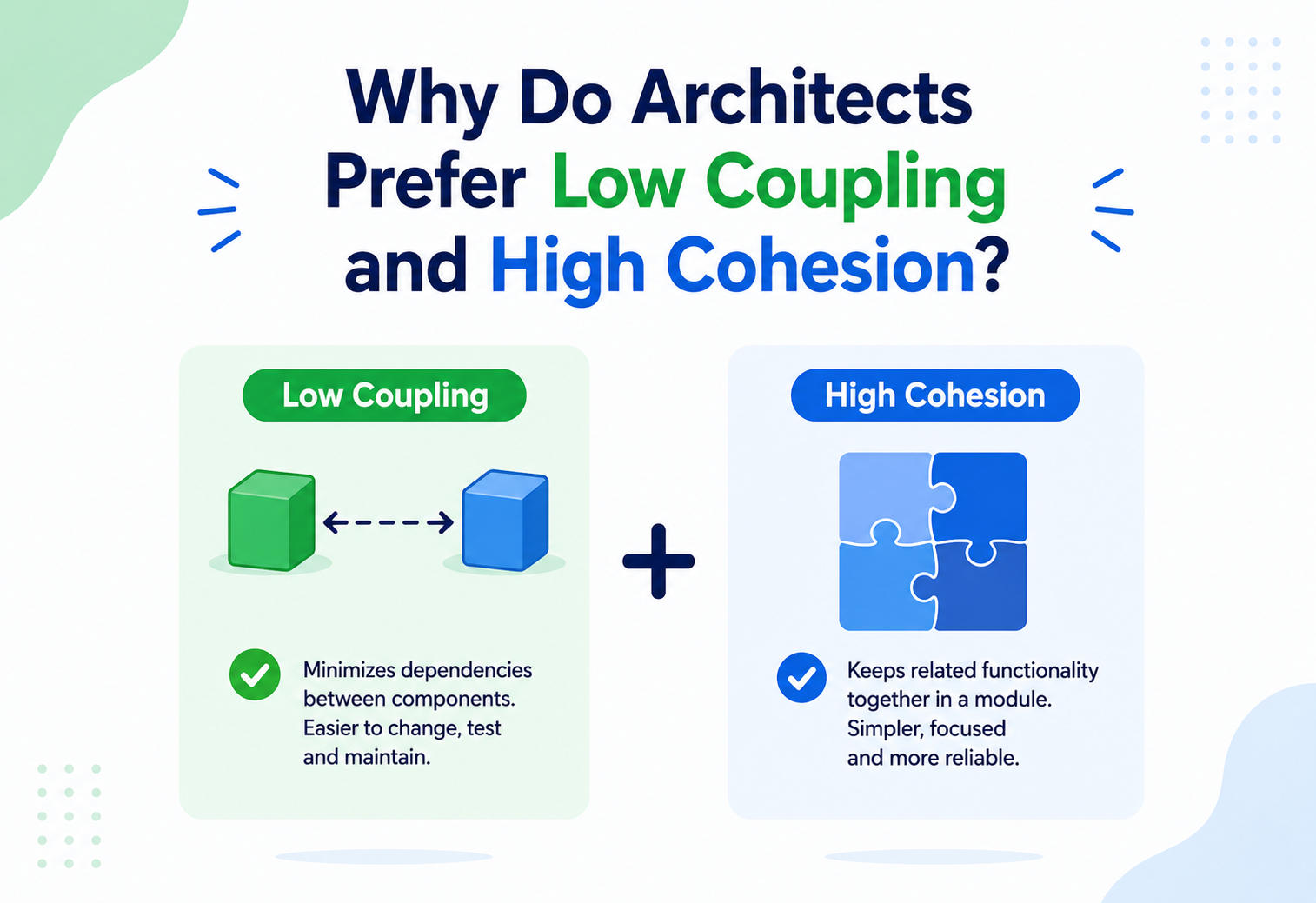
Why Do Architects Prefer Low Coupling and High Cohesion?
Ask any experienced architect what makes a system pleasant to work in five years from now, and two words come up almost every time: coupling and cohesion. This guide brings both ideas together and answers the question every engineer eventually asks — why does this pairing matter so much, in practice, in real money, and in real time saved?
The Big Idea, in One Breath
High cohesion means each piece of a system does one clear job well. Low coupling means those pieces connect through simple, stable rules rather than a tangled web. Together, they’re the single most agreed-upon pairing in architecture.
Picture a great sports team. Each player has one clear position and gets excellent at it — the goalkeeper focuses on goalkeeping, the striker focuses on scoring. That’s focus, and in software we call it cohesion. At the same time, the players don’t need to know every detail of each other’s training routines to work together well on the field — they simply pass the ball at the right moment, following a few shared, well-understood rules. That’s a healthy connection without unnecessary tangling, and in software we call it low coupling.
Put those two qualities together, and you get a team that plays beautifully — flexible, resilient, and able to bring in a new player without retraining the entire squad. Put them together in software, and you get a system architects genuinely love working in: one where each part does one job well, and where those parts connect through clean, simple, dependable rules rather than a tangled web of assumptions. This combination — high cohesion and low coupling — is one of the very few pieces of advice nearly every experienced architect agrees on, regardless of language, industry, or company size.
Think of a set of interlocking building blocks. Each block does one simple job — being a wall piece, a roof piece, a window piece — and every block connects to any other block through the very same simple studs on top. You can swap a red wall block for a blue one, or replace the roof entirely, without the rest of the structure caring in the slightest. That’s high cohesion (each block does one clear job) working hand in hand with low coupling (a simple, universal way for blocks to connect) — and it’s exactly why building with blocks like this feels so effortless compared to building with a pile of oddly shaped, custom-glued parts.
What makes this particular pairing so widely agreed upon, across nearly every corner of the software industry, is that it isn’t tied to any one programming language, company size, or fashionable trend. Whether a team is building a tiny mobile app or a sprawling banking platform, the same underlying question keeps returning: does each piece know its own job clearly, and does it avoid leaning too heavily on the private details of its neighbours? The answer to that question, more than almost any other single factor, predicts how pleasant — or how painful — working in that codebase will feel a year from now.

A Quick Refresher on Both Ideas
Cohesion looks inward at a single piece of code — a function, a class, a service — and asks: “how well do the things inside this piece genuinely belong together?” A highly cohesive piece does one clear job, and everything inside it exists purely to support that job.
Coupling looks outward between two separate pieces of code and asks: “how much does one of these depend on the private, internal details of the other?” Low coupling means two pieces can change independently, cooperating only through a small, stable, agreed-upon connection point.
Cohesion asks “does this piece make sense on its own?” Coupling asks “how much trouble does this piece cause its neighbours when it changes?” Good architecture answers “yes” to the first question and “very little” to the second.
It’s worth noting that neither idea is brand new or exotic — both were studied and named decades ago, as engineers looked for ways to explain, in precise terms, why some programs were a joy to maintain while others became slower and more painful to touch with every passing year. What’s changed since then isn’t the underlying idea, but the scale at which it’s applied — from a single function inside one program, all the way up to how hundreds of independent services within a massive company are organized around each other today.
Why This Pairing Matters So Much
At the heart of almost every architectural decision sits one quiet, unavoidable truth: software changes constantly, and the real cost of a system isn’t how hard it is to build the first time — it’s how hard it is to change afterward, again and again, for years. High cohesion and low coupling exist specifically to keep that ongoing cost of change as low as possible.
Think about what happens without them. In a low-cohesion, high-coupling system, a single small request — “just update how shipping costs are calculated” — can quietly ripple through a dozen unrelated files, break something in an unrelated screen, and take a nervous, cautious engineer three days instead of thirty minutes. In a high-cohesion, low-coupling system, that same request touches one clearly labelled place, and the change is finished, tested, and shipped with confidence, often within the hour.
This difference compounds dramatically over the life of a real project. A single slow, risky change might feel like a minor annoyance the first time it happens. But multiply that same friction across hundreds of small changes, spread across several years and many different engineers, and the gap between a well-structured system and a poorly structured one stops being a minor annoyance — it becomes the single biggest factor separating a product that keeps shipping new features confidently from one that quietly grinds to a crawl under the weight of its own history.
Changes finish faster
Focused, loosely connected pieces mean less time spent tracing ripple effects across the whole system.
Fewer accidental breakages
Engineers can change one part without constantly worrying about silently breaking five others.
Lower long-term maintenance bills
Untangling a messy, tightly coupled system later is consistently far more expensive than building cleanly from the start.
Easier to scale the team
More engineers can work safely at the same time when the pieces they’re touching don’t constantly step on each other.
The Four Quadrants Every Architect Recognizes
Placing cohesion and coupling on two crossing axes produces four honest, recognizable outcomes, and every real system leans toward one of them. This simple mental map is one of the most useful tools an architect can carry, because it turns a fuzzy feeling — “this code feels messy” — into a specific, nameable diagnosis that a whole team can discuss and act on together.
High Cohesion, Low Coupling — “The Ideal”
Each part does one clear job, and connects to its neighbours only through small, stable, well-understood interfaces. This is the quadrant every architect is quietly aiming for, even if perfection is never fully reached.
High Cohesion, High Coupling — “The Fragile Specialist”
Each part is individually well-focused and easy to understand on its own, but the parts are tangled together tightly, so a change to one still ripples painfully into the others. It’s a well-organized team of specialists tied together with rigid, unbreakable ropes.
Low Cohesion, Low Coupling — “Scattered but Safe”
The parts don’t depend heavily on each other, which limits the damage of any single change, but each individual part is a confusing grab-bag of unrelated responsibilities, making the system merely tedious to work in rather than genuinely dangerous.
Low Cohesion, High Coupling — “The Danger Zone”
The worst possible combination — messy, unfocused parts that are also tightly tangled together, meaning small changes are both hard to locate and likely to break something else entirely unrelated. Systems that fall into this quadrant are the ones teams eventually describe as “nobody wants to touch that code.”
It’s worth being honest that no system stays perfectly still in one quadrant forever. A codebase that starts firmly in “the ideal” can drift toward “the fragile specialist” or even the danger zone over time, usually not through any single dramatic decision, but through a long accumulation of small, individually reasonable shortcuts. Recognising which quadrant a piece of code currently sits in — and noticing which direction it’s drifting — is far more useful in practice than treating the map as a one-time judgment made only at the very beginning of a project.
How These Two Qualities Quietly Reinforce Each Other
It’s not a coincidence that cohesion and coupling are almost always discussed together — improving one tends to naturally improve the other. When a class is genuinely focused on one clear purpose, it usually only needs a small, specific slice of information from its neighbours, which keeps the connections between them thin and simple. When a class is doing several unrelated jobs, it usually needs to reach out to many different, unrelated things to support all of those jobs, tangling it up with far more of the system than it should ever need to touch.
The relationship works in reverse too. Deliberately working to reduce coupling — by introducing a clean interface, for instance — often forces a helpful, clarifying question: “what exactly does this piece need to expose to the outside world?” Answering that question honestly frequently reveals that a class was trying to do too much in the first place, nudging it naturally toward higher cohesion as a side effect.
This mutual reinforcement is part of why experienced architects rarely try to fix one quality in complete isolation from the other. Picking up any thread — tidying a messy interface, or splitting an overloaded class — tends to pull gently on the other thread too, which is exactly why small, regular improvements compound so effectively over time, even without a single grand redesign effort.

The Real, Measurable Benefits
What This Combination Delivers
- Bugs stay contained to the piece that caused them, rather than spreading unpredictably
- New features can often be added by writing new code, not editing risky, unrelated old code
- Testing becomes dramatically simpler, since each piece can be verified largely on its own
- New engineers ramp up faster, since each piece tells one honest, understandable story
- Individual pieces can be replaced or rewritten without threatening the rest of the system
What Its Absence Costs a Team
- Simple requests take unexpectedly long, because nobody’s quite sure what else might break
- Engineers grow hesitant and slow, since every change feels like walking on thin ice
- Onboarding new team members takes far longer, with no clear story to follow
- Technical debt accumulates quietly, since nobody wants to touch the messiest areas
- Eventually, a full, expensive rewrite starts to feel like the only realistic option
A well-organized library, where books are grouped by clear, sensible categories and each shelf holds only what belongs there, lets a librarian reorganize the mystery section without disturbing the cookbooks at all. A library where books are shelved randomly, with strings tied between related titles scattered across the building, makes even a small reorganization a nerve-wracking, tangled ordeal. High cohesion and low coupling are simply good shelving, applied to code.
It’s worth noticing that almost none of these benefits are purely technical — every single one of them eventually shows up as something a business genuinely cares about: faster delivery of new features, fewer late-night incidents, lower hiring and onboarding costs, and a team that can confidently commit to deadlines instead of padding every estimate with fear of the unknown. This is precisely why the pairing shows up so consistently in serious architectural conversations, well beyond the walls of any single engineering team.
The Honest Trade-offs
Pursuing Both Perfectly Takes Real Time
Carefully designing clean interfaces and genuinely focused classes takes more upfront thought than simply writing the fastest thing that works today. For a short-lived prototype or a weekend experiment, this extra care may not be worth the investment — the trade-off shifts meaningfully once code is expected to live and grow for years.
Over-Correction Creates Its Own Mess
Chasing this ideal too aggressively can lead to needless layers of tiny interfaces and hyper-fragmented classes, creating a different kind of confusion — one where following a single feature requires jumping through far more files than the problem actually warrants. The goal was never maximum separation everywhere; it was meaningful, honest separation where it genuinely helps.
Some Coupling and Some Sharing Is Simply Necessary
A system with zero coupling and infinitely narrow cohesion couldn’t actually do anything useful, since nothing would ever cooperate with anything else. The goal is always a healthy balance suited to the actual problem, not the theoretical extreme of either quality.
Treating high cohesion and low coupling as a checkbox to tick once and forget, rather than an ongoing habit. Systems drift toward the “danger zone” gradually, one small shortcut at a time, unless someone keeps gently steering them back.
How Architects Actually Evaluate It
Neither cohesion nor coupling comes with one single perfect number, but experienced architects rely on a handful of honest, practical signals rather than guesswork.
A particularly telling, practical signal is watching how often a class or module gets modified, and for how many genuinely different reasons. A class that’s edited constantly, for reasons spanning five unrelated features, is quietly announcing both low cohesion (it’s doing too much) and high coupling (too many unrelated things depend on it) at the very same time.
Some teams also track more formal metrics — counting how many other components a given piece depends on, or how many depend on it — as an early-warning system. These numbers are never the whole story on their own, but a component with an unusually high count in either direction is usually worth a closer, human look, the same way an unusual reading on a health check-up prompts a doctor to investigate further, not to panic immediately.
Perhaps the most reliable measurement of all, though, isn’t a number at all — it’s simply asking the engineers who work in a piece of code every day how it feels to change. A team that answers “we dread touching that file” is describing low cohesion and high coupling in plain, human language, just as accurately as any formal metric could, and often earlier than any automated tool would catch it.

How to Actually Achieve Both Together
Struggle to name it? Split it.
If a class or module can’t be named clearly and honestly, that’s usually a sign it’s doing more than one job.
Talk through a small doorway
Let components interact through a simple, stable interface, hiding their internal details from each other completely.
Not by surface similarity
Keep things together because they genuinely change for the same reason, not merely because they sound related.
Revisit boundaries as the system grows
A boundary that made sense a year ago may no longer fit; healthy teams redraw boundaries deliberately, rather than never at all.
A genuinely practical exercise is to periodically pick the single class or module that causes the team the most anxiety to touch, and ask two direct questions about it: “does everything inside genuinely belong together?” and “does it know far more about its neighbours than it should?” Improving even one honest answer to either question, on a regular basis, compounds remarkably well over the life of a project.
It’s also worth building this thinking into the very earliest stages of designing something new, rather than only applying it as cleanup later. Before writing the first line of a new feature, sketching out — even roughly, on paper — which piece will be responsible for what, and how those pieces will talk to each other, tends to prevent a large share of coupling and cohesion problems from ever being written in the first place, which is always cheaper than fixing them afterward.
Common Mistakes Teams Make
Even teams who genuinely understand both concepts in theory still stumble in practice, usually because the two qualities are easy to discuss separately but harder to hold in mind together while actually writing code under deadline pressure.
Chasing One Quality While Ignoring the Other
Some teams obsess over splitting everything into tiny, focused pieces while forgetting to design clean interfaces between them, accidentally landing in the “fragile specialist” quadrant. Others obsess over loose connections while letting individual pieces grow bloated and unfocused, landing in “scattered but safe.” Real success requires attention to both qualities together, not just one.

Treating It as a One-Time Design Decision
A system designed with excellent cohesion and coupling on day one can still drift toward the danger zone over months of feature additions, unless someone keeps deliberately tending to it. This is a maintenance habit, not a single milestone to check off and forget.
Optimizing for the Wrong Timeframe
Applying the full rigor of this principle to a two-week prototype that will be thrown away can genuinely waste effort. Applying too little rigor to a system expected to last a decade guarantees painful, expensive problems later. Matching the level of care to the expected lifespan of the system is itself an important architectural judgment.
Forgetting the Human Side
It’s tempting to treat this purely as a technical metric, but its biggest real-world payoff is human: engineers who feel confident, unafraid, and unhurried when making changes. Losing sight of that human outcome while chasing a theoretically “perfect” structure misses the entire point of pursuing it in the first place.
Saying “We’ll Clean It Up Later” Indefinitely
It’s easy to acknowledge a piece of tangled, unfocused code and quietly promise to fix it “once things calm down.” In most real teams, things rarely calm down on their own, and the promised cleanup keeps sliding further into the future while the underlying problem quietly grows more expensive to fix. Small, immediate improvements tend to actually happen; large, deferred ones very often don’t.
Best Practices for Keeping Both Healthy
Ask the two key questions together
During reviews, ask both “does this belong together?” and “does this share more than it needs to?” as a paired habit.
Improve gradually, not all at once
Fixing one clearly overloaded, entangled piece whenever you’re already working nearby beats scheduling one giant cleanup.
Give the team a common language
Make sure everyone on the team understands and uses these two words the same way, so design conversations stay precise.
Notice when it pays off
When a change genuinely takes thirty minutes instead of three days because of clean structure, point it out — it reinforces the habit.
Above all, remember that this pairing is a means to an end — calmer, faster, more confident engineering — not a trophy pursued for its own sake. Any effort spent chasing higher cohesion or lower coupling that doesn’t genuinely make the team’s day-to-day work easier is worth questioning, no matter how correct it looks on paper.
Quick Questions, Straight Answers
Which matters more — cohesion or coupling?
Neither one meaningfully outranks the other; they work as a pair. Focusing entirely on one while neglecting the other tends to land a system in one of the two “half-good” quadrants rather than the genuinely ideal one.

Can a system have perfect cohesion and coupling?
In practice, no — there’s always some tension, some judgment call, some corner of the system that isn’t perfectly clean. The goal is steady, honest improvement over time, not an unreachable, flawless end state.
Does this apply only to code, or to bigger architectural decisions too?
It applies at every scale — from a single function, to a class, to an entire microservice, to how different teams within a company are organized. The same underlying question — does this belong together, and does it share too much with its neighbours — is remarkably consistent no matter how far you zoom out.
How do I convince my team or manager this is worth the extra time?
The most persuasive argument is almost always a real, recent story from the team’s own experience — a specific change that took far longer than it should have because of tangled, unfocused code. Pointing to that concrete, shared memory tends to land far better than an abstract argument about theoretical best practice.
Is it ever acceptable to deliberately accept tighter coupling or lower cohesion?
Yes, occasionally, and being honest about it is far healthier than pretending otherwise. A small, genuinely temporary shortcut, taken consciously and documented clearly, can be a perfectly reasonable trade for meeting an urgent deadline — the danger lies not in ever accepting the trade-off, but in forgetting that it was a deliberate, temporary choice rather than a permanent design decision.
Real-World Examples You Already Recognize
Electrical appliances and wall sockets
Each appliance is focused on its own job — a kettle boils water, a lamp gives light — and every appliance connects through the very same simple plug, a clean example of both qualities working together.
A well-run restaurant kitchen
Each station handles one clear job, and stations pass finished work to each other through simple, agreed hand-offs rather than everyone reaching into everyone else’s pots.
A large e-commerce platform
Payments, inventory, and recommendations are each handled by their own focused service, connected through simple, well-documented requests rather than shared, tangled databases.
A cautionary example
A single class that manages login, sends marketing emails, and calculates shipping costs — while also being directly called from a dozen unrelated screens — sits squarely in the danger zone, and every team that inherits it dreads the day they have to touch it.
Every genuinely good example on this list shares the very same quiet secret: someone, deliberately, drew a clear boundary around one focused purpose, and then designed a simple, stable way for that purpose to connect with everything around it. That single habit, repeated patiently across a whole system, is really the entire art behind why architects care so much about this pairing.
And every cautionary example shares its own quiet secret too: not one big mistake, but a long series of small, reasonable-sounding shortcuts, none of which felt dangerous at the time they were made. That’s ultimately the most important lesson this whole guide has to offer — the difference between a codebase people love and one people dread rarely comes down to a single dramatic decision. It comes down to hundreds of small ones, made a little more carefully.
Key Takeaways
Remember This
- Cohesion asks whether a piece of code makes sense on its own; coupling asks how much trouble it causes its neighbours.
- The four quadrants — the ideal, the fragile specialist, scattered but safe, and the danger zone — describe every real system’s current state.
- High cohesion and low coupling naturally reinforce each other; improving one usually helps the other.
- The real payoff is human: faster changes, fewer accidental bugs, and engineers who feel confident rather than anxious.
- Pursuing this pairing has honest trade-offs too — it takes real time, and can be overdone if chased without judgment.
- It’s a habit to maintain continuously, not a milestone to complete once and forget.