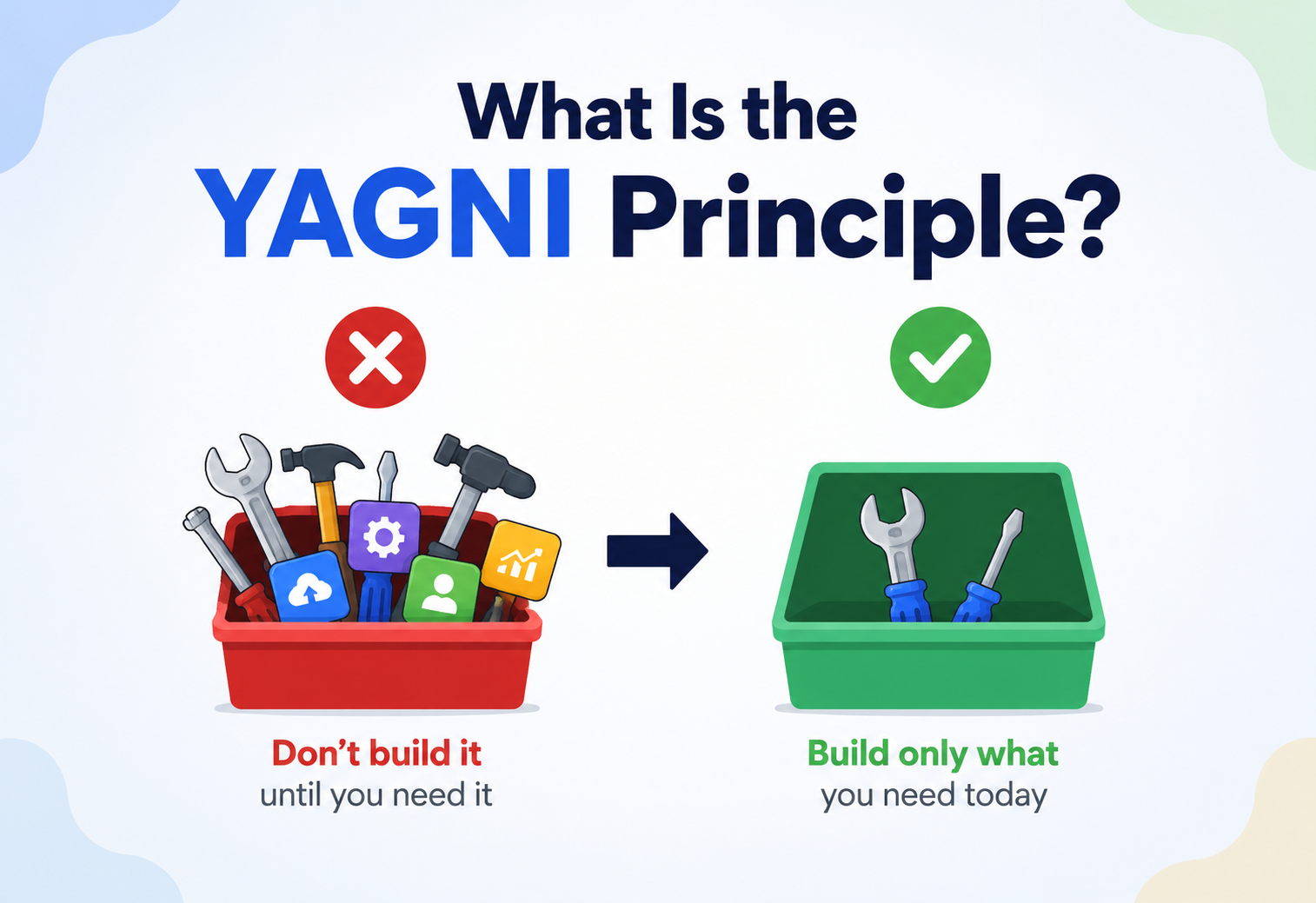
What Is the YAGNI Principle?
A calm, thorough walk through “You Aren’t Gonna Need It” — a principle born on a factory-payroll project in the 1990s that has quietly saved millions of engineering hours ever since, by teaching teams to build for today, not for a guess about tomorrow.
The Big Idea, in One Breath
Imagine packing for a weekend trip to visit a cousin who lives two hours away by car. You could pack exactly what the weekend actually calls for — a couple of outfits, a toothbrush, your phone charger. Or you could also pack your winter coat in case it suddenly snows in July, a spare pair of hiking boots in case you decide to climb a mountain nobody mentioned, and a formal suit in case you get invited to a wedding you don’t know about yet. Every one of those “just in case” items is heavier to carry, takes longer to pack, and, if the weekend goes the way weekends usually go, never actually gets used at all.
That overstuffed suitcase is exactly the trap a well-known software principle was created to help engineers avoid. It is called YAGNI, short for You Aren’t Gonna Need It, and its instruction is refreshingly blunt: build the thing your project actually needs right now, and resist the pull to build extra capability for a future need that has not actually shown up yet. Not because thinking ahead is bad — thinking ahead is a genuinely valuable skill — but because building ahead of a real, confirmed need turns out, again and again, to cost far more than most people expect, and to pay off far less often than most people hope.
YAGNI is not an argument against planning, and it is not permission to write careless, short-sighted code. It is a targeted, practical challenge aimed at one specific habit: writing code today to serve a requirement that only exists in someone’s imagination, rather than in an actual, present need.
Think about a lemonade stand run by two kids for a single Saturday afternoon. One approach is to set up a simple table, a jug of lemonade, and a cash box — everything the afternoon actually requires. Another approach is to first spend the whole morning building a loyalty card system, a delivery service for nearby streets, and a suggestion box for future flavors, on the theory that the stand might someday become a real business. By the time all of that extra machinery is built, the afternoon is half over, and most of it will likely never be used at all. YAGNI is the voice that says: sell lemonade this afternoon. Build the loyalty program if and when there is an actual next Saturday that needs one.
What makes this principle worth a full guide, rather than a single reminder sentence, is how naturally it clashes with a very common, very human instinct among people who build things: the instinct to prepare. Preparation feels responsible. It feels like the mark of an experienced, thoughtful builder. And yet, again and again, across countless real projects, the preparation that turns out to matter is the kind grounded in actual, confirmed needs — not the kind built on an educated guess about a future that, more often than not, arrives looking rather different from how anyone imagined it.
What YAGNI Actually Means
At its core, YAGNI asks a single, honest question before any new piece of functionality, flexibility, or abstraction gets added to a system: is there a real, confirmed need for this right now, or are we building it because we think it might be needed someday? If the answer is a genuine, present need, YAGNI has nothing to say against building it. If the answer is a guess about the future, however reasonable that guess feels, YAGNI’s advice is to wait.
One of YAGNI’s original champions summarized the whole idea in a single, memorable sentence: build things when you actually need them, not simply because you can picture a future where you might. That framing matters, because it draws a clean line between two things that feel similar but are actually quite different — anticipating a need, which is a normal and healthy part of thinking about a system, and building for a need before it has actually arrived, which is where the real cost begins.
Not the Same as “Don’t Think Ahead”
YAGNI is frequently misunderstood as advice to avoid all future thinking, which is not quite right and undersells what the principle is really protecting against. Thinking about where a system might go is valuable, and a thoughtful architect absolutely should keep an eye on the horizon. YAGNI’s real target is narrower and more specific: the moment that forward thinking turns into actual code, configuration, or structure built today to serve a need that has not yet been confirmed. Thinking ahead costs nothing. Building ahead costs quite a lot, as the rest of this guide will show in detail.
YAGNI does not say “never think about the future.” It says “don’t spend today’s time and effort building for a future that hasn’t actually arrived yet.”
A helpful habit that follows from this distinction is separating a conversation from a commitment. It is entirely reasonable, and often valuable, for a team to discuss where a system might eventually need to grow — that conversation costs nothing but a little time and produces useful shared understanding. The moment that conversation turns into actual code, configuration, or database structure built today, purely on the strength of that discussion, is the moment YAGNI’s caution applies. Talking about the future is free. Building for it in advance rarely is.
Where YAGNI Came From
YAGNI grew out of a software methodology from the late 1990s called Extreme Programming, often shortened to XP, developed largely by Kent Beck alongside collaborators including Ward Cunningham and Ron Jeffries. Extreme Programming pushed back hard against the dominant thinking of its era, which favored extensive upfront planning and design before any code was written. XP argued, instead, for short cycles, constant feedback, and a willingness to build only what was truly needed at each step, trusting that later steps could adapt as real requirements became clearer.
The specific phrase behind YAGNI is often traced to a real, human moment on a project known as the Chrysler Comprehensive Compensation system, commonly called C3, an early and influential proving ground for many Extreme Programming ideas. As the story is usually told, a colleague named Chet Hendrickson kept approaching Kent Beck with a series of capabilities the system would supposedly need in the near future. Each time, Beck’s reply was the same: you aren’t going to need it. The phrase stuck, and it was formalized soon afterward in the XP literature, eventually becoming one of the methodology’s most recognizable ideas.
Ron Jeffries, another central figure in Extreme Programming, is widely credited with capturing the underlying philosophy in one especially clear sentence: always build things when you actually need them, never simply because you foresee that you might. That single sentence has outlived the specific project and even the specific methodology that produced it, and it remains, decades later, one of the most quoted pieces of practical wisdom in software engineering.
It is worth appreciating just how contrarian this idea was at the time it emerged. The dominant thinking in the software industry throughout the 1980s and much of the 1990s favored extensive upfront requirements gathering and design, sometimes stretching across months, before any real code was written, on the theory that careful planning would prevent costly mistakes later. Extreme Programming, and YAGNI along with it, pushed directly against that tradition, arguing that plans made with the least available information — right at the very start of a project — were often the least reliable guides for exactly the kind of long-term structural decisions people were trying to get right by planning early. That contrarian stance was controversial in its own era, and the fact that YAGNI has not just survived but become mainstream, quoted approvingly across nearly every corner of modern software practice, says a great deal about how well its core insight has held up.
The Hidden Costs of Building Early
Building a feature before it is genuinely needed feels, in the moment, like getting ahead of the game. In reality, it usually creates several separate, quietly compounding costs, each easy to underestimate on its own.
The Cost of Building It
The most visible cost: time and effort spent designing, writing, and testing a feature that nobody has actually asked for yet. That time is gone whether or not the feature ever turns out to be useful.
The Cost of Delay
Every hour spent on a speculative feature is an hour not spent on the feature real users or stakeholders are actually waiting for right now. Building ahead of need often means the genuinely needed work arrives later than it otherwise would have.
The Cost of Carrying It
Once built, a speculative feature does not sit quietly and cost nothing. It still needs to be read, understood, tested, and maintained by everyone who touches that part of the system afterward, whether or not it is ever actually used.

The Cost of Getting It Wrong
Perhaps the least visible, and most damaging, cost of all: a feature built ahead of real need is built on a guess about what that future need will actually look like. Real requirements, once they finally do arrive, often look different in the details from what was originally imagined — meaning the early, speculative version frequently has to be reworked or discarded anyway, adding a second cost on top of the first.
A feature built “ahead of time” that, once the real requirement finally arrives, does not quite fit and has to be significantly reworked. This is one of the clearest, most common signs that speculative building did not actually save the time it promised.
What makes these four costs especially worth naming individually, rather than lumping them together as one vague “waste,” is that each one is easy to overlook on its own. A team might notice the time spent building a speculative feature and still feel it was worthwhile, without ever accounting for the delay it caused elsewhere, the ongoing weight it added to the codebase, or the very real chance that the guess behind it turns out to be wrong. Seeing all four costs laid out together makes the true price of building ahead of need far harder to underestimate.
The Building Blocks, Side by Side
A picture helps make this concrete. Below, the left side shows a small notification feature built with speculative flexibility for formats nobody has actually requested. The right side shows the same feature, built for exactly what is needed today.
Three of the four channels on the left were never requested by anyone, never tested against a real use case, and never used in production — yet all three still had to be written, still show up every time someone searches the codebase for how notifications work, and still need to be considered every time this part of the system is changed. The version on the right does exactly what today’s actual requirement calls for, and nothing else. If a second channel is genuinely requested next month, that is exactly the moment to build it — with the benefit of knowing precisely what it needs to do, rather than guessing months in advance.
It is also worth noticing what this diagram implies about the person joining the project six months from now. Looking at the left-hand version, that person has no way to tell, just by reading the code, which of the four channels actually matter. All four look equally real, equally finished, equally intentional. Only someone with long institutional memory of the project would know that three of them have never once been used. The right-hand version carries no such hidden history — what exists is exactly what is needed, and nothing requires special inside knowledge to understand.
Why YAGNI Matters So Much
It helps to state plainly what disciplined YAGNI practice actually earns a team, since the benefits are easy to nod along to in the abstract and far more convincing spelled out concretely.
Real needs get built sooner
Time not spent on speculative features is time spent on the requirements that are actually waiting, right now, for attention.
Less to read, less to maintain
A system built only for confirmed needs stays smaller and easier for every engineer to hold in their head at once.
Built with real information
A feature built once the real need is known and understood almost always fits that need more precisely than one guessed at months earlier.
Nothing built purely to be discarded
Speculative features that never get used represent genuine, unrecoverable effort spent on something that added no real value.
There is also a subtler, compounding benefit worth naming directly: a codebase built strictly around real, confirmed needs tends to stay easier to understand as it grows, because every part of it can be explained by pointing to an actual requirement that justified it. A codebase padded with speculative features, by contrast, accumulates confusing, half-explained corners — pieces nobody can quite remember the reason for, because the reason was always a guess to begin with, and guesses are much harder to recall clearly than actual decisions grounded in real events.
There is a genuine business case underneath all of this as well, worth stating plainly for anyone who needs to explain the value of YAGNI to people outside engineering. Every hour spent on a feature nobody asked for is an hour that could have gone toward something a real customer, user, or stakeholder is genuinely waiting on. Over the course of a full year, the cumulative effect of consistently avoiding speculative work can be substantial — not because any single decision was dramatic, but because the discipline compounds, quietly, across hundreds of small choices made throughout a project.
The fastest way to build the wrong thing well is to build it before anyone actually needs it.
A Worked Example: Feeling the Difference
Let’s walk through a small, realistic scenario twice — once built ahead of a guessed future need, and once built strictly for today’s confirmed requirement — so the contrast becomes something you can actually feel while reading code.
Built Ahead of Need
A pricing engine, generalized for currencies nobody has asked forinterface CurrencyConverter {
    double convert(double amount, String fromCurrency, String toCurrency);
}

class ExchangeRateService implements CurrencyConverter {
    private Map<String, Double> rates; // loaded from an external service, just in case
    public double convert(double amount, String from, String to) {
        double rate = rates.get(from + "_" + to);
        return amount * rate;
    }
}

class PriceCalculator {
    private CurrencyConverter converter;
    private String storeCurrency;

    PriceCalculator(CurrencyConverter converter, String storeCurrency) {
        this.converter = converter;
        this.storeCurrency = storeCurrency;
    }

    double finalPrice(double basePrice, String customerCurrency) {
        return converter.convert(basePrice, storeCurrency, customerCurrency);
    }
}

// The store has only ever sold in one currency, to customers in one country.
// No customer, stakeholder, or roadmap has ever mentioned multi-currency support.
Built for Today’s Real Need
A pricing engine, sized to the one confirmed requirementdouble finalPrice(double basePrice) {
    return basePrice;   // the store sells in a single currency; no conversion needed
}
The first version is not badly engineered in isolation — an interface, a rate service, and a calculator are all reasonable, professional patterns. The problem is that none of it was asked for. An external exchange rate dependency, a currency-pair lookup table, and an entire abstraction layer were all built to support a capability that exists nowhere in the store’s actual requirements. If multi-currency support becomes a real, confirmed need next year, building it then — with real information about which currencies, which providers, and which edge cases actually matter — will very likely produce a better solution than the speculative one built today ever would have.
The simple version is not a lesser solution — it is the correctly sized solution for the requirement that actually exists. Sizing a solution to a guess, rather than to reality, is the exact habit YAGNI exists to interrupt.
It is worth being fair to the first version, too: none of its individual pieces are poorly designed. If the store genuinely served customers across many countries and currencies today, that interface-and-service structure would be a perfectly sensible way to organize the work. The mistake was never in how it was built — it was in when. Building the same structure the day multi-currency support becomes a real, confirmed requirement would be exactly the right decision, made with exactly the right timing, using real details about which currencies and providers actually matter rather than a guess made months or years too early.
How to Apply YAGNI in Practice
YAGNI is easy to agree with and, in the heat of an actual project, surprisingly easy to quietly abandon. A few concrete habits help keep it genuinely in practice.
Ask the One Question, Out Loud
Before adding any new capability, ask plainly: is there a real, current, confirmed need for this, or are we anticipating one? Saying the question out loud, in a design discussion or code review, makes it far harder for a speculative feature to sneak through unnoticed.
Notice the Trigger Phrase
The sentence “we might need this later” is one of the clearest, most reliable signals that a decision has drifted from real need into speculation. Hearing that phrase is a natural cue to pause and check whether a genuine requirement actually exists yet.
Wait for the Second and Third Real Case
A single confirmed use case rarely justifies a broad, generic abstraction. Waiting for a second and third genuinely different case to appear gives you real evidence about the actual shape a shared solution should take, rather than guessing at it from one example.
Separate Structural Quality from Speculative Capability
YAGNI is not an excuse for careless, poorly named, or poorly tested code. Clean structure, clear naming, and solid test coverage are not speculative features — they are the ongoing quality of the code you are already writing for a real, current need, and they remain fully expected under YAGNI.
Scope Down Pull Requests That Grew Beyond the Ticket
A change that quietly does more than the original task actually required is harder to review, harder to test, and harder to safely undo if something goes wrong. Checking whether each part of a change answers a need that exists today is a simple, effective habit during code review.
YAGNI is not about writing worse code. It is about only writing the code a real, present requirement actually calls for — and writing that code as well as you would write anything else.
These habits are most effective when practiced consistently, rather than invoked only occasionally as a last-minute objection. A team that regularly asks the one question — is there a confirmed need for this — as a normal, expected part of every design discussion tends to internalize the discipline naturally, to the point where speculative features become noticeably rare without anyone needing to actively police them. A team that only remembers YAGNI after a project has already accumulated significant unused complexity faces a much harder, more disruptive cleanup task than the one they would have faced by simply asking the question earlier and consistently.
YAGNI and Reversibility
One of the most practical refinements to YAGNI is recognizing that not all decisions are equally expensive to postpone. Some choices are cheap to make later, once real information is available. Others are genuinely costly to change after the fact, and deserve a little more forethought even under YAGNI’s general guidance to wait.
Usually Safe to Defer
- Adding a new feature or screen once it is actually requested.
- Introducing a new configuration option when a second real use case appears.
- Extending a function to handle a case nobody has hit yet.
Often Worth Extra Care Upfront
- Choices about the core shape of a database schema.
- The design of a public API other teams or customers will depend on.
- Foundational security or data-privacy decisions.
The practical test many experienced engineers use is straightforward: imagine the real requirement arrives later, and estimate honestly how expensive it would be to add the capability at that point, compared to building it now. If later turns out to be only slightly more expensive — which is true far more often than most people expect — YAGNI’s advice to wait holds firm. If later would genuinely mean an expensive migration, a breaking change for external users, or a rebuild of foundational structure, a small amount of forethought now is a reasonable, deliberate exception, not a violation of the underlying spirit of YAGNI.
YAGNI is at its strongest exactly where reversing course later is cheap. It should be applied with more care, not abandoned, in the narrower set of situations where reversing course later is genuinely expensive.
A useful habit for making this judgment concrete is to picture the actual work involved in adding the deferred capability later, in specific, physical detail — not just a vague sense of “it would be harder.” Would it mean writing a database migration that touches millions of existing rows? Would it mean asking external partners to change how they call a public API they already depend on? Or would it simply mean adding a new function and a few new tests, entirely contained within a single part of the system? The more specific and physical this mental picture becomes, the easier it is to tell genuine, expensive irreversibility apart from a vague, generalized fear of change that does not actually hold up under closer examination.
The Practices YAGNI Depends On
YAGNI was never meant to operate alone. It was originally introduced as one part of a larger set of mutually supporting practices within Extreme Programming, and it tends to work poorly when those supporting practices are missing.
Continuous Refactoring
YAGNI’s promise — build it later, when you actually need it — only holds up if “later” is genuinely affordable. A team with a strong, ongoing habit of refactoring can reshape existing code confidently when a real new requirement arrives. A team without that habit may find that adding the delayed feature later is far more painful than it should have been, not because YAGNI was wrong, but because the supporting practice that makes YAGNI safe was missing.
Automated Testing
A solid, trustworthy suite of automated tests gives a team the confidence to reshape and extend code safely when a real need finally appears. Without that safety net, teams understandably become more hesitant to change existing code later, which can quietly push them back toward speculative building, out of fear rather than genuine need.
Continuous Integration
Frequent, small, well-tested changes make it far easier to extend a system incrementally, exactly when new requirements actually arrive, rather than requiring occasional large, risky pushes of accumulated, speculative work.
YAGNI practiced without these supporting habits can slide into disorganized, patched-together code and accumulating technical debt, since the safety net that makes “build it later” genuinely affordable simply is not there.
This dependency explains an important nuance that is easy to miss: YAGNI is not really a standalone rule that can be lifted out of its original context and applied in isolation with the same confidence. It was designed as one piece of a coordinated set of habits, each one making the others safer and more effective. A team adopting YAGNI on its own, without also building genuine strength in refactoring, testing, and integration, is adopting only half of the original idea — and may find themselves surprised when “we’ll build it later” turns out to be more painful than the principle promised.
YAGNI and Its Neighboring Principles
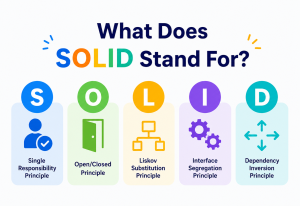
YAGNI sits closely alongside several other well-known design ideas, and seeing how they relate helps sharpen exactly what each one is asking for.
YAGNI and KISS
These two principles are close cousins, but they focus on slightly different moments in a decision. KISS asks, broadly, “is there a simpler way to solve this problem,” which applies to any design decision. YAGNI asks the more specific, timing-focused question: “do we actually have a confirmed need for this right now, or are we anticipating one.” A design can be simple yet still speculative, and YAGNI is the principle that catches that particular case.
YAGNI and DRY
DRY‘s own Rule of Three, discussed in related guides on this topic, actually leans on the same underlying instinct as YAGNI: wait for real, repeated evidence before committing to a shared abstraction. Building a generalized, reusable structure around a single example is both a DRY risk and a YAGNI risk at the same time, since it assumes future repetition that has not yet been confirmed.
YAGNI and Minimum Viable Products
The now-common practice of shipping a minimum viable product — the smallest version of a product that can deliver real value and generate real feedback — is, in many ways, YAGNI applied at the level of an entire product rather than a single line of code. Both share the same underlying belief: real information gathered from an actual, working version beats speculation gathered in advance.
KISS asks “is this simple enough?” DRY asks “is this knowledge duplicated?” YAGNI asks a question that sits earlier than either: “do we even need to build this yet?”
Seeing these three principles as a natural sequence, rather than three unrelated rules, can make them easier to apply together in practice. YAGNI comes first, deciding whether something should be built at all right now. Once the answer is yes, KISS shapes how simply it should be built. And as a solution grows and a genuine, repeated pattern emerges over time, DRY’s Rule of Three decides when that pattern has earned a proper, shared abstraction. Applied in that order, the three principles reinforce rather than compete with one another.
When YAGNI Goes Wrong
Like every principle covered in this series, YAGNI can be misapplied, and understanding the common failure modes matters just as much as understanding the principle itself.
Using YAGNI as a Reflex Instead of a Judgment
Shouted at every single suggestion during a planning meeting, “YAGNI” stops being a thoughtful principle and becomes a conversation-ending reflex. The genuinely useful version of YAGNI is a real question, asked honestly each time — is there a confirmed need — not an automatic objection to anything that sounds forward-looking.
Ignoring Requirements That Are Already Confirmed
YAGNI applies to guessed, unconfirmed future needs. It does not apply to a requirement a stakeholder has already clearly stated, even if that requirement will only become active in a future release. Confusing “not yet active” with “not yet needed” is a common, costly misreading of the principle.
Forgetting About Expensive-to-Reverse Decisions
As discussed earlier in this guide, a small number of foundational decisions are genuinely costly to change later. Applying YAGNI without exception to these decisions can create real, painful problems that a small amount of upfront care would have avoided.
Skimping on Quality and Calling It YAGNI
Poor naming, missing tests, and tangled structure are not “avoided speculative work” — they are simply lower-quality engineering, and YAGNI was never intended to excuse them. Ron Jeffries himself, one of the principle’s earliest champions, has been clear on this exact point: applying YAGNI is not the same as accepting technical debt.
Someone justifying messy, poorly tested code by invoking YAGNI. The principle governs what you build, not how carefully you build it.
What ties all four of these failure modes together is a shift from genuine judgment to lazy shorthand. YAGNI, used well, requires actually thinking through each situation — is this need real, is this decision reversible, is this quality or is this speculation. Used poorly, the same three letters become a way to avoid that thinking altogether, either by rejecting everything forward-looking on reflex, or by excusing genuinely poor engineering under a respectable-sounding name. The principle earns its value only when the underlying judgment is actually exercised, every time, rather than assumed.
YAGNI in the Age of AI Coding Tools
A genuinely modern wrinkle worth addressing directly: AI coding assistants have become remarkably capable at generating large amounts of code quickly, and they frequently produce exactly the kind of elaborate, “future-proof” scaffolding that YAGNI warns against — configuration systems, plugin architectures, and generalized abstractions, offered up cheerfully and confidently, whether or not the underlying project actually has a confirmed need for any of it.
This makes YAGNI, if anything, more relevant today than it was in the 1990s, not less. When generating extra flexibility costs an engineer almost no visible effort — just accepting a suggestion — the natural resistance that used to come from “this will take me time to write” quietly disappears. YAGNI becomes the deliberate, human judgment call that decides which of an assistant’s generous suggestions actually reflects a real, current need, and which should be politely declined in favor of the smaller, more precisely fitted version.
The question to ask when reviewing AI-generated code is the same question this guide has emphasized throughout: does this piece of the suggestion answer a need that exists today, or does it anticipate one that has not yet been confirmed? Everything in the second category is a candidate for trimming, regardless of how well-written it looks.
There is a small irony worth noting here: the very tools that make it easier than ever to generate speculative complexity can also make YAGNI easier to practice, once a team builds the habit of reviewing suggestions with this lens. Trimming an AI assistant’s overly generous suggestion down to exactly what today’s requirement needs takes only a moment, and it produces the same benefit YAGNI has always promised — a smaller, clearer, more precisely fitted system, built with real information rather than a guess, however well-intentioned that guess might have been.
A Decision Recipe
When you are unsure whether a piece of proposed work is a real, confirmed need or a speculative guess, here is a calm, repeatable way to work through the decision.
This recipe works best as a quick, shared checklist during design discussions and code reviews, rather than a heavyweight process reserved for major decisions only. Most of the time, walking through these five steps takes only a minute or two, and the value comes precisely from making the habit automatic and low-friction, so it gets applied consistently rather than only when someone happens to remember.
Name the requirement precisely
Write down, in one clear sentence, exactly who is asking for this and why, right now.
Check for a confirmed source
Trace the requirement back to an actual stakeholder, user request, or business need — not an internal guess about what someone might eventually want.
Estimate the cost of waiting
If this were built later instead of now, how much harder would it genuinely be? Be honest — the answer is usually “not much harder” more often than intuition suggests.
Check reversibility
Is this a decision that would be cheap to change later, or does it touch something foundational, like a public API or a core data structure?
Decide, and write down why
If the need is confirmed, build it, sized to exactly what is known today. If it is speculative and cheap to defer, wait, and note briefly why the decision was made, in case the same question comes up again later.
Step five’s habit of writing down the reasoning, even briefly, is often the most valuable part of this recipe. It turns a private judgment call into something the whole team can learn from and revisit later.
Over time, a team that consistently applies this small recipe tends to develop a much sharper, more shared instinct for spotting speculative work early, often catching it in casual conversation long before it ever reaches a design document or a pull request. That shared instinct, more than any formal checklist, is really the end goal — a team that asks the right question naturally, as a matter of everyday habit, rather than needing a formal process to remember to ask it.
Side-by-Side Comparison
The table below summarizes the practical differences between building ahead of need and building strictly for confirmed requirements.
| Aspect | Built Ahead of Need | Built for Confirmed Need |
|---|---|---|
| Basis for the decision | A guess about a future requirement | An actual, present requirement |
| Fit to eventual real need | Often has to be reworked once the real need arrives | Fits precisely, since it was built with real information |
| Maintenance burden | Carried by the whole team, whether used or not | Justified by active, real use |
| Delivery speed for real priorities | Slower — time spent on speculation | Faster — full attention on confirmed needs |
| Best suited for | Rare, genuinely expensive-to-reverse decisions | The large majority of everyday features and code |
As with every comparison table in this series of guides, the goal is not to declare one column universally correct. A small amount of deliberate, forward-looking work, applied specifically to genuinely expensive-to-reverse decisions, is good engineering judgment, not a violation of YAGNI. The table simply reflects what tends to be true across the large majority of everyday decisions, where waiting for real, confirmed information almost always produces a better-fitting, cheaper result than guessing in advance.
Common Pitfalls
Beyond the deeper failure modes already covered — using YAGNI as a reflex, ignoring confirmed requirements, forgetting about reversibility, and excusing poor quality — a few smaller, everyday habits are worth watching for as well.
Confusing Anticipation With Confirmation
A team’s own internal guess about what customers might eventually want is not the same thing as an actual, confirmed requirement, even when the guess feels highly likely to come true.
Applying YAGNI Selectively, to Win Arguments
Invoking YAGNI only when it conveniently supports a preferred outcome, while ignoring it elsewhere, turns a genuinely useful principle into a rhetorical trick rather than an honest, consistently applied practice.
Treating Every Decision as Equally Reversible
As discussed earlier, a small number of foundational decisions are genuinely expensive to change later. Applying the same relaxed, “wait and see” approach to those decisions as to everyday feature work is a common and avoidable mistake.

Skipping the Supporting Practices
YAGNI without strong refactoring habits, solid tests, and frequent integration loses much of what makes “build it later” genuinely safe and affordable, turning a sound principle into a source of real risk.
A team that talks about YAGNI often but never actually revisits or builds the features it deferred, even once real demand clearly appears. Deferring is only half of YAGNI — building it well once the need is confirmed is the other, equally important half.
This last point deserves special emphasis, because it is the pitfall most likely to quietly undermine trust in the principle itself. If a team consistently defers requests under the banner of YAGNI, but never circles back once those requests turn into confirmed, real needs, stakeholders understandably begin to feel unheard, and the word “YAGNI” starts to sound like a polite way of saying no rather than a genuine engineering discipline. YAGNI only works, and only earns ongoing trust, when deferral is reliably followed by delivery, the moment real need actually arrives.
A Few More Real-World Analogies
Shopping for this week’s meals
Buying only the ingredients for the meals actually planned this week avoids waste far better than buying a little of everything “just in case” a recipe changes.
Wiring for a room that doesn’t exist yet
Running extra electrical wiring through a wall for a home theater system nobody has decided to buy adds cost and complexity today for a plan that may never happen.
Reviewing the syllabus, not the whole library
Focusing study time on what an actual upcoming exam will cover serves a student far better than trying to master every possible topic that might conceivably come up.
Chairs for confirmed guests
Renting exactly enough chairs for the number of guests who have actually confirmed attendance avoids the cost and hassle of guessing a much larger number “to be safe.”
Think about a small bakery deciding how many loaves of a new bread to bake each morning. Baking based on actual, observed demand — how many loaves of this bread sold yesterday, and the day before — produces a number that fits reality closely, with little waste. Baking a large batch based on a hopeful guess about how popular the bread might eventually become often means either running out of the flavors people actually want, or throwing away unsold loaves of a flavor nobody asked for as much as expected. YAGNI is the bakery’s equivalent of baking to match real, observed demand, rather than an optimistic guess about a future that has not yet arrived.
What unites every analogy in this section is the same quiet truth: real information, gathered from what has actually happened, is almost always a better guide than a hopeful guess about what might happen. This is not a call for timidity or a refusal to ever take a chance — it is simply a reminder that the most reliable way to know what a system truly needs is to wait until that need has genuinely shown up, and to build for it then, with real details in hand rather than an imagined outline.
Frequently Asked Questions
Does YAGNI mean I should never think about future requirements?
No. Thinking ahead is valuable and encouraged. YAGNI specifically targets the moment forward thinking turns into actual code or structure built for a need that has not yet been confirmed.
How do I know if something is a confirmed need or a guess?
Ask whether the requirement traces back to an actual stakeholder, user, or business decision, or whether it exists only as an internal assumption about what might eventually be wanted. If you cannot point to a real source, it is likely still a guess.
Isn’t it sometimes cheaper to build flexibility in from the start?
Occasionally, yes — particularly for decisions that are genuinely expensive to reverse later, such as core data structures or public APIs. For the large majority of everyday feature work, though, later turns out to be only slightly more expensive than now, which is exactly why YAGNI generally recommends waiting.
Does YAGNI conflict with Agile’s embrace of changing requirements?
They actually reinforce each other. Agile approaches accept that requirements will evolve, and YAGNI supports that same spirit by avoiding early, speculative commitments that would make adapting to real, changing requirements later more difficult.
Can YAGNI be applied outside of software?
Yes. The same underlying discipline — building for confirmed, present need rather than guessed future need — applies naturally to planning, purchasing, staffing, and many other everyday decisions, as the analogies throughout this guide illustrate.
Where did the YAGNI principle actually come from?
It emerged from Extreme Programming in the late 1990s, associated closely with Kent Beck and Ron Jeffries, and is often traced to a real exchange on the Chrysler C3 payroll project, where a colleague’s proposed future capabilities were repeatedly met with the reply, “you aren’t going to need it.”
What should I do with speculative code that already exists in my project?
Treat it the same way you would treat any other candidate for removal: check whether it is actually being used, confirm nothing depends on it, and if it truly serves no real, current need, remove it. Unused, speculative code left in place carries the same ongoing maintenance cost as if it were still being actively added to today.
Glossary
A short reference of the terms used throughout this guide, useful to revisit whenever a conversation with your own team turns to speculative work and confirmed need.
| Term | Definition |
|---|---|
| YAGNI | “You Aren’t Gonna Need It” — the principle of building only what a confirmed, present requirement actually calls for. |
| Extreme Programming (XP) | The agile software methodology, developed in the late 1990s, within which YAGNI was first formalized. |
| Speculative Feature | Code or structure built to support a need that has not yet been confirmed by an actual stakeholder or requirement. |
| Reversibility | How cheap or expensive it would be to change a decision later, once real information becomes available. |
| Continuous Refactoring | The ongoing practice of reshaping existing code safely, which makes deferring speculative features under YAGNI genuinely affordable. |
| Minimum Viable Product | The smallest version of a product capable of delivering real value and generating real feedback, closely related in spirit to YAGNI. |
| Technical Debt | The accumulated cost of shortcuts or unfinished work in a codebase, which YAGNI does not excuse or create when applied correctly. |
| Rule of Three | A related guideline suggesting a shared abstraction should wait for a third real, confirmed example before being built. |
Key Takeaways
This guide has traveled from a payroll project in the 1990s to modern AI-assisted coding, all in service of one enduring instinct: build for what is real, not for what is imagined. The list below distills everything into the ideas most worth carrying forward.
Remember This
- YAGNI stands for “You Aren’t Gonna Need It,” and it means building only what a real, confirmed requirement actually calls for, right now.
- The principle emerged from Extreme Programming in the late 1990s, closely tied to Kent Beck and Ron Jeffries and the Chrysler C3 project.
- Speculative features carry four hidden costs: the cost to build them, the delay they cause to real priorities, the ongoing cost of maintaining them, and the risk of getting the guess wrong.
- YAGNI is not an excuse to skip forward thinking or write careless code — it targets building ahead of confirmed need, not thoughtful planning or code quality.
- Reversibility matters: YAGNI applies most confidently where reversing a decision later is cheap, and deserves more care around foundational, expensive-to-reverse choices.
- YAGNI depends on supporting practices — refactoring, testing, and continuous integration — to make “build it later” genuinely safe and affordable.
- YAGNI works closely alongside KISS, DRY’s Rule of Three, and the idea of a minimum viable product, all sharing a preference for real evidence over speculation.
- In an era of AI coding assistants that generate elaborate scaffolding effortlessly, YAGNI’s judgment — does this answer a real need today? — matters more than ever.