Solution Architect vs. Technical Architect?
Two architect titles that get used interchangeably in every enterprise — here is what actually separates them, and how they collaborate to deliver a real project end to end.
The Big Idea, in One Breath
Both titles say “architect”. They are not the same role, and the difference matters when a project actually needs one or the other.
“Solution architect” and “technical architect” sit next to each other in almost every enterprise, and the two get confused constantly. Both are senior. Both spend the day thinking about how software should be built. What separates them is scope: how wide their attention has to stretch, and how deep it has to go in any single spot.
The cleanest analogy is a construction site. On any real build there is a general contractor, and there are specialist tradespeople such as a master electrician. The general contractor holds the whole project in their head — foundation, framing, plumbing, electrical, drywall, roofing, inspections, budget — and makes sure every trade shows up in the right order so the house actually gets built. The master electrician goes deep on one specific system, from the panel through every switch, and knows the code and the failure modes of their craft better than anyone else on site.
Think of a solution architect as the general contractor and a technical architect as the master electrician. One coordinates the whole build across every trade; the other goes deep on one system through every last detail. Both are experts. Neither can replace the other.
What a Solution Architect Really Is
A solution architect stitches many systems together into an end-to-end answer to a specific business problem.
A solution architect is anchored to a business problem. Their job is to look across whatever systems, teams, vendors, and technologies are involved and produce an end-to-end answer that meets the business goal within its real-world constraints of time, money, risk and people.
Most of a solution architect’s attention lives at the seams between things. Their week typically involves:
- Sitting with business stakeholders to understand what “success” for this project actually means.
- Mapping which existing systems the solution has to talk to, and where new pieces need to be built.
- Weighing vendor products against in-house builds, and negotiating the trade-offs.
- Producing a solution blueprint that engineering teams and management can both agree on.
The value they bring is breadth: the ability to hold an entire cross-system solution in their head and see where it might fall apart at a seam.

A solution architect is the person you bring in when a business problem clearly needs several systems to cooperate, and nobody yet owns the full picture.
What a Technical Architect Really Is
A technical architect goes deep on the internals of one system — its stack, its structure, and the trade-offs that shape its long-term evolution.
A technical architect is anchored to one system. Their job is to go deep on that system’s technology stack, internal structure, non-functional requirements, and long-term evolution — and to make sure it is built and operated to a high standard.
Most of a technical architect’s attention lives inside the boundaries of that one system. Their week typically involves:
- Choosing frameworks, libraries and infrastructure that fit this system’s specific needs.
- Designing how the system’s internal modules and services are laid out and how they scale.
- Reviewing designs and code inside the system for structural soundness and consistency.
- Owning the technical roadmap of the system through refactors, upgrades and rewrites.
The value they bring is depth: knowing one system so well that they can predict how a proposed change will play out three releases from now.

A technical architect is the person you bring in when one specific system has to be built or overhauled to a high standard, and its internals need real ownership.
Side by Side: The Key Differences
Once you see both definitions side by side, the practical differences get concrete fast.
Put the two roles next to each other and the fog usually lifts fast:
| Aspect | Solution Architect | Technical Architect |
|---|---|---|
| Anchored to | A business problem | A single system |
| Scope | Across many systems, vendors, teams | Within the boundaries of one system |
| Main output | End-to-end solution blueprint | Detailed technical design and standards |
| Depth of one stack | Moderate — enough to reason about trade-offs | Deep — expert level in the chosen stack |
| Business fluency | High — core to the role | Enough to understand the goal, not to negotiate it |
| Typical engagement | Project-shaped, sometimes cross-project | Long-lived, tied to the life of the system |
None of these lines are perfectly sharp — every company draws them a little differently — but they capture the direction each role leans on any given day.
The Architecture Family Tree
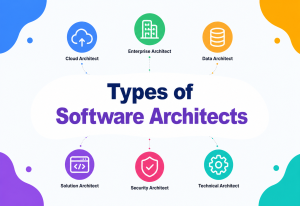
Solution and technical architects are two of several architect roles. Seeing where they sit in the family makes the distinctions cleaner.
Solution and technical are only two of the architect titles you will run into. In most large orgs the roles form a small family, each with its own scope of authority.
Enterprise architects sit above everyone, thinking about the shape of the whole organisation’s technology landscape. Solution architects live at the project level, tying together whatever systems a specific business initiative needs. Technical architects own individual systems in depth. And the specialists — data, cloud, and security architects — sit alongside them, going even deeper on one crosscutting concern that spans multiple systems.
A Day in Their Shoes, Compared
Watching a single working day in each role makes the difference easiest to feel.
Two Tuesdays, side by side.
Across many systems
Walks a business owner through a proposed CRM-plus-ERP integration, meets a vendor to compare product options, reviews a legal constraint that changes the data flow, and updates the solution blueprint by end of day.
Deep inside one system
Reviews the new caching design for the checkout service, benchmarks two message-broker options, pairs with a senior engineer on a tricky race condition, and updates the system’s technical roadmap.
On any given day the solution architect is more likely to be found in a conference room with people from different departments, while the technical architect is more likely to be found in a design review with engineers from one team — though both regularly borrow from the other’s world when the day calls for it.
Skills and Tools Compared
Both roles rest on a shared architectural foundation, but each also leans on strengths the other rarely needs to exercise.
Both start from a common architectural base — a solid grasp of design, distributed systems, and non-functional requirements. On top of that base, each role stretches in a different direction.
Solution Architect leans on
- Broad awareness of many technologies and vendor products
- Comfort translating business language into technical strategy
- Negotiation skill across teams, vendors and stakeholders
- Tools for enterprise modelling, roadmaps and cost estimation
Technical Architect leans on
- Deep expertise in one primary stack — framework, database, cloud
- Strong reviewing eye for code and low-level design
- Comfort making detailed technical trade-offs about scale, security and resilience
- Tools for diagramming, prototyping and performance profiling
Solving One Business Problem, Step by Step
Neither role delivers alone. Here is how the two typically collaborate to take a business need from idea to production.
On real projects the two roles are almost always paired — the solution architect shapes the answer at the business-and-integration level, and one or more technical architects own the deep design of each system inside that answer. A typical hand-off looks like this:
Solution architect frames the problem
Meets the business, understands the goal, maps existing systems and produces an end-to-end blueprint that says which systems will do what.
Technical architects own each system
For every system the blueprint touches, a technical architect designs how that system will be built or extended internally to meet its part of the plan.
Solution architect keeps the seams aligned
As each technical design lands, the solution architect checks that the pieces still fit together and adjusts the blueprint if a system-level decision has forced a boundary to move.
Both stay engaged through build and rollout
The technical architects steer the day-to-day build inside their systems; the solution architect steers the cross-system rollout, watching for integration surprises.
Get the pairing right and each role reinforces the other. Miss it — give the solution architect too little depth in any one system, or leave the technical architects without a shared view of the seams — and integrations drift, deadlines slip and rework piles up.
Career Paths and Certifications
Both roles usually grow out of years of hands-on engineering — but the sideways moves and certifications differ.
Both roles are almost always downstream of years of engineering practice; neither is an entry-level position. The path forks in a familiar way once someone has a strong technical foundation:
Grow breadth & business fluency
Rotate across systems, sit in on business planning, and take vendor-neutral or platform-wide credentials such as TOGAF or the AWS / Azure / Google Solutions Architect certifications.
Grow depth in a chosen stack
Go deep on one platform — language, framework, database, cloud — and pursue technology-specific credentials that signal mastery of that stack’s advanced design and operational patterns.
Neither branch is universally more prestigious. In consulting and integration-heavy companies, solution architects tend to be more visible. In product companies that own one or two large systems for a long time, technical architects often carry more weight day to day. Some people move fluidly between the two over a career; others stay firmly on one branch and go deep for decades.

When Projects Need Each One
A quick guide to which role a project actually needs — and when a project needs both.
Not every project needs both roles, and adding either one prematurely can add coordination overhead without a matching payoff. The tell-tale signals are different for each:
Many systems must cooperate
A business initiative touches multiple existing platforms, third-party vendors, or new integrations, and nobody yet owns the end-to-end picture.
One system needs real depth
A specific system must be built, redesigned or scaled to a demanding standard, and its internal structure needs long-term ownership.
Large, cross-cutting programmes normally justify both simultaneously. Small, single-system builds often thrive with just a technical architect and no dedicated solution architect. Purely business-facing initiatives with almost no bespoke build sometimes need only a solution architect and no technical architect at all.
Common Myths, Cleared Up
Three misconceptions that keep resurfacing whenever the two titles get compared — and the reality behind each.
“They are basically the same job with different titles.”
Not really. The daily focus, the skills they lean on, and the criteria they get evaluated against are genuinely different. Treating them as interchangeable usually leads to at least one part of a project going under-served — either the seams between systems, or the depth of one specific system.
“A technical architect does not need to understand the business at all.”
They absolutely do — just at a different depth than a solution architect. Even for one system, priorities like “must handle 10x growth next year” or “must meet financial-services audit rules” come from the business, and shape almost every technical decision.
“A solution architect must be a deep coding expert.”
Usually the opposite — a solution architect who insists on being the deepest coder in every system they touch tends to become the bottleneck. Solution architects are still expected to have credible hands-on engineering roots, but their leverage comes from breadth of judgement, not from being the best coder in every room.
Job descriptions that ask a single person to be both roles at once for a large programme. On small work it is fine; on genuinely complex projects it is usually a sign the org is under-hiring and expecting one person to cover for a missing colleague.
Key Takeaways
The five ideas from this guide worth carrying into any conversation about which architect a project actually needs.
What to Remember
- Different anchor points. A solution architect is anchored to a business problem; a technical architect is anchored to a single system.
- Breadth vs depth. Solution architects cover many systems at moderate depth; technical architects go deep on one stack.
- They usually pair up. On real projects the two roles work together — solution shapes the seams, technical owns each system inside them.
- Career paths fork on breadth vs depth, and neither branch is universally more senior than the other.
- Match the role to the shape of the problem: many systems cooperating → solution architect; one system needing real depth → technical architect.