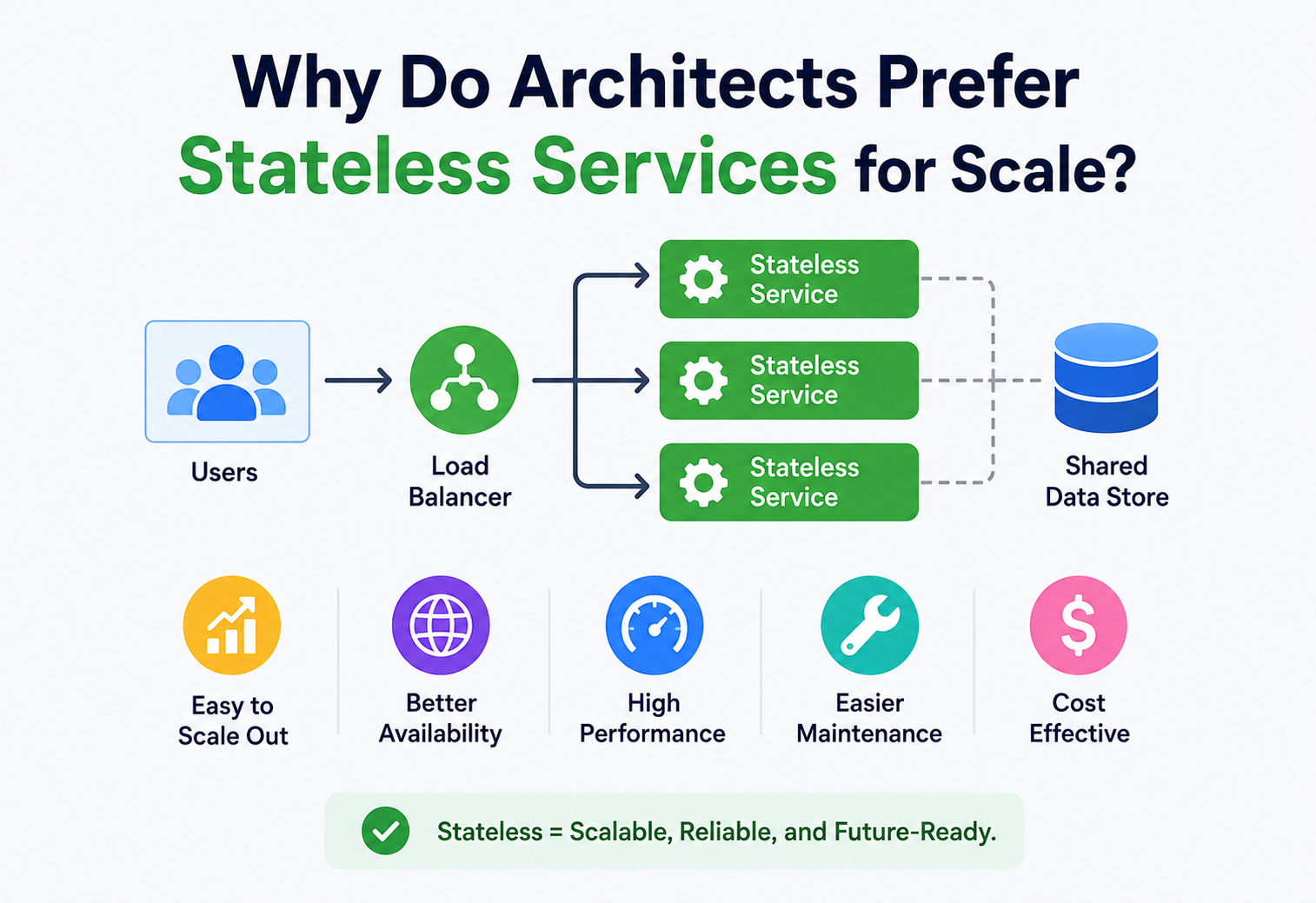
Why Do Architects Prefer Stateless Services for Scale?
Imagine a waiter with no memory of who ordered what. Sounds like a disaster, right? Now imagine that “forgetful waiter” is actually the secret to serving a million customers at once, without ever losing an order. This complete guide unpacks why software architects deliberately design services that forget everything about you the instant they are done helping — and why that forgetfulness is one of the smartest tricks in modern computing.
The Big Idea, in One Breath
A stateless service is like a coffee shop where every barista is equally capable and none of them remembers you personally — because the order card on the counter carries everything they need to know.
Picture two coffee shops. In the first, the same barista serves you every single day. She remembers your name, your usual order, and exactly how you like your coffee — which feels lovely, until the day she calls in sick. Suddenly nobody else knows your order, and you have to explain everything from scratch to whoever is covering for her.
In the second coffee shop, none of the baristas remember you personally. Instead, there is a little card on the counter where you always write your order before handing it over. Any barista working that day — there might be five of them — can pick up your card and make your coffee exactly right, without ever needing to have met you before. If one barista goes on a break, or ten more customers suddenly walk in, any of the other baristas can simply pick up the next card and keep the line moving.
That second coffee shop is exactly how a stateless service works, and it is exactly why software architects reach for this design again and again when building systems meant to serve enormous numbers of people. Instead of one special “barista” server remembering everything about you personally, every server in the group is equally capable, equally interchangeable, and free of any private memory that only it holds. This one architectural decision — designing services that do not remember things about you between requests — turns out to unlock nearly every superpower a large system needs: the ability to grow, the ability to survive failure, and the ability to stay simple even as it gets enormous.
Think of a hotel’s key card system instead of an old‑fashioned metal key. Any staff member at any front desk can reprogram or reissue your card in seconds, because the important information — which room is yours, when your stay ends — lives in the hotel’s central computer, not inside any one staff member’s head. Lose your card, and a completely different staff member across the building can fix it instantly, because nothing important was ever trapped in one person’s memory.
This guide walks through exactly why senior architects lean on this “forgetful by design” approach so heavily, especially the moment a system needs to grow beyond what a single server could ever handle alone. It is not that architects dislike memory — memory is essential, and every real system needs it somewhere. The insight is about where that memory should live, and the surprising number of benefits that show up once it is moved out of individual servers and into one well‑designed, shared home instead.
What “State” Actually Means
In computing, state is any piece of information a system needs to remember, from one moment to the next, to keep behaving correctly for a particular person — from being logged in, to a shopping cart, to a half‑finished form.
Before going further, it is worth being precise about a word that gets used constantly in this topic: state. In everyday language, “state” just means “the condition something is currently in.” In computing, state means much the same thing — it is any piece of information a system needs to remember, from one moment to the next, in order to keep behaving correctly for a particular person.
Are you currently logged in? That is state. What is sitting in your shopping cart right now? That is state. How far you have scrolled through a long article, or which step of a multi‑step form you have filled in so far — all of that is state too. Basically, anything a service needs to “remember” about you between one visit and the next counts as state.
- Being logged in — the system remembers you have already proven who you are, so it does not ask for your password on every single click.
- A shopping cart — the system remembers exactly which items you have added, even if you leave the site and come back later.
- Game progress — the system remembers your score, your level, your unlocked items, so you do not start from zero every time you play.
- A half‑finished form — the system remembers what you have typed so far, so a slow internet connection does not cost you everything you have written.
Notice that all four examples share something in common: they are all genuinely useful. Nobody wants to re‑enter their password every second, or watch their shopping cart empty itself the moment they blink. The goal was never to eliminate this kind of helpful memory — it is to be thoughtful and deliberate about exactly where that memory is kept, which is precisely the question the rest of this guide sets out to answer.
If someone asks “does this service hold state?”, they are really asking: “does this service need to remember anything specific about me from one request to the next?”
It is worth noticing that “state” is not a bad word — every useful system needs some. A shopping app that permanently forgot your cart the second you clicked away would be useless. The real question this guide explores is not whether state should exist at all, but where it should be allowed to live, and who should be responsible for remembering it.
A Short History: Where This Idea Came From
Statelessness is not new. It goes back to the very foundations of how the web itself was designed — a deliberate choice made for practical reasons that turned out to be quietly world‑changing decades later.
The idea of statelessness is not a brand‑new invention dreamed up for today’s giant cloud systems — it actually goes back to the very foundations of how the web itself works. When the earliest version of the web was being designed, engineers made a deliberate choice: every time your browser asks a web server for a page, that request should stand completely on its own, carrying everything needed to understand it, with the server not required to remember anything about your previous visits.
At the time, this was mostly a practical decision to keep early web servers simple and fast. Nobody fully anticipated just how valuable that same “forgetfulness” would become decades later, once companies started needing to serve hundreds of millions of people through enormous groups of servers working together. As systems grew larger through the 2000s and 2010s, architects increasingly rediscovered and doubled down on this old, simple idea, formalising it into what is now widely taught as one of the core principles behind building large, reliable web services.
Today, statelessness sits at the heart of extremely common architectural styles used across the industry — including a widely used approach for designing web APIs that explicitly lists “no server‑side memory of the client between requests” as one of its defining rules. What began as a simple, practical choice for early web servers has become one of the most quietly influential ideas in all of large‑scale software design.
Researchers studying large distributed systems have long noticed a related pattern: systems that avoid depending on any one part remembering something unique tend to be dramatically easier to reason about, recover, and scale than systems where memory is scattered unpredictably across many different places. Statelessness, in a sense, is the practical, everyday application of that deeper research insight — a way of designing real, working systems so that no single part ever becomes irreplaceable.
Stateless vs. Stateful, Side by Side
A stateful service keeps memory locally, tucked inside its own head. A stateless service keeps no memory of you at all between requests — every request is treated as if the service is meeting you for the very first time.
A stateful service is one that keeps state locally — tucked away in its own private memory, remembered only by that one particular server. A stateless service, by contrast, keeps no memory of you at all between requests. Every single request it receives is treated as if it is meeting you for the very first time, with absolutely everything it needs to know included right there in that one request.
| Trait | Stateful Service | Stateless Service |
|---|---|---|
| Where memory lives | Inside the one server that handled you before | Nowhere on the server — sent with each request or stored centrally |
| Can any server help you? | No, usually only “your” server | Yes, any server in the group |
| What happens if that server crashes? | Your information can be lost with it | Nothing lost — another server steps in seamlessly |
| Typical examples | An old‑style file server, a game server holding a live match | A weather‑lookup API, most modern web APIs |
Neither approach is automatically “better” in every situation — but as you are about to see, once a system needs to serve a truly large number of people reliably, statelessness offers a long list of advantages that are hard to walk away from.
It is worth noting too that “stateless” describes the server’s behaviour, not the visitor’s experience. A visitor using a stateless service can still feel like the system remembers them perfectly well — their cart is there, they are still logged in, their preferences are saved. The forgetting only happens at the level of the individual server; from the visitor’s point of view, the memory feels just as reliable as ever, often more so, since it is not tied to the fragile fate of any single machine.

Reason One: It Unlocks Effortless Scaling
Remember the coffee shop with the order cards? That is exactly how a stateless service grows: any new server can start helping visitors immediately, with zero training about “who belongs to whom.”
Remember the coffee shop with the order cards? That system could add five more baristas tomorrow, and every single one of them could start helping customers immediately, with zero training about “who belongs to whom.” That is the single biggest reason architects love statelessness: it makes adding more servers almost trivially easy.
When a service does not remember anything locally, every server in the group is a perfect, interchangeable copy of every other server. A load balancer — the component that decides which server handles each visitor — can send any request to any server, without worrying about whether that particular server “knows” that particular visitor. Need to handle more traffic? Add more identical servers. Traffic dropped overnight? Remove some. The group simply grows and shrinks like a rubber band, with no complicated matchmaking required between visitors and specific machines.
This connects directly back to a wider truth about large‑scale systems: growth is easy when every piece is interchangeable, and painful when pieces are special. A stateless service turns every server into an ordinary, replaceable piece, which is exactly the quality that lets a system grow from a handful of machines to thousands without ever needing to rethink its fundamental design along the way.
Compare this to a stateful service, where a visitor might need to always be sent back to the one server that remembers them — a rule called session affinity or a “sticky session.” That rule works, technically, but it quietly limits how freely a load balancer can spread traffic around, and it means the group can never grow or shrink as gracefully as a fully stateless one can.
Why “Interchangeable” Is the Real Superpower
The word architects often reach for here is homogeneity — the idea that every server in a group is, for practical purposes, identical and interchangeable. A stateless design makes homogeneity easy to achieve, because there is genuinely nothing that makes Server A different from Server B in the eyes of a visitor. That interchangeability is what allows automated tools to add and remove servers on their own, based purely on how busy the group currently is, without needing to ask any complicated questions about who remembers what.
Reason Two: It Survives Failure Beautifully
If no server was ever the “owner” of your information in the first place, losing one server is a shrug rather than a disaster. The whole idea of blast radius shrinks toward zero.
Here is a sobering but important question: what happens to a visitor’s information if the one server holding it suddenly crashes? For a stateful service, the honest answer is often “it is gone” — whatever that server was remembering about that visitor disappears along with it, unless a great deal of extra engineering effort was put in to prevent exactly that.
A stateless service sidesteps this problem entirely, because no server was ever the “owner” of your information in the first place. If the server handling your request crashes mid‑task, another server can simply pick up the very next request — carrying everything it needs along with it — and continue as if nothing happened. Nobody has to scramble to recover lost memory, because there was never any memory sitting precariously on a single machine to lose.
Imagine a library where every librarian carries a copy of the exact same shared catalogue, rather than each librarian keeping their own private, hand‑written notes about which books are where. If one librarian goes home sick, any other librarian can help the next visitor perfectly well, because nothing important was ever locked away in just one person’s notebook.
This connects to a wider idea in system design called blast radius — how much damage is done when one particular part of a system fails. A stateful server that crashes has a blast radius that includes every visitor it was personally remembering at that moment. A stateless server that crashes has a blast radius of essentially zero, because it was not uniquely responsible for anyone’s information in the first place. Shrinking the blast radius of everyday, inevitable failures — rather than trying to prevent every possible failure, which is impossible — is one of the quiet, unglamorous reasons statelessness is treated as such a foundational choice for reliable systems.
Reason Three: Updates and Deployments Get Simpler
Large systems are never really “finished.” Statelessness turns routine updates from stressful, choreographed events into refreshingly calm, invisible rolling deployments.
Large systems are never really “finished” — engineers are constantly releasing small improvements, bug fixes, and new features. With a stateless service, rolling out an update is refreshingly calm: a new version of the server can be started up, quietly join the group, start handling requests, and the old version can be switched off — all without anyone needing to worry about transferring memory from the old server to the new one, because there was never any memory to transfer in the first place.
This kind of update, often called a rolling deployment, lets a large system release new code constantly, sometimes many times a day, without ever needing a scheduled maintenance window where everything pauses. Stateful services make this same process far trickier, since swapping out a server that is quietly holding onto live information about active visitors risks losing or corrupting that information right in the middle of the swap.
If a team wants to release new versions of their software quickly and often, without scary maintenance windows, statelessness is usually one of the very first architectural decisions that makes that pace realistically possible.
Picture two teams releasing an update on the same busy Tuesday afternoon. The team running a stateless service quietly swaps in new servers one small batch at a time, watches everything continue working normally, and finishes without a single visitor noticing anything happened. The team running a stateful service has to carefully plan around the visitors currently connected to each server, perhaps waiting for their sessions to naturally end, or accepting the risk of interrupting them — turning a routine Tuesday update into a stressful, carefully choreographed event. Multiply that difference across dozens of updates a month, and it is easy to see why teams shipping fast‑moving products lean so heavily toward stateless design.
There is a broader benefit hiding inside this one too: confidence. Teams that trust their deployment process tend to release smaller, more frequent updates, catching problems early while they are still small and easy to fix. Teams that dread their deployment process tend to delay, batching up larger, riskier releases less often — and larger releases are, almost by definition, harder to test thoroughly and more likely to hide a serious problem. Statelessness, by making deployments boring and safe, quietly encourages the healthier of these two habits.
Reason Four: It Is Simply Easier to Test and Understand
A stateless service is predictable: the same input always produces the same output, no matter what happened before. That single property saves enormous amounts of debugging time at scale.
There is a quieter, less flashy benefit that engineers appreciate just as much: stateless services are dramatically easier to reason about. Since a stateless service treats every request independently, a developer testing it does not need to first put the system into some specific, complicated “remembered” condition before testing a particular feature. They can simply send a request with everything it needs, check the response, and trust that the result will be the same every time, no matter what happened before.
This quality — where the same input always produces the same output, no matter what came before it — is something engineers often describe as being predictable or free of hidden side effects. It might sound like a small, technical detail, but at scale, it saves enormous amounts of debugging time. Chasing down a mysterious bug that only appears “sometimes, depending on what happened earlier” is one of the most frustrating experiences in software engineering, and stateless design mostly makes that particular kind of bug disappear altogether.
This same predictability makes automated testing far more powerful too. A testing tool can fire thousands of requests at a stateless service, in any order, all at once, from many different simulated locations, and trust that the results will be consistent and meaningful. Testing a stateful service properly often requires carefully recreating a specific sequence of earlier steps just to reach the right starting condition, which makes thorough, large‑scale automated testing considerably harder to set up and trust.
Why Statelessness and the Cloud Fit So Well Together
The cloud’s biggest promise is flexibility — adding a server in seconds, removing it just as fast. That promise only really pays off if servers are cheap and easy to swap, and statelessness is exactly what makes that possible.
It is no coincidence that stateless design became even more popular exactly as cloud computing took off. The cloud’s biggest promise is flexibility — the ability to add a server in seconds, and remove it just as quickly once it is no longer needed. That promise only really pays off if servers are cheap and easy to add and remove, and that is exactly what statelessness enables.
Two cloud ideas in particular depend almost entirely on statelessness to work well. The first is auto‑scaling, where a system automatically adds or removes servers based on real‑time demand — something that only works smoothly if any new server can immediately start helping visitors without needing to be taught anything first. The second is serverless computing, where small pieces of code run only when triggered, on whatever machine happens to be available at that exact moment, then disappear again seconds later. Serverless computing is, in many ways, the purest possible expression of statelessness — the “server” barely exists as a lasting thing at all, and could not remember anything locally even if it wanted to.
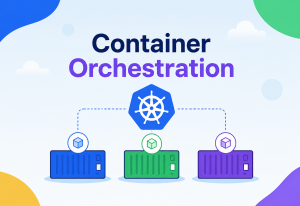
Containers play a supporting role in all of this too. A container packages a stateless service so it behaves exactly the same way no matter which physical machine it is copied onto, which pairs perfectly with the idea that any server should be able to help any visitor. Orchestration tools then watch over large groups of these containers, restarting failed ones and adding fresh ones under pressure — all of which only works smoothly because the containers themselves are not secretly holding onto anything that would be lost when they are restarted or moved.
So Where Does the State Actually Go?
Being stateless does not mean forgetting everything forever. It means the individual server does not personally hold onto memory — the information still exists, but it lives somewhere shared, somewhere every server can reach equally.
Being stateless does not mean a system forgets everything forever — that would make shopping carts, logins, and saved progress completely impossible, which clearly is not the case in the real world. It simply means the individual server handling your request does not personally hold onto that memory. The information still exists; it just lives somewhere shared, somewhere every server can reach equally.
The long‑term memory
Information like your saved shopping cart or order history typically lives in a central database that any server can read from and write to.
The quick‑access memory
Frequently needed details, like whether you are currently logged in, are often kept in a super‑fast shared memory store that every server checks in a flash.
Memory you carry yourself
Sometimes the information travels with you, tucked inside a small, secure token your device sends along with every request.
Memory on your own device
Small, non‑sensitive pieces of information can be stored directly in your web browser, so the server does not need to track them at all.
One particularly clever pattern worth understanding is the token. Instead of a server remembering “this visitor is logged in,” the server can hand the visitor a small, digitally signed token the very first time they log in. From then on, the visitor includes that token with every request they make, and any server — instantly, without checking anywhere else — can verify the token is genuine and know exactly who is asking, all without needing to remember anything itself. It is a bit like a wristband at a theme park: any staff member can glance at your wristband and instantly know you have paid for entry, without needing to personally remember signing you in at the gate.
What makes a signed token so clever is the “signed” part. The token is not just a plain note that could easily be copied or faked — it carries a special digital signature that only the original system could have created, and that any server can quickly check without needing to phone home and ask permission. This is what allows the verification to happen instantly, on any server, anywhere, without slowing down to consult some central authority for every single request.
Stateless does not mean “no memory anywhere.” It means “no memory trapped on one particular server.” The memory simply moves somewhere every server can equally access.
Choosing the Right Home for Different Kinds of Memory
Not all information deserves the same kind of home. Something checked constantly, on almost every single request — like whether a visitor is currently logged in — usually belongs in a fast shared cache, designed to answer in a tiny fraction of a second. Something that needs to be kept safely for a long time, like an order history that must never be lost, belongs in a proper shared database, built for careful, durable storage rather than raw speed. A thoughtful architect treats this as a genuine design decision, not an afterthought, weighing how often something is needed against how important it is that it is never lost.
How Teams Know Statelessness Is Actually Working
Declaring a service “stateless” on paper is one thing; proving it holds up under real, messy, everyday use is another. Experienced teams check for a handful of telltale signs.
Declaring a service “stateless” on paper is one thing; proving it holds up under real, messy, everyday use is another. Experienced teams check for a handful of telltale signs to make sure their stateless design is genuinely doing its job.
Any server, any time
Sending repeated requests from the same visitor to deliberately different servers should produce perfectly consistent, correct results every time.
Nothing lost on restart
Restarting or replacing a server in the middle of normal use should not cause any visitor to lose their progress or get logged out unexpectedly.
Growing without drama
Adding new servers to the group should let them start helping visitors almost immediately, with no special setup or warm‑up period required.
Fair distribution
Traffic should spread roughly evenly across all servers, rather than clustering around a few “favourite” servers that visitors keep getting sent back to.
When all four of these checks come back clean, it is a strong sign that a service is genuinely stateless in practice, not just in name. When one of them fails — say, restarting a server suddenly logs some visitors out — it usually means a small piece of local memory has quietly crept back in somewhere, waiting to be found and moved to its proper shared home.
Many teams build these checks directly into their regular testing routines, running them automatically every time new code is released. Treating statelessness as something to continuously verify, rather than a box ticked once at the start of a project, helps catch small regressions early — long before they turn into a confusing, hard‑to‑diagnose problem in front of real users.

Stateless Design in the Real World
This is not an abstract idea reserved for textbooks — stateless design quietly powers an enormous amount of the internet you use every day.
This is not an abstract idea reserved for textbooks — stateless design quietly powers an enormous amount of the internet you use every day.
The backbone of modern apps
Most modern web services are built as stateless APIs, where each request carries everything needed to be understood and answered on its own.
Code with no fixed home
These tiny pieces of code run only when needed, on whichever machine happens to be available, which is only possible because they do not rely on any local memory.
Many small, focused services
Large systems built from many small services almost always design each one to be stateless, so any instance of any service can be scaled independently.
Serving the same thing to everyone
Services that simply hand out the same content to many visitors — like images or videos — are naturally stateless, since there is rarely anything personal to remember.
It is telling that when companies redesign an older, struggling system to handle far more traffic, one of the very first changes they usually make is hunting down and removing any leftover local memory, converting the service to be properly stateless before attempting to scale it out across many machines. Trying to scale a stateful service without fixing this first is one of the most common and painful mistakes in large‑scale system design.
A Familiar Scenario: Logging In on a Busy Morning
Picture a large app on a Monday morning, when everyone logs in at roughly the same time before starting their workday. A load balancer sends your login request to whichever server happens to be free at that instant — it could be any one of dozens. That server checks your details, and if everything matches, it does not try to remember you personally. Instead, it hands you back a small, signed token and quietly steps out of the picture. Every request you make for the rest of the morning can land on a completely different server each time, and every single one of them can instantly recognise your token and know exactly who you are, without ever needing to check back with whichever server first logged you in. That is statelessness working exactly as intended, thousands of times a minute, without anyone giving it a second thought.
Statelessness Shows Up at Every Layer
Statelessness is not just something the API layer does. The same principle threads through nearly every layer of a large, modern system, from the gateway at the front door to the workers running in the background.
It is easy to picture statelessness as something that only applies to one particular kind of server, but the same principle actually threads through nearly every layer of a large, modern system.
Where most people picture it
The web APIs that handle everyday requests are usually the clearest, most well‑known example of stateless design in action.
The front door
The component that first receives every request from the outside world is typically built stateless too, so it can be scaled independently of everything behind it.
The workers behind the scenes
Background jobs that process orders, send emails, or resize images are usually designed stateless, so any available worker can pick up any waiting task.
A softer version of the idea
Even the app on your phone often applies a lighter version of this idea, fetching fresh information rather than trusting old, possibly outdated local memory.
Seeing statelessness applied consistently across every layer, rather than in just one spot, is often a sign of a mature, well‑thought‑out architecture. It is rarely a single decision made once — it is closer to a habit of mind that architects apply, layer after layer, any time they are deciding where a particular piece of information should live.
This layered consistency also makes large systems far easier to hand over between teams. A new engineer joining a well‑designed, consistently stateless system can generally assume the same rule applies everywhere they look, rather than needing to learn a different set of assumptions for every individual layer. That predictability, multiplied across a codebase with hundreds of engineers, is a genuine and often underestimated productivity gain.
When Stateful Design Still Wins
None of this means statelessness is always the right choice for every piece of a system. Some jobs genuinely need memory close by — databases, live game servers, real‑time calls, hot caches — and pretending otherwise would be dishonest.
None of this means statelessness is always the right choice for every single piece of a system — some jobs genuinely need memory close by, and pretending otherwise would be dishonest.
- Databases themselves are inherently stateful — their entire job is to remember information reliably, and that is perfectly appropriate. Nobody expects a database to forget your order the moment it is placed.
- Live multiplayer games often need one server actively tracking the fast‑moving, constantly changing state of a match in real time, since re‑fetching every player’s position from a shared database dozens of times a second would be far too slow.
- Video and voice calls frequently rely on a stateful connection to keep the conversation flowing smoothly without constant reconnecting, since the cost of re‑establishing a fresh connection for every single word spoken would make conversation impossible.
- Certain caching layers are deliberately stateful, since their whole purpose is holding onto recently used information for speed — ironically, these stateful caches are often exactly what makes the stateless services in front of them fast enough to be practical.
The real skill in software architecture is not making everything stateless no matter what — it is identifying which small, specific parts of a system genuinely need memory, keeping those parts intentionally stateful and well protected, and designing everything else to be stateless wherever realistically possible.
Treating “stateless” as an all‑or‑nothing rule. The goal is not zero state anywhere in the system — it is making sure state lives in a small number of well‑designed, well‑protected places, rather than scattered accidentally across every server.
Signs a “Stateless” Service Is Not Really Stateless
Sometimes a service is called stateless on paper, but small habits creep in over time that quietly break the promise. A few warning signs tend to show up together when that happens.
Sometimes a service is called stateless on paper, but small habits creep in over time that quietly break the promise. A few warning signs tend to show up together when this happens, and catching them early saves a great deal of pain later.
- Restarting a server logs some visitors out unexpectedly, revealing that login information was being kept locally after all.
- Certain visitors always seem to land on the same server, hinting at a hidden dependency the load balancer is quietly working around.
- A new server needs a long “warm‑up” period before it can properly help visitors, suggesting it is missing something the older servers have locally.
- Bugs only appear “sometimes,” depending on which server handled a previous request, a classic sign of stray local memory somewhere in the system.
None of these problems mean the whole design has failed — they are simply useful clues pointing toward exactly where a small piece of state has been left behind, waiting to be moved to its proper shared home.
Experienced teams treat these signs almost like a doctor treats symptoms — not something to be embarrassed about, but useful information pointing toward exactly what needs attention. A system that occasionally shows one of these signs and gets it fixed quickly is in a far healthier position than a system that never checks for them at all, only to discover a serious problem during a major, painful outage.

The Honest Challenges of Going Stateless
Like every architectural choice, statelessness is not a free lunch. It solves real problems, but it asks something of the team choosing it — and a fair guide names that cost plainly rather than only celebrating the upside.
Like every architectural choice, statelessness is not a free lunch. It solves real problems, but it asks something of the team choosing it, and a fair guide owes it to the reader to name that cost plainly rather than only celebrating the upside.
What Statelessness Buys You
- Any server can help any visitor at any moment
- Losing one server barely affects anyone
- Scaling up or down is fast and simple
- Updates and deployments become far less risky
What It Asks of You
- State has to be carefully redesigned to live somewhere shared
- That shared store must itself be fast, reliable, and well scaled
- Every request tends to carry a little more information with it
- Older, existing systems may need real rework to adopt it
It is also worth noting that statelessness moves a problem rather than magically deleting it. The individual servers become simpler, but the shared database or cache they all depend on now carries more responsibility, and it needs its own careful design so that it does not quietly become a new single point of failure hiding behind an otherwise beautifully stateless set of servers.
There is also a small but real cost in how requests are built. Since a stateless request must carry everything it needs, requests can end up slightly larger or more detailed than they would be in a stateful system that already “remembers” some of that context. In practice this cost is almost always tiny compared to the benefits, but it is a fair trade‑off to name honestly rather than pretend does not exist.
Common Myths Worth Clearing Up
A few misunderstandings about statelessness come up again and again, even among people who work with these systems regularly. Clearing them up early saves a lot of confused conversations later.
Myth: Stateless services never store any data at all
Not true. Stateless simply means the server handling your request does not personally hold onto data between requests. The data itself is usually stored very carefully, just somewhere shared rather than locally.
Myth: Stateless design is only useful for huge companies
Not true. Even a small app with a handful of users benefits from statelessness, because it makes the system easier to understand, test, and grow later, long before it actually needs to handle a large audience.
Myth: Going stateless always makes a system slower
Not necessarily. While a single lookup to a shared store adds a tiny bit of time compared to checking local memory, a well‑designed shared cache is usually so fast that the difference is barely noticeable, and the scaling benefits more than make up for it.
Myth: Stateless and stateless‑feeling are the same thing
Not true, and this one trips people up often. A visitor can feel like a service remembers them perfectly — their cart is there, they are still logged in — while the underlying servers themselves remain completely stateless. The forgetting happens behind the scenes, not in the visitor’s experience.
Myth: Once a system is stateless, it stays that way forever
Not true, unfortunately. Statelessness has to be actively maintained. It is entirely possible for a small piece of local memory to sneak back into a codebase months later, added by a well‑meaning engineer solving an unrelated problem in a hurry. This is exactly why the checks described earlier in this guide are worth running regularly, not just once when a system is first built.
Best Practices for Building Stateless Services
Teams that build stateless services well tend to follow a fairly consistent set of habits — most of them learned the hard way after a hidden piece of local memory caused a confusing bug somewhere down the line.
Teams that build stateless services well tend to follow a fairly consistent set of habits, most of them learned the hard way after a hidden piece of local memory caused a confusing bug somewhere down the line.
- Never store visitor‑specific data in a server’s local memory. If it needs to be remembered, it belongs in a shared store, not tucked away locally.
- Include everything a request needs within the request itself. Do not assume the server has “already been told” something earlier.
- Choose a fast, reliable shared store for anything checked frequently. Logins and permissions are checked constantly, so speed matters enormously here.
- Keep tokens small, signed, and short‑lived. This limits the damage if one is ever lost or stolen, while keeping servers free of local memory.
- Test by restarting servers on purpose. If restarting a server ever loses a visitor’s progress, some hidden local state has crept back in somewhere.
- Design the shared database or cache with just as much care as the servers. A stateless front line is only as strong as the shared memory behind it.
- Review new code for accidental local memory. A quick habit of asking “where would this be remembered if the server restarted right now?” catches most problems early.
It is a bit like a well‑run relay race. Each runner does not need to remember the entire race history — they just need the baton, which carries everything forward. Pass a clear, complete baton at every handoff, and it does not matter which runner is currently holding it.
Notice that nothing about this list requires exotic tools or rare expertise — it is mostly a matter of consistent habits, applied patiently across a codebase over time. Teams that build this discipline early tend to find that statelessness becomes second nature, quietly shaping how new features get built long after anyone consciously thinks about it as a deliberate architectural rule.
Questions People Often Ask
A handful of questions about stateless design come up in nearly every conversation on this topic. Here are short, honest answers to the ones that surface most often.
Does stateless mean a system has no database at all?
No — almost every real system still has a database somewhere. Stateless simply means the individual servers handling requests do not personally hold onto that information; they fetch and update it from a shared, central place instead.
Is a stateless service always faster than a stateful one?
Not automatically. A stateless service sometimes needs to fetch information from a shared store that a stateful service would have had ready in local memory. In practice, a fast shared cache usually closes this gap, and the scaling benefits tend to far outweigh the small extra lookup cost.
Can a large system be entirely stateless, with no stateful parts anywhere?
Rarely, and that is expected. Even the most stateless‑looking systems usually have a database or two quietly doing stateful work behind the scenes. The goal is minimising unnecessary state, not eliminating it completely everywhere.
Why is this especially important for microservices?
Because a system built from many small services needs to scale each one independently, and add or remove instances of any one service without disturbing the others. That kind of independent flexibility depends heavily on each service being stateless on its own.
Is it hard to convert an old stateful system into a stateless one?
It can be a real project, especially for older software that was never designed with this in mind. Teams usually do it gradually, piece by piece, moving local memory into shared stores one feature at a time rather than rewriting everything at once.
Does statelessness apply to mobile apps too, not just websites?
Yes — the same idea applies to the servers behind mobile apps just as much as websites. Your phone might remember plenty locally for a smooth offline experience, but the servers it talks to still benefit enormously from treating each request independently.
What is the difference between a token and a cookie?
A cookie is simply a small piece of information a browser stores and sends back with future requests — it can be used to carry a token, but it can also be used in stateful ways, like storing a reference to a session kept on one particular server. A token, especially a signed one, is specifically designed to prove identity on its own, without needing the server to look anything up locally.
Do stateless services use more or less computing power overall?
It varies, but often slightly more per request, since some information has to be checked or fetched that a stateful service might have already had close at hand. In exchange, the system as a whole becomes so much easier to scale efficiently that this small extra cost is almost always considered well worth paying.
Who actually decides whether a service should be stateless?
Usually a senior architect or a small group of experienced engineers, early in a project, as part of deciding the overall shape of the system. It is the kind of decision that is cheap to get right at the start and expensive to fix later, which is exactly why it tends to be made carefully and deliberately rather than left to chance.
Does statelessness make security easier or harder?
In many ways, easier. Because nothing sensitive is left sitting locally on individual servers, there are fewer places for an attacker to target, and losing access to one server does not hand over a treasure trove of remembered visitor information. The trade‑off is that the tokens and shared stores that do carry sensitive information need to be protected with real care, since they now carry more responsibility.
Is there a simple test to check if a design decision is “stateful” or “stateless”?
A handy question to ask is: “if this server vanished right now and a brand‑new one instantly took its place, would anything be lost?” If the honest answer is no, the design is behaving statelessly. If the answer is yes, something worth protecting has quietly been left sitting in the wrong place.
Words Worth Knowing
A short glossary gathering the key terms from this guide, worth a quick glance any time one of these words comes up again in conversation.
Something remembered
Any piece of information a system needs to recall from one moment to the next to behave correctly for a particular visitor.
The sticky rule
A rule that sends a visitor back to the same server every time, often needed by stateful services.
Portable proof
A small, secure piece of information a visitor carries with every request, proving who they are without the server needing to remember them.
Updating without stopping
Releasing a new version of software gradually across a group of servers, without ever pausing the whole system at once.
The traffic director
The component that decides which server should handle each incoming request.
Same result, every time
A request that produces the same outcome no matter how many times it is repeated — a quality stateless design encourages.
How far damage spreads
How much of a system is affected when one particular part of it fails.
Code without a fixed home
A cloud approach where small pieces of code run only when triggered, on whichever machine is available at that moment.
A Day in the Life of a Stateless Request
To bring everything together, it helps to follow one single request from start to finish, through a fully stateless system.
You tap “buy now”
Your device sends a request that includes everything needed — your token proving who you are, and exactly what you are buying.
A load balancer picks a server
It does not matter which one — busy, quiet, brand new, does not matter. Any available server is a perfectly good choice.
The server checks your token
Instantly, without asking anywhere else, it confirms you are really you, and that this request is genuine.
It reaches into shared storage
The server asks the shared database to record your purchase, then immediately forgets everything about the interaction.
You get your confirmation
A response comes back, and the server that helped you is now completely free, with zero memory of you, ready for its very next request — possibly from someone on the other side of the world.
Nothing about that server’s next task depended even slightly on what it just did for you. That is the quiet, elegant simplicity that makes stateless design so powerful at scale — millions of these tiny, self‑contained interactions can happen every second, spread evenly across an enormous group of interchangeable servers, with nobody needing to keep track of who did what for whom.
Now imagine that same request landing during the busiest five minutes of the whole year — a flash sale, a major announcement, a sudden rush of visitors. Because every server in the group is equally capable and equally forgetful, extra servers can join mid‑rush and start helping within seconds, each one handling its own steady stream of these tiny, self‑contained interactions exactly like the one just described. There is no warm‑up, no handoff, no waiting for a new server to “learn” anything — it is ready the moment it exists, which is precisely the quality that makes stateless design feel almost effortless once it is properly in place.
Key Takeaways
We began with a forgetful barista and a card left on the counter, and ended up walking through tokens, load balancers, blast radius, and rolling deployments. One deceptively simple choice sits underneath all of it.
We began with a forgetful barista and a card left on the counter, and ended up walking through tokens, load balancers, blast radius, and rolling deployments. Underneath all of it sits the same simple choice this whole guide has explored: let individual servers forget everything about you, and place that memory somewhere every server can reach equally. It sounds almost too simple to matter, yet it is one of the single biggest reasons the internet’s largest, busiest systems are able to grow, survive failure, and update themselves constantly, all without most of us ever noticing the enormous machinery working quietly underneath. The next time an app you are using feels fast, reliable, and always available no matter how many other people are using it at that exact moment, there is a good chance a small army of forgetful, interchangeable servers is quietly working behind the scenes to make that feeling possible.
Remember This
- State is any information a service needs to remember about a visitor from one moment to the next.
- Stateless services keep that memory out of any individual server, treating every request as complete and self‑contained.
- This one design choice makes scaling, surviving failure, deploying updates, and testing all dramatically simpler.
- Being stateless does not mean forgetting everything — it means moving memory into a well‑designed, shared place every server can reach.
- Some parts of a system, like databases and live game servers, still need to be genuinely stateful, and that is perfectly fine.
- The real architectural skill is choosing carefully where state should live, rather than treating “stateless everywhere” as a rigid rule.