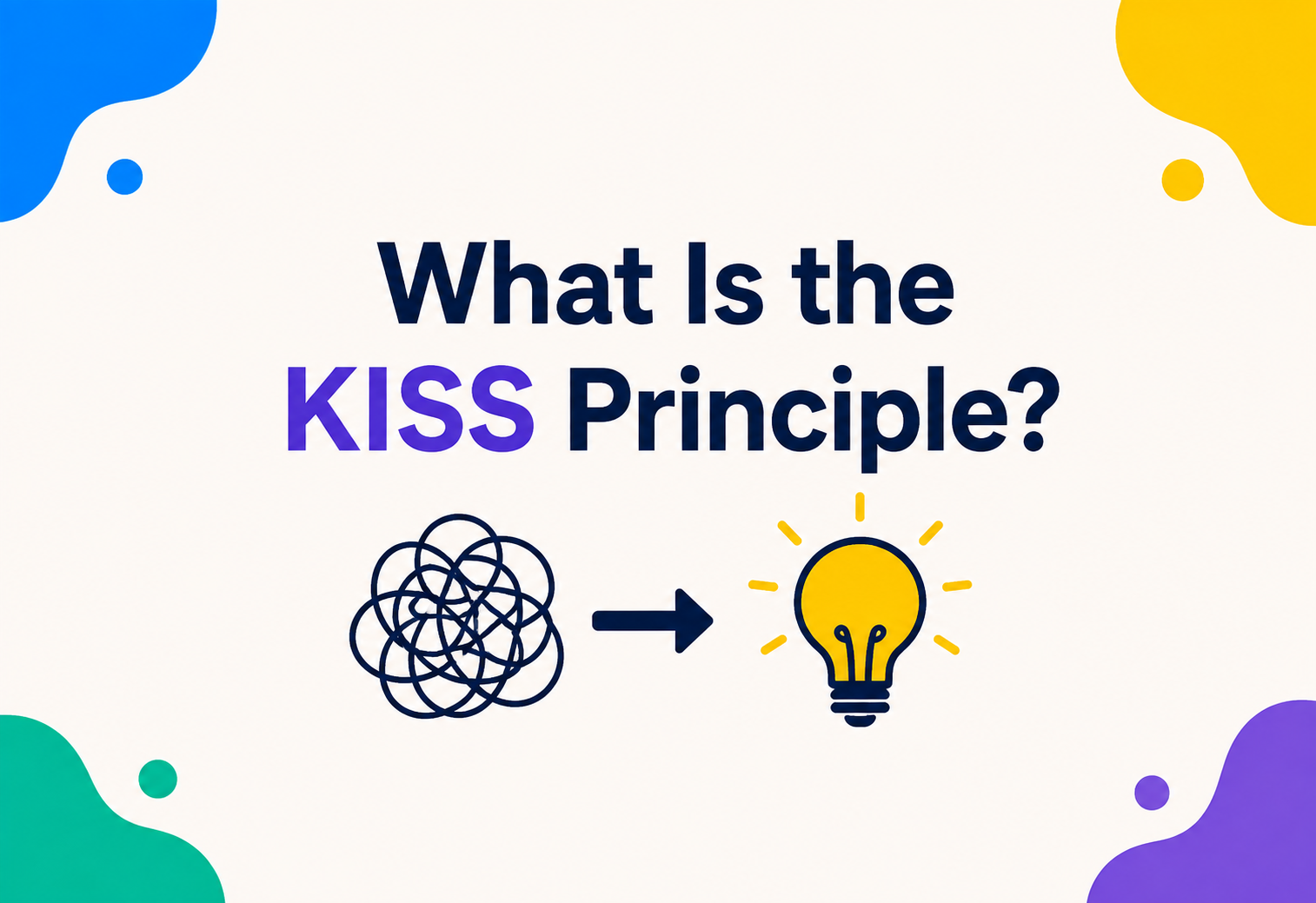
What Is the KISS Principle?
A calm, thorough walk through “Keep It Simple” — a principle born on the battlefield, adopted by engineers everywhere, and still one of the most reliable tests for whether a design is actually good.
The Big Idea, in One Breath
Imagine two remote controls sitting on a coffee table. The first one has exactly three buttons: power, volume, and channel. Anyone who picks it up, even a small child or a visiting grandparent who has never seen it before, can figure out what to do within seconds. The second remote control has forty-two buttons, six of them unlabeled, three that only do something when held down for exactly four seconds, and a tiny switch on the back that changes what every other button does. Both remotes might technically be able to do more or less the same job. Only one of them actually gets used without a headache.
That difference between the two remotes is the entire idea behind a rule that engineers, designers, and writers have leaned on for more than sixty years, known as the KISS principle — short for Keep It Simple, Stupid. The core instruction is almost aggressively plain: whenever you are building something, whether it is a piece of software, a physical product, a process, or even a plan, look for the simplest version that still gets the job done properly, and resist the pull toward anything fancier than that.
This does not mean simple things are always easy to create — in fact, arriving at true simplicity is often one of the hardest, most skillful parts of any design work. What KISS asks for is not laziness. It is discipline: the discipline to keep cutting away anything that is not truly needed, even when adding “just one more clever feature” would have been easier in the moment.
Think about packing a school bag for a single day of classes. A well-packed bag holds exactly the books, pens, and lunch you need for that day — nothing more. An over-packed bag, stuffed with every book from every subject “just in case,” becomes heavy, hard to search through, and slower to use every single time you need to find something. The extra weight does not make the bag more capable. It just makes carrying it, and using it, more tiring than it needed to be.
What makes this idea worth studying carefully, rather than simply nodding along and moving on, is that almost nobody sets out to build something needlessly complicated. Complexity rarely arrives all at once, in one obviously bad decision. It arrives quietly, one small, individually reasonable addition at a time — one extra setting here, one clever shortcut there — until a system that started out clean and understandable has slowly become the forty-two-button remote control, without anyone ever deciding, on purpose, that it should.
What KISS Actually Means
At its heart, KISS is a test you can apply to almost any decision: given two ways of solving the same problem, one simpler and one more complicated, and both of which genuinely work, choose the simpler one. It sounds almost too obvious to need saying — and yet, in practice, the pull toward unnecessary complexity is remarkably strong, which is exactly why this principle has survived, largely unchanged, for over six decades.
It is worth being precise about what “simple” means here, because the word gets used loosely in everyday conversation. In this context, simple does not mean “basic,” “unpolished,” or “lacking features.” It means a design with the fewest moving parts necessary to do its job well — nothing missing that is truly needed, and nothing present that is not. A simple solution can still be powerful, still be well thought out, and still handle real, difficult problems. It just avoids doing so with more machinery than the problem actually calls for.
A Test, Not a Ban
KISS is sometimes misread as “never build anything complicated,” which is not quite right. Some problems are genuinely complicated, and pretending otherwise does not make the complication disappear — it just hides it somewhere less obvious, usually somewhere that causes more trouble later. KISS is better understood as a standing question you keep asking throughout a project: is this piece of complexity actually necessary for the problem at hand, or did it sneak in because it was interesting to build, convenient to copy from somewhere else, or simply the first idea that came to mind?
This reframing matters because it changes KISS from a restrictive rule into an ongoing conversation. A team that treats KISS as a strict ban on complexity will eventually run into a genuinely hard problem and feel forced to either violate the rule or under-serve the requirement. A team that treats KISS as a standing question, asked honestly and repeatedly, can build exactly as much complexity as a hard problem truly demands, while still catching and removing the complexity that crept in without earning its place.
KISS does not say “make it simple no matter what.” It says “do not make it any more complicated than the problem genuinely requires.”
A useful habit that follows directly from this framing is to treat every added piece of a design as something that must justify its own existence, rather than something automatically welcome. This is a subtle but important shift in posture. Instead of asking “is there any reason not to add this,” which almost anything can survive, the sharper, more useful question is “is there a clear, present reason this needs to be here at all.” That second question is much harder for unnecessary complexity to slip past unnoticed.
Where KISS Came From
The phrase traces back to the world of aircraft engineering, not software at all, which is part of what makes it such an enduring, broadly applicable idea. Clarence “Kelly” Johnson, a legendary aeronautical engineer who led Lockheed’s secretive advanced projects division, nicknamed the Skunk Works, is widely credited with popularizing the phrase “keep it simple, stupid” around 1960, while overseeing the design of high-performance aircraft like the U-2 spy plane and, later, the extraordinary SR-71 Blackbird.
The reasoning behind the phrase was intensely practical, not philosophical. Johnson’s aircraft were built to operate in real combat conditions, often far from any well-equipped repair facility. His challenge to his own engineering team was blunt: design a jet complex enough to do its demanding job, but simple enough that an averagely trained mechanic, working out in the field with a limited toolkit, could still repair it if something broke. Any design that failed that test — however clever or advanced — was treated as a liability, not an achievement, because a broken, unrepairable aircraft in the middle of a mission was worse than useless.
The idea resonated far beyond Johnson’s own team. By the 1960s, the United States Navy had formally adopted the same underlying philosophy as an official design principle, and by around 1970 the term “KISS principle” was in wide, popular use across engineering circles generally. From there, it steadily spread outward — into general product design, into business strategy, into writing and communication, and eventually into software engineering, where it remains one of the most frequently quoted design principles taught to this day.
It is worth noting, as many who tell this story point out, that Johnson himself is said to have written the phrase without a comma — “keep it simple stupid” — using the word bluntly, almost as a nudge rather than an insult. Many modern retellings soften the acronym into gentler alternatives, such as “keep it simple and straightforward” or “keep it small and simple,” for teams who find the original phrasing a little too blunt for comfort. The underlying instruction, whichever wording you prefer, has never changed.
What is genuinely remarkable about this origin story is how directly it maps onto modern software concerns, despite coming from an entirely different industry and era. Johnson’s field mechanic, working under pressure with limited tools, is not so different from a software engineer paged awake at two in the morning to fix a production outage, working under pressure with limited time and a system they may not have personally built. Both situations reward the same underlying quality: a design simple enough to be understood and repaired quickly by someone who is not its original author, under conditions that are far from ideal.
Simple vs. Easy: An Important Distinction
One of the most valuable, and most frequently overlooked, refinements to KISS is the difference between something being simple and something being easy. These two words get used almost interchangeably in casual conversation, but in the world of design, they point at genuinely different qualities, and confusing them is a common source of bad decisions.
Something is simple when it has few interconnected parts, and each part does one clear thing. Something is easy when it is familiar, close at hand, or requires little immediate effort to start using. These two qualities often overlap, but not always — and the gap between them explains a great deal of confusion around what KISS is really asking for.
Learning to ride a bicycle
A bicycle is mechanically simple — pedals, wheels, handlebars — but genuinely takes practice and effort to master at first.
Copying a familiar shortcut
Reaching for a familiar library, framework, or existing piece of code you already know feels easy in the moment, even when it quietly drags a large amount of complexity into your project.
This distinction matters enormously for engineers in particular. Reaching for a heavy, feature-rich framework because it is familiar can feel like the easy path today, while actually making the resulting system more complicated — harder to fully understand, harder to reason about, and harder to change later. KISS is not asking you to always choose whatever feels easiest in the moment. It is asking you to choose whatever keeps the underlying structure simplest, even if that occasionally takes a little more up-front thought to arrive at.
A genuinely simple solution sometimes takes more initial effort to design than a quick, familiar, but tangled one. KISS is a principle about the shape of the final result, not about which path felt least effortful to walk.
This distinction gained wider attention through a well-known talk given by a respected software engineer, which drew a sharp line between the two words and argued that much of the accumulated complexity in modern software comes precisely from teams chasing ease — familiar tools, familiar patterns, quick wins — rather than genuinely pursuing simplicity. The talk’s central argument still holds up well: simplicity is an objective property of a design’s structure, while ease is a subjective, personal, and often temporary feeling about how effortful something is to start using. Chasing the feeling of ease can accidentally lead a team away from true structural simplicity, especially when the familiar tool happens to be a heavy, general-purpose one built to solve many problems far larger than the one actually at hand.
The Building Blocks, Side by Side
It helps to see this contrast drawn out visually. Below, the left side shows a small feature — sending a welcome notification to a new user — built with far more moving parts than the job actually requires. The right side shows the same feature, solved with exactly the pieces it needs and nothing more.
Neither diagram is “wrong” in an absolute sense — the left-hand version might genuinely be the right answer for a system sending millions of notifications a day with strict reliability requirements. The point KISS makes is about fit: building the six-part version for a small application that sends a handful of welcome emails a day is complexity borrowed against a future that may never actually arrive, paid for today in the form of six separate things that can each break, six separate things a new engineer must learn, and six separate things standing between “a user signed up” and “a user received their email.”
It is worth adding one further observation about the diagram: the six-part version is not automatically wrong even for a small application, provided the team is honest about why it exists. If it was built because someone anticipated real, near-certain future scale, that is a deliberate, informed trade-off, not a violation of KISS. The trouble only begins when nobody can actually explain why each part exists, and the honest answer, if anyone bothered to ask, would simply be “it seemed like the thorough way to build it.”
Why KISS Matters So Much
It helps to be concrete about what a genuinely simple design actually buys a team, because the benefits are easy to nod along to in the abstract and far more convincing once spelled out plainly.
Less surface area for mistakes
Every additional moving part is one more place a bug can hide. A design with fewer parts simply has fewer places for something to go wrong.
Less to learn before contributing
A new engineer can understand a simple system in an afternoon. A needlessly complicated one can take weeks before anyone feels confident touching it.
Problems are easier to trace
When something breaks, fewer moving parts means fewer places to search before finding the real cause.
Requirements shift, simple designs bend
A simple design tends to be easier to reshape when requirements change, since there is less accumulated structure to carefully work around.
There is also a broader, almost universal truth hiding behind KISS: complexity does not stay contained. A complicated piece of a system rarely just sits quietly in its corner — it tends to leak outward, forcing everything that touches it to become a little more complicated too, in order to correctly account for all its extra moving parts. Simplicity, by contrast, tends to spread outward in the same generous way, making everything nearby easier to reason about as well.
There is a strong business case underneath all of this, too, worth stating plainly for anyone who needs to justify the value of simplicity to people outside the engineering team. Simpler systems generally cost less to maintain over their lifetime, since fewer engineering hours are spent fighting accumulated complexity and more are spent building things that actually matter to the business. Teams working on simple, well-understood systems also tend to ship new features with more confidence and less fear of unintended side effects, which translates directly into faster, safer delivery over the long run.
The best design is not the one with the most features. It’s the one with nothing left to take away.
A Worked Example: Feeling the Difference
Let’s walk through a small, realistic scenario twice — once built with more machinery than the problem calls for, and once kept genuinely simple — so the difference becomes something you can actually feel while reading code.
The Over-Engineered Version
Configurable "just in case" for a rule that never changesinterface DiscountStrategy {
    double apply(double price);
}

class PercentageDiscountStrategy implements DiscountStrategy {
    private double percentage;
    PercentageDiscountStrategy(double percentage) { this.percentage = percentage; }
    public double apply(double price) { return price - (price * percentage); }
}

class DiscountStrategyFactory {
    static DiscountStrategy create(String type, double value) {
        if (type.equals("percentage")) return new PercentageDiscountStrategy(value);
        throw new IllegalArgumentException("Unknown discount type: " + type);
    }
}

class DiscountConfigLoader {
    static DiscountStrategy loadFromConfig() {
        // Reads a config file, just in case the discount type ever needs to change
        String type = ConfigReader.get("discount.type", "percentage");
        double value = Double.parseDouble(ConfigReader.get("discount.value", "0.10"));
        return DiscountStrategyFactory.create(type, value);
    }
}

// Usage, for a flat 10% discount that has never once changed in three years:
double finalPrice = DiscountConfigLoader.loadFromConfig().apply(price);
The Simple Version
Exactly as much machinery as the actual rule needsdouble applyStandardDiscount(double price) {
    return price - (price * 0.10);   // 10% standard discount
}

// Usage:
double finalPrice = applyStandardDiscount(price);
The first version is not badly written — every individual piece of it is a reasonable, well-known pattern. The problem is fit: an interface, a factory, and a configuration loader were all built to support a kind of flexibility — swapping discount types at runtime, loading values from an external file — that the actual business requirement never asked for. If the discount really has been a flat, unchanging ten percent for three years, all of that extra machinery is complexity paid for in advance, on the speculation that it might someday be needed.
The simple version is not “less professional.” It is exactly as sophisticated as the problem requires — no more, no less. The moment a second discount type genuinely appears, that is the moment to reach for more structure, not before.
It is also worth noticing what happens to the people reading this code, not just the code itself. A new engineer encountering the simple version understands the entire discount rule in the time it takes to read one line. A new engineer encountering the over-engineered version must first understand an interface, then a concrete implementation of that interface, then a factory that decides which implementation to create, then a configuration loader that feeds the factory — four separate concepts, chained together, to express a single, unchanging ten percent. The simple version respects the reader’s time. The over-engineered version quietly spends it, for a flexibility nobody has ever actually used.
Techniques for Staying Simple
KISS is easy to agree with in principle and surprisingly easy to drift away from in practice. A few concrete habits help keep a design honestly simple rather than simple only in name.
Solve Today’s Problem, Not Tomorrow’s Guess
Build for the requirements you actually have in front of you right now, rather than a speculative future requirement that may or may not ever arrive. It is almost always cheaper to add structure later, once a real need appears, than to carry unused flexibility around for months or years on the chance it might someday be useful.
Prefer Plain Language Over Cleverness
Code, documents, and interfaces that favor obvious, plainly readable choices over clever, compact tricks tend to age far better, because a clever trick that impresses today often confuses everyone, including its original author, six months later.
Cut Ruthlessly During Review
Treat every piece of complexity as something that must earn its place, rather than something automatically allowed to stay. Asking “what would we lose if we removed this?” during a design or code review is one of the most reliable ways to catch complexity that snuck in unnecessarily.
Favor Small, Well-Named Pieces
A handful of small, clearly named functions or components, each doing one obvious thing, is almost always simpler to reason about than one large, do-everything piece, even when the large piece technically has fewer total files.
Say No to “Just in Case” Features
Every optional setting, configuration flag, or “just in case” branch adds a small, permanent tax on everyone who reads the code afterward. Each one should be justified by a real, current need, not a hypothetical future one.
Write Down Why, Not Just What
Whenever a piece of genuine, necessary complexity is added, leaving a short note explaining why it exists helps future readers tell it apart from accidental complexity later. A brief comment or design note explaining “this handles concurrent edits, which happen in practice roughly a hundred times a day” prevents a future engineer from mistakenly “simplifying” away something that was actually essential.
The simplest version of a good habit is this: before adding anything, ask whether the problem in front of you actually needs it today. If the honest answer is “not yet,” it is usually fine to wait.
These habits work best when they become part of a team’s shared culture rather than one person’s individual discipline. A single engineer who values simplicity, working alongside teammates who do not share that instinct, will find their careful restraint slowly diluted as other parts of the system grow heavier around them. Genuine, lasting simplicity tends to be a team-level habit — something discussed openly during design conversations and code reviews, not a private preference quietly practiced by one person while everyone else builds differently.
KISS in Design and User Experience
KISS did not stay confined to engineering — it became one of the most repeated pieces of advice in visual and product design as well, for essentially the same reason it works in code: people using a product do not want to think harder than they have to.
Designers who study how people actually interact with products have found, again and again, that the human mind has a limited appetite for effort when navigating something new. Every extra choice presented at once, every extra step required before reaching a goal, quietly taxes that limited appetite a little further. A product that respects this limit, offering one clear path forward at a time, tends to feel effortless. A product that ignores it, however powerful its underlying capabilities might be, tends to feel exhausting, regardless of how genuinely useful its features are.
A well-known observation in usability research is that people form an impression of how easy something will be to use within a fraction of a second of first seeing it, long before they have actually tried using it. A cluttered screen, packed with options, buttons, and competing visual signals, creates an immediate, often subconscious sense of effort — even before anyone has clicked anything. A clean, focused screen creates the opposite impression, inviting someone to simply begin.
Fewer paths, clearer choices
A website with three clear main sections is easier to navigate confidently than one with fifteen competing menu items.
Ask for less, ask clearly
A signup form asking for only the information truly needed right now converts far better than one demanding twenty fields upfront.
White space is not wasted space
Generous empty space around important elements actually makes a design easier to scan, not less efficient.
One idea at a time
Introducing a new user to one feature at a time, in a short guided sequence, works better than explaining everything at once.
The underlying lesson translates directly back to software architecture: a simple user interface is usually backed by a simple underlying system, and a confusing, overloaded interface is often a visible symptom of a confusing, overloaded system hiding just beneath the surface. Simplicity in design and simplicity in engineering tend to travel together.
There is a well-known design habit worth mentioning directly: many respected product teams treat a new feature as something that must prove it deserves to exist, rather than something automatically welcome once someone has built it. Removing an option, a screen, or a step is often treated with just as much care and celebration as adding a valuable new one, because every removed piece of unnecessary friction genuinely improves the experience for everyone who uses the product afterward. This mirrors, almost exactly, the same discipline this guide has described for code — treating complexity as something that must earn its keep, not something automatically accepted.
KISS in Project Management
The same instinct shows up again in how teams plan and run their work, well outside the boundaries of any single piece of code or screen. A project plan with fewer, clearer milestones is easier for a whole team to track and commit to than one buried in dozens of interdependent sub-tasks, each with its own separate owner and deadline.
This matters especially during moments of pressure or uncertainty, which is exactly when complicated plans tend to fail most visibly. A simple plan, with a small number of clear priorities, gives a team something steady to hold onto when circumstances change unexpectedly. An elaborate plan, dependent on many precisely sequenced steps, tends to fall apart at the first unexpected disruption, simply because there are so many more places where a single delay or miscommunication can ripple outward and derail the rest.
Fewer, clearer goals
A small number of well-understood objectives keeps everyone aligned far better than a long list of competing priorities.
Plain, shared language
Avoiding unnecessary jargon in planning documents helps every stakeholder, technical or not, stay genuinely on the same page.
Lean process, not heavy process
A lightweight, well-understood workflow that the team actually follows beats an elaborate one that gets quietly ignored under pressure.
Smaller, shippable steps
Breaking large efforts into small, independently deliverable pieces keeps progress visible and reduces the risk hiding in any single step.
This connects back to the same underlying idea running through this entire guide: complexity, wherever it appears, adds friction. A team spending its energy navigating an overly complicated process has less energy left for the actual work the process was supposed to support.
It is worth adding one further, practical observation from project management specifically: complicated processes are often introduced with good intentions, usually as a direct response to some past problem — a missed deadline, a miscommunication, a bug that slipped through. Each new rule or checkpoint, added one at a time, feels like a small, reasonable safeguard in isolation. Left unchecked over months or years, these accumulated safeguards can quietly grow into a process so heavy that it becomes its own source of delay and frustration, which is precisely the same accidental-complexity pattern this guide has described in code, simply wearing a different outfit.

Essential vs. Accidental Complexity
A genuinely useful refinement to KISS, well known among experienced engineers, separates complexity into two very different categories: the complexity a problem truly requires, and the complexity a particular solution happens to add on top of that, often unnecessarily.
Essential Complexity
Some problems are simply, inherently complicated — calculating accurate financial interest across different currencies and time zones, coordinating many independent users editing the same document at once, or safely controlling an aircraft’s flight surfaces. This kind of complexity lives in the nature of the problem itself, and no amount of clever design can fully wish it away. It can only be organized as clearly as possible.
Accidental Complexity
Other complexity has nothing to do with the actual problem and everything to do with the specific choices made while building the solution — an overly clever abstraction, a tool reached for out of familiarity rather than fit, a feature added speculatively rather than because it was actually needed. This kind of complexity is, in principle, entirely avoidable, and it is exactly the kind KISS is most directly aimed at removing.
Essential Complexity
- Comes from the real-world problem itself.
- Cannot be fully removed, only organized well.
- Worth investing real design effort into managing clearly.
Accidental Complexity
- Comes from specific implementation choices.
- Can usually be avoided or removed entirely.
- The primary target of the KISS principle.
Learning to separate these two categories is one of the most practical skills a technical architect can develop. When a design feels heavy, the first, most useful question to ask is not “how do we make this simpler overall?” but the more precise “which parts of this heaviness truly come from the problem, and which parts did we, ourselves, accidentally add?”
This distinction between essential and accidental complexity, first popularized in an influential essay about software engineering written decades ago, remains one of the most useful mental tools available for having productive conversations about simplicity, because it avoids a common trap: two people arguing about whether a system is “too complicated” often actually disagree about something more specific — one person sees essential complexity that genuinely needs to be there, while the other sees accidental complexity that does not. Naming that distinction explicitly turns a vague disagreement into a focused, answerable question.
KISS and Its Neighboring Principles
KISS shares deep, friendly overlap with several other well-known ideas in software design, and seeing how they relate helps sharpen exactly what each one is asking for.
KISS and DRY
Avoiding repeated knowledge and keeping a design simple usually reinforce each other, since duplicated logic is itself a form of unnecessary complexity. Occasionally, though, an aggressive pursuit of zero duplication can produce a tangled, overly generalized abstraction — in exactly that moment, KISS is the principle that should win, favoring the version a newcomer could understand fastest.
KISS and YAGNI
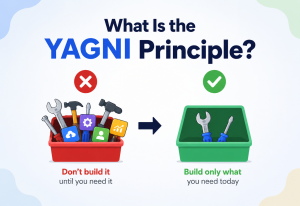
A closely related piece of advice, often shortened to YAGNI — “you aren’t gonna need it” — specifically targets the habit of building speculative flexibility for imagined future requirements. Where KISS asks broadly “is this simpler than it needs to be,” YAGNI asks the more pointed question “do we actually have evidence this feature is needed right now.”
KISS and Occam’s Razor
Long before software existed, this much older philosophical principle argued that, among competing explanations for the same observation, the one requiring the fewest assumptions is usually the best starting point. KISS applies the same spirit to design decisions rather than explanations: among competing designs that solve the same problem, prefer the one with the fewest assumptions and moving parts.
DRY asks “is this knowledge duplicated?” YAGNI asks “do we actually need this yet?” KISS asks the broadest question of all: “is there a simpler way to solve this same problem?”
None of these principles are meant to be applied in isolation, competing against each other for a single “correct” answer. They work best as a small set of lenses, each catching a slightly different kind of unnecessary weight, checked together during design conversations and code reviews. A decision that survives all three questions comfortably — not duplicated, actually needed now, and about as simple as the problem allows — is usually a genuinely sound one.
When Simple Becomes Simplistic
Just as DRY can be taken too far into over-abstraction, KISS can be taken too far in the opposite direction: cutting away something that was not actually optional, in the name of simplicity, and ending up with a design that is simple but genuinely broken or inadequate.
This usually happens when essential complexity, described earlier in this guide, gets mistaken for accidental complexity. A payment system that skips proper error handling “to keep things simple” has not actually achieved simplicity — it has achieved fragility, dressed up in simplicity’s clothing. Real simplicity handles the hard, necessary parts of a problem cleanly. Simplistic design pretends those hard parts do not exist, and pays for that pretense later, usually at the worst possible moment.
A design praised as “nice and simple” that quietly cannot handle a case everyone privately knows will eventually happen — a network failure, a duplicate submission, a user typing something unexpected. That gap is not simplicity. It is a missing requirement, wearing simplicity as a disguise.
The reliable way to tell the two apart is to return to the essential-versus-accidental distinction from earlier: before removing anything in the name of KISS, ask honestly whether it was handling a real, necessary part of the problem, or whether it was extra machinery that never needed to exist in the first place. Cutting the second kind is KISS working exactly as intended. Cutting the first kind is a different, more dangerous mistake wearing the same name.
A helpful practical safeguard against this trap is to involve more than one perspective before removing anything that touches a genuinely risky or important part of a system — payments, authentication, data integrity, safety-critical logic. A second, independent set of eyes is often better positioned to notice when “simplifying” has quietly crossed the line into “removing something necessary,” precisely because the person doing the simplifying is often too close to their own reasoning to see the gap clearly.
A Step-by-Step Simplifying Recipe
When an existing design has grown more complicated than it needs to be, here is a calm, deliberate way to bring it back toward genuine simplicity, without accidentally cutting away something the system actually depends on.
It is worth setting the right expectation before starting: this kind of work rarely produces a dramatic before-and-after story worth celebrating in a single meeting. It is quiet, steady maintenance, closer to tidying a well-used workshop than to a grand renovation. Yet it is exactly this kind of unglamorous, ongoing attention that determines whether a system stays pleasant to work in for years, or slowly turns into the cluttered junk drawer described earlier in this guide.
List every moving part
Write down every component, configuration option, and code path currently involved in the feature or system under review.
Ask what each part is really for
For every item on the list, write one honest sentence explaining the real, current need it serves. If that sentence is hard to write, take note.
Sort essential from accidental
Separate the list into complexity the real problem genuinely requires, and complexity that was simply a choice made along the way.
Remove or simplify the accidental items
For each accidental item, either remove it entirely or replace it with the smallest version that still does the job.
Verify nothing essential was lost
Run the full test suite, and specifically check the hard, necessary cases identified earlier, to make sure genuine requirements were not accidentally simplified away.
Repeat periodically, not just once
Complexity tends to creep back in gradually over time, so revisiting this exercise occasionally keeps a system honestly simple rather than simple only on the day it was last cleaned up.
Step two, writing an honest sentence for each part’s real purpose, is often the most revealing step in the whole recipe. A part whose purpose is genuinely hard to state clearly is very often the part that turns out not to be needed at all.
Side-by-Side Comparison
After walking through so many angles of this idea, it helps to see the practical differences summarized together in one place.
| Aspect | Over-Engineered | Kept Simple |
|---|---|---|
| Moving parts | More than the problem requires | Exactly what the problem requires |
| Onboarding a new engineer | Slow, requires learning unused flexibility | Fast, the design matches the actual need |
| Debugging a failure | More places to search | Fewer, clearer places to look |
| Adapting to real new requirements | May already have unused, mismatched flexibility | Extended deliberately, when a real need appears |
| Risk of hidden bugs | Higher — more surface area | Lower — less surface area |
| Best suited for | Problems with proven, current need for flexibility | Most everyday problems, especially early on |
As with the essential-versus-accidental distinction discussed earlier, this table is not meant to declare one column universally superior. Genuine, proven need for flexibility does exist, and building for it deliberately is good engineering, not a violation of KISS. The table is simply a reminder of what tends to be true on average, useful as a starting point whenever a design decision feels unclear.
Common Pitfalls
Beyond the core risk of drifting into simplistic, under-built designs, a handful of everyday habits tend to quietly pull teams away from genuine simplicity.
Building for an Imagined Future
The single most common way complexity sneaks into a design is the quiet assumption that a future requirement will definitely arrive, so it is best to prepare for it now. Most of the time, that imagined future either never arrives or arrives looking different enough that the early preparation does not actually fit.
Mistaking Familiar Tools for Simple Ones
Reaching for a large, feature-rich framework purely because it is familiar can quietly import far more complexity into a small project than the project’s actual needs justify. Familiarity and simplicity are not the same thing, as discussed earlier in this guide.
Cutting Essential Complexity by Mistake
As covered in detail above, removing something that was genuinely handling a hard, necessary part of the problem is not simplification — it is a hidden gap waiting to cause trouble later.
Treating KISS as a One-Time Cleanup
Complexity tends to accumulate gradually, the same way clutter accumulates in a room that gets tidied only once a year. A system kept simple through one determined cleanup effort will likely need the same attention again down the line, unless simplicity becomes an ongoing habit rather than a single event.
A design decision defended with “it might be useful someday” rather than “we need this right now.” That phrase is one of the most reliable early warning signs of complexity being added ahead of any real, proven need.
Every one of these pitfalls shares a common root: complexity is almost always easier to add than to remove. Adding a feature, a setting, or a layer of flexibility is a single, local decision. Removing one later often requires checking that nothing else in the system has quietly come to depend on it, which is inherently harder and riskier work. This asymmetry is exactly why KISS asks for restraint at the moment something is being added, rather than relying on a future cleanup effort to fix it — prevention, in this particular case, really is easier than the cure.
A Few More Real-World Analogies
A good knife over a gadget drawer
One sharp, versatile knife handles most kitchen tasks better than a drawer full of single-purpose gadgets that each only do one narrow job.
Furniture assembly diagrams
The best furniture instructions use simple pictures with almost no words, because a clear picture explains a step faster than a paragraph ever could.
A capsule wardrobe
A small set of clothes that all mix and match well serves a trip better than a suitcase packed with many single-use outfits.
A clear, short explanation
The person who can explain a complicated idea in one clear sentence usually understands it far better than the person who needs ten confusing ones.
Think about the difference between a well-organized toolbox and a junk drawer. The toolbox has a clear place for each tool, holds exactly the tools actually used, and lets you find what you need in seconds. The junk drawer has accumulated one item at a time, each addition individually reasonable, until finding anything at all means digging through a pile of half-forgotten objects. No single item made the drawer bad. The accumulated weight of unnecessary things did. Software, left unattended, drifts toward the junk drawer far more naturally than it drifts toward the toolbox — which is exactly why KISS has to be a deliberate, ongoing choice rather than something that happens automatically.
What ties all of these analogies together is a simple, recurring truth: the value of simplicity is rarely visible in the moment something is built. It becomes visible later, every single time someone has to use, fix, or understand that thing again. A remote control, a toolbox, a school bag, and a piece of software are all judged, in the end, not by how impressive they looked while being assembled, but by how easily they serve the person who has to rely on them afterward.
Frequently Asked Questions
Does KISS mean I should never use advanced tools or patterns?
No. Advanced tools and patterns are perfectly appropriate when a problem genuinely calls for them. KISS asks you to justify that need honestly, rather than reaching for complexity out of habit or speculation.
How can I tell if something is essential complexity or accidental complexity?
Ask whether the complexity comes directly from a real, current requirement of the problem itself, or from a specific implementation choice that could reasonably have been made differently. If it could be removed without losing any real capability the system actually needs today, it is likely accidental.
Isn’t KISS just common sense? Why does it need a name?
Giving it a memorable name helps it survive the everyday pressures — deadlines, curiosity about a new tool, the appeal of an elegant-looking abstraction — that quietly pull most teams toward unnecessary complexity without anyone fully noticing it happening.
How does KISS relate to YAGNI?
They are close cousins. YAGNI specifically targets building speculative features ahead of proven need, while KISS is the broader principle of favoring the simplest workable design overall, of which avoiding speculative features is one common application.
Can a team apply KISS too aggressively?
Yes — this guide calls that outcome “simplistic” rather than simple, and it happens when genuinely necessary complexity gets mistaken for unnecessary complexity and cut away by mistake.
Where did the KISS principle actually come from?
It is widely credited to Kelly Johnson, an aeronautical engineer at Lockheed’s Skunk Works, who popularized the phrase around 1960 while emphasizing that aircraft needed to be simple enough for field mechanics to repair under real combat conditions. The U.S. Navy later formally adopted the same underlying idea.
Does KISS apply outside of software and engineering?
Yes. The principle is widely used in visual design, project management, business communication, and even everyday writing, wherever the goal is to help someone else understand or use something with as little unnecessary effort as possible.
How do I convince a team that values clever solutions to embrace simplicity instead?
Framing the conversation around essential versus accidental complexity, discussed earlier in this guide, tends to work well, because it does not ask anyone to abandon rigor — it simply asks that every piece of complexity be tied to a real, current need rather than admired for its own cleverness.
Glossary
A short reference of the terms used throughout this guide, useful to revisit whenever a design conversation with your own team turns to simplicity and complexity.
| Term | Definition |
|---|---|
| KISS | “Keep It Simple, Stupid” — the principle of favoring the simplest workable design that still solves the problem at hand. |
| Essential Complexity | Complexity that comes directly from the real, inherent difficulty of a problem, and cannot be fully removed. |
| Accidental Complexity | Complexity introduced by specific implementation choices, which can usually be avoided or reduced. |
| YAGNI | “You Aren’t Gonna Need It” — a related principle warning against building speculative features ahead of proven need. |
| Occam’s Razor | A much older principle stating that, among competing explanations, the one with the fewest assumptions is usually preferable. |
| Simple vs. Easy | A key distinction — simple means few interconnected parts; easy means familiar or low-effort in the moment. The two are not the same. |
| Over-Engineering | Building more flexibility, structure, or machinery into a solution than the actual problem currently requires. |
| Simplistic | A design that appears simple but has mistakenly cut away genuinely necessary complexity, leaving real gaps. |
Key Takeaways
This guide has traveled from a battlefield repair problem in the 1960s all the way to modern software architecture, user experience design, and project planning. The list below distills everything into the ideas most worth carrying forward.
Remember This
- KISS stands for “Keep It Simple, Stupid,” and it means choosing the simplest workable design for the problem actually in front of you.
- The phrase traces back to Kelly Johnson at Lockheed’s Skunk Works around 1960, later formally adopted by the U.S. Navy, long before it became a software design principle.
- Simple and easy are not the same thing — simple means few interconnected parts, while easy means familiar or low-effort right now.
- Essential complexity comes from the real problem and cannot be removed; accidental complexity comes from implementation choices and usually can be.
- KISS reaches beyond code into visual design, user experience, and how teams plan and run their work.
- Taken too far, simplification can turn “simplistic” — cutting away complexity that was genuinely necessary, not just accidental.
- KISS works closely alongside DRY, YAGNI, and Occam’s Razor, each offering a slightly different angle on the same underlying instinct toward restraint.
- Staying simple is an ongoing habit, not a one-time cleanup — complexity tends to creep back in gradually unless it is deliberately kept in check.